Millions of Americans manage their money the way Dave Ramsey tells them to. Pay off the debt, skip the fads, put the rest in mutual funds. It turns out the boring advice may have a boring pro
Millions of Americans manage their money the way Dave Ramsey tells them to. Pay off the debt, skip the fads, put the rest in mutual funds.
It turns out the boring advice may have a boring problem, the returns.
Related: Michael Saylor calls it a Bitcoin 'gold rush,' sees $120 trillion upside
What Ramsey tells people to do with their money
Ramsey's investing instructions are specific. He tells listeners to put their money in mutual funds (pools of money run by a professional manager who picks stocks for you, and charges a yearly fee for the service.)
Not just any mutual funds. He says to spread the money across four types: growth, growth and income, aggressive growth, and international. He says to pick funds with a strong track record. And he tells listeners a good fund can earn about 12% a year.
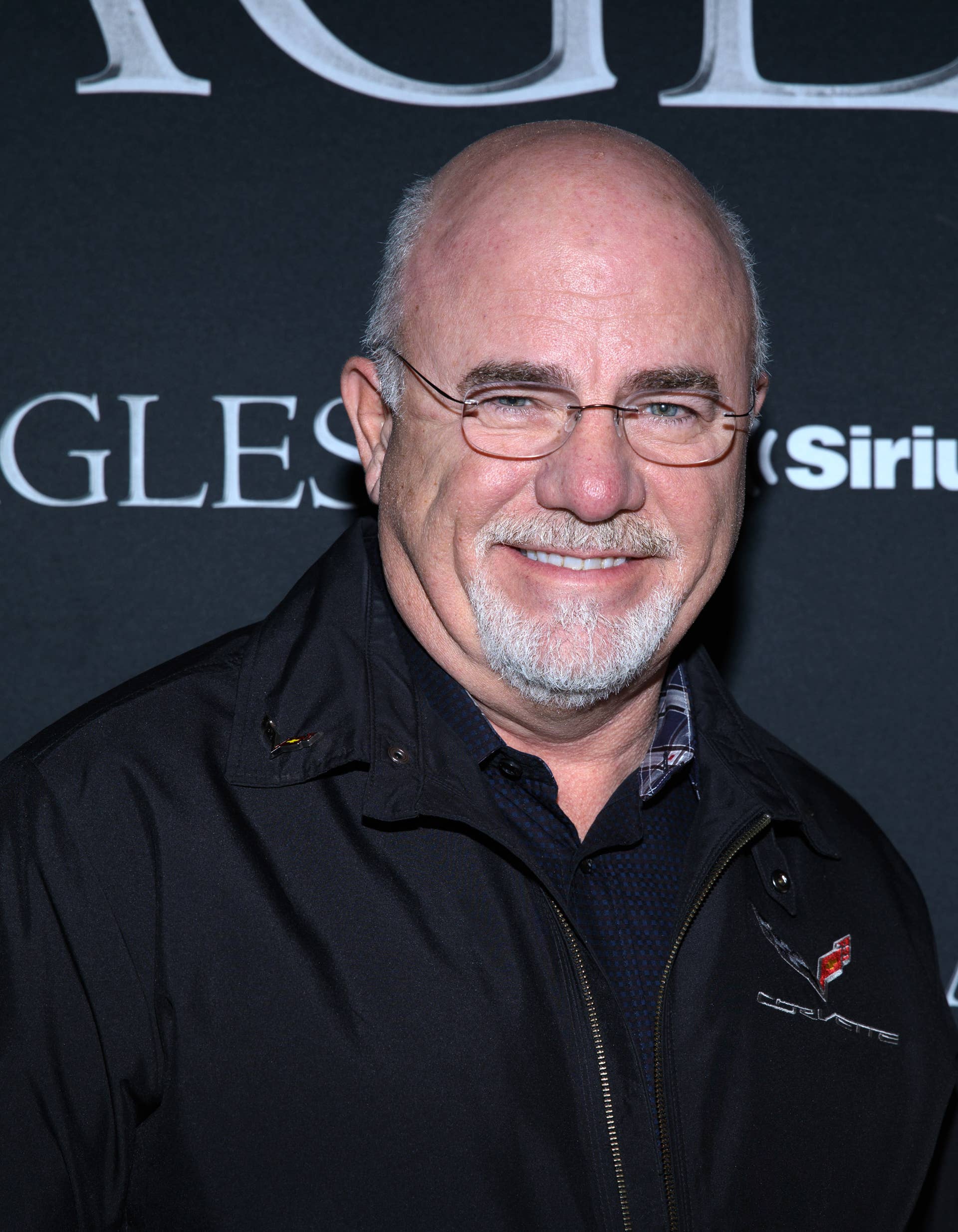
Dave Ramsey
Getty Images
He is openly against the alternative: index funds. An index fund doesn't employ a manager to pick stocks. It simply buys every stock in a list, the S&P 500, the 500 biggest U.S. companies, and charges almost nothing, because there's nobody to pay. "It's just not that hard to beat the S&P 500," Ramsey has said.
On his show in 2024, he laid out his whole portfolio in one breath.
"I have three investments, that's all I have. My business, paid-for real estate and mutual funds. I don't play single stocks. I don't screw around with gold. I don't mess with Bitcoin," he said.
So the question is testable.
Does Ramsey's way — paying a professional to pick stocks — actually beat the cheap autopilot fund?
What Ramsey says vs. what the data shows
Ramsey's investing claims have been checked against the historical record repeatedly, here's what we found
- The claim: 12% is a reasonable long-term planning number, based on the market's history.
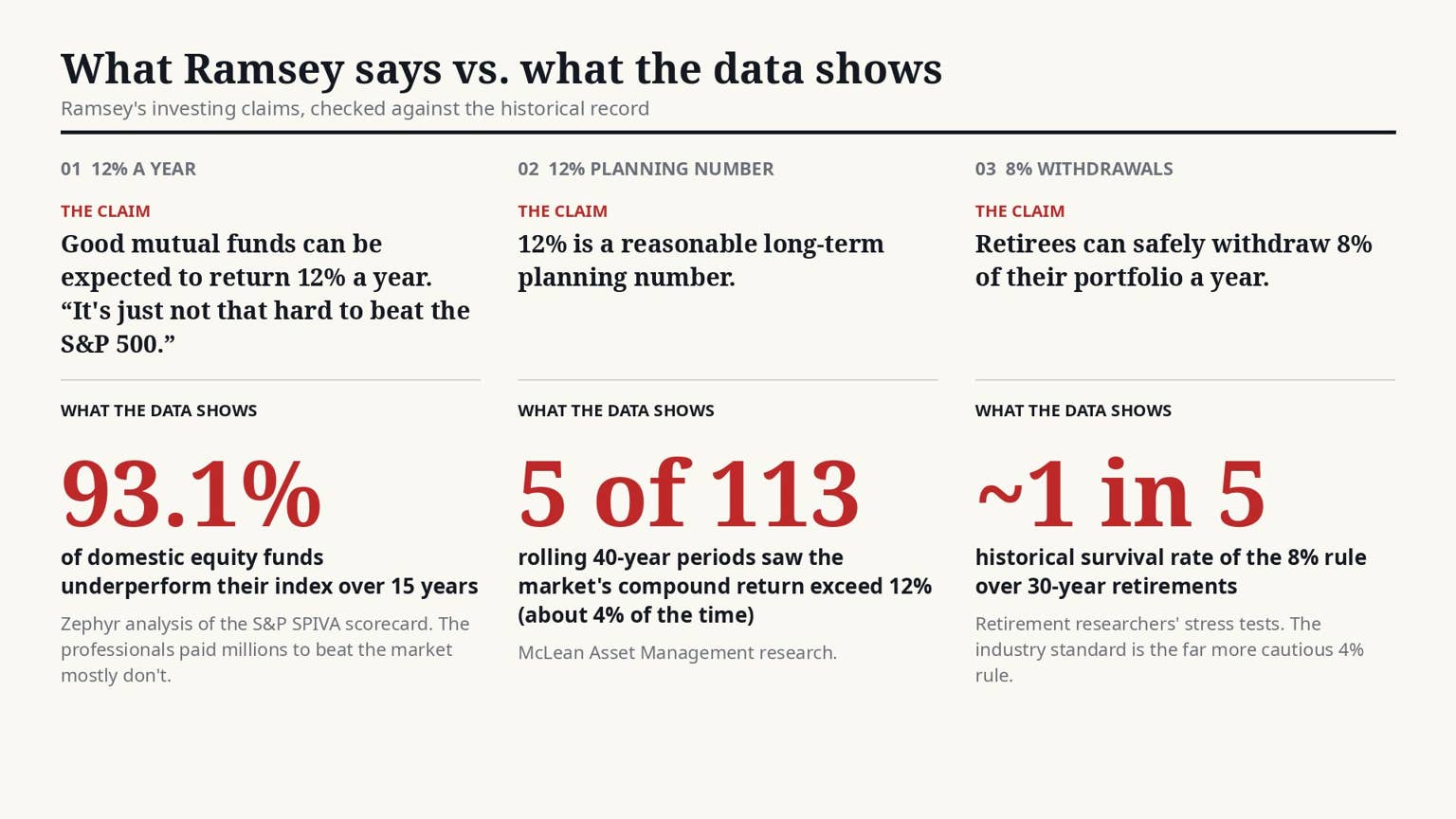
- What the data shows: Research firm McLean Asset Management found the market's compound return exceeded 12% in only 5 of 113 rolling 40-year periods — about 4% of the time.
- The claim: Past winners keep winning, pick funds with a strong track record.
- What the data shows: Fund performance barely persists. Per S&P's persistence data cited in that same analysis, of the large-cap funds in the top quartile from 2014 to 2018, not one was still in the top quartile by the end of 2022. Over 2020-2022, just 2.47% of large-cap funds beat the S&P 500.
Ramsey's investing claims vs. the historical record: 93.1% of domestic equity funds underperform their index over 15 years, the market beat a 12% compound return in only 5 of 113 rolling 40-year periods, and an 8% withdrawal rate survived roughly 1 in 5 30-year retirements. (
Source: TheStreet Roundtable)
- The claim: Retirees can safely withdraw 8% of their portfolio a year, as Ramsey argued in a November 2023 episode of his show.
- What the data shows: Retirement researchers who stress-tested the 8% rule against market history found it failed in a large share of 30-year retirements — one analysis put the historical survival rate near 1 in 5. The industry standard, for comparison, is the far more cautious 4% rule.
The other thing he told you to skip
Ramsey first called Bitcoin a "high-risk gamble" in 2017, when it traded around $10,000. His reasoning hasn't moved since:
"Crypto is a currency, a digital one, and I don't invest in currencies," he said, putting it in the same bucket as gold and oil."
He has compared the crypto craze to Beanie Babies, the stuffed-toy collecting mania of the 1990s whose values crashed and whose name became shorthand for hype that goes nowhere.
When a caller with $28,000 in debt and $20,000 in crypto asked what to do, Ramsey's answer was vintage Ramsey: sell the coins, pay off the debt.
For context, Bitcoin hit an all-time high of $126,198 in October 2025, per CoinMarketCap data — then days later, more than $19 billion in leveraged trades were wiped out in the largest liquidation event in crypto history. The slide carried into 2026, with Bitcoin falling toward $60,000 in February before recovering to around $85,000, still roughly 32% below its record.
Ramsey's fans will read that crash as vindication. His critics will note that even at $85,000, Bitcoin sits more than eight times above the price where he first warned everyone off.
Most Popular on TheStreet Roundtable:
Still, he has admitted crypto may one day build a long enough track record to be considered legitimate.
Editor's Inputs: To be fair to Ramsey, his advice was never really about maximizing returns. It's about keeping people who've been burned by debt from burning themselves again, and on that score, millions credit him with saving their finances. He has even left himself a door on crypto, admitting it may one day build a long enough track record to be considered legitimate.
Related: Ripple releases 1 billion XRP from escrow as October kicks off