By Crypto Markets Analyst. Reviewed by the Crypto Markets Editor. Data captured August 1, 2026, from a live DEX price tracker. Direct answer: DSNT dropped roughly 11.66% in a single sharp mov
By Crypto Markets Analyst. Reviewed by the Crypto Markets Editor. Data captured August 1, 2026, from a live DEX price tracker.
Direct answer: DSNT dropped roughly 11.66% in a single sharp move overnight, not across a gradual multi-hour decline, a pattern that historically points to one or two large sell orders hitting thin liquidity rather than sustained broad selling.
That distinction matters more to this DeepSnitch AI price prediction than the headline percentage itself, since it changes which recovery scenario is actually more likely.
What the DeepSnitch AI Chart Actually Shows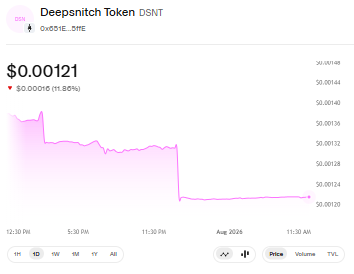
Source: DSNT Info by Uniswap
DSNT trades at $0.00121, down $0.00016, or 11.66%, over the past 24 hours.
The 1-day chart shows a distinct shape: price held a relatively stable range, then dropped in one sharp vertical move before flattening into a tight band just above $0.00120 through the following morning.
That is meaningfully different from a token bleeding out gradually across many small candles, and the difference is the whole basis for calling this a flash crash rather than a trend reversal.
DSNT Data Snapshot: Verified vs. Assumption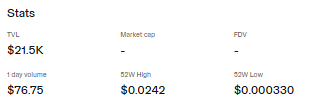
Source:DSNT Chart by Uniswap
DSNT Verification Status CategoryDetailsVerified (Tracker)
Current Price: $0.00121
TVL: $21.5K
24H Volume: $76.75
52-Week High: $0.0242
52-Week Low: $0.000330Verified (Chart Pattern)The chart shows a single sharp overnight decline followed by flat price consolidation, rather than a gradual multi-hour selloff.UnconfirmedWhether the flash crash originated from one large wallet or multiple coordinated sellers remains unknown because wallet-level on-chain data was unavailable at the time of analysis.UnconfirmedNo centralized exchange listing for
DSNT has been officially announced as of this writing.
DeepSnitch AI Price Prediction: Flash Crash Recovery vs. Listing Trap
This section models two distinct questions separately, since conflating them produces a weaker forecast: whether the flash crash itself gets absorbed and whether the word "listing" in the title is doing real work or just borrowing urgency from a listing that hasn't been confirmed.
DeepSnitch AI (DSNT) 7-Day Price Outlook ScenarioKey TriggerExpected Price RangeBear CaseSelling pressure continues while Total Value Locked (TVL) weakens alongside price. $0.0008 – $0.0011 Base CaseThe flash crash gets absorbed and DSNT continues trading within its current consolidation range. $0.0011 – $0.0015 Bull CaseTVL expands independently of price while trading volume returns and buyer activity strengthens. $0.0016 – $0.0022
Methodology: these ranges are anchored to DSNT's own $0.00121 post-crash price and its $0.000330 all-time low as the outer floor, scaled against how comparable thin-liquidity micro-cap tokens have behaved after a single-candle drop of similar size, rather than a gradual decline.
Invalidation:the bull case fails if TVL falls below $18K within the week, signaling capital actually leaving rather than just price cooling.
The bear case is invalidated by a sustained close-back above $0.0014 with volume exceeding $150/day.
Is "Listing Trap" the Right Framing Here?
No DSNT listing has been announced on any centralized exchange as of this writing, which makes the "listing-trap" framing worth questioning rather than repeating uncritically.
A listing trap specifically describes a pattern where a token pumps into a real or rumored listing, then dumps hard once early buyers exit into the announcement.
That pattern requires an actual listing event, confirmed or strongly rumored, to trap buyers around.
Without one on record here, this looks more like an ordinary thin-liquidity flash crash than a listing-specific trap, an important distinction for readers trying to understand what actually happened versus what a dramatic headline implies.
Bear-Case Risks Worth Naming Directly
Beyond the price scenarios above, three structural risks apply regardless of which case plays out.
Liquidity risk: $DSNT's $76.75 daily volume means even the base-case recovery band could break on a single moderate trade.
Contract and audit risk:this article does not have confirmation of an independent, current smart-contract audit for DSNT, a gap worth flagging rather than assuming resolved.
Comparable-pattern risk:Snorter Token (SNORT) earlier this cycle documented a token trading at effectively zero recorded volume for extended stretches, a fate that thin-liquidity tokens like $DSNT can share if buyer interest does not return following a crash like this one.
What Would Actually Confirm a Recovery Here
The single most useful thing to track is not tomorrow's price; it's whether DSNT's $21.5K TVL holds or grows over the next several days independent of price.
TVL growing while the price stays flat or even dips slightly would suggest real capital sitting in the platform rather than fleeing it; a stronger recovery signal than a bounce on thin volume would be.
TVL declining alongside price would support the bear case regardless of how the chart looks day to day.
Glossary
Flash Crash: A sharp, single-candle price drop followed by consolidation, distinct from a gradual multi-day decline.
Listing Trap:A pattern where buyers enter around a real or rumored exchange listing and sell pressure spikes once it's announced or falls through.
TVL (Total Value Locked): The dollar value of assets held in a project's liquidity pool or platform, tracked here as a usage signal independent of price.
Disclaimer
Informational purposes only, not financial advice. All DeepSnitch AI Price Prediction figures are analyst estimates based on thin-liquidity conditions and are not guaranteed outcomes. No DSNT exchange listing has been confirmed as of this writing. DSNT carries elevated liquidity and volatility risk. Cryptocurrency carries a significant risk of loss. Verify all data independently before acting.