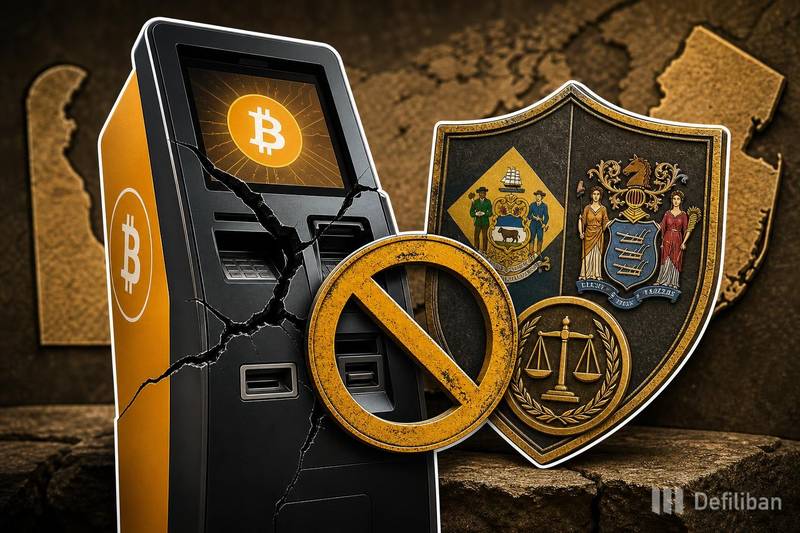
Delaware and New Jersey are advancing legislation to ban cryptocurrency ATMs, with both states targeting unregulated crypto kiosks in a push to strengthen consumer protection at the state lev
Delaware and New Jersey are advancing legislation to ban cryptocurrency ATMs, with both states targeting unregulated crypto kiosks in a push to strengthen consumer protection at the state level.
What the Delaware and New Jersey laws do
TLDR: KEY POINTS
- Delaware's House Economic Committee released a bill to eliminate unregulated cryptocurrency kiosks in the state.
- New Jersey introduced Senate Bill S2141, which targets cryptocurrency ATM operations.
- Both states are acting independently but in parallel, signaling growing state-level regulatory pressure on crypto access points.
Delaware's House Economic Committee released a bill on June 9, 2026, aimed at eliminating unregulated cryptocurrency kiosks operating within the state. The legislation, designated HB 441, moves through the state's legislative process as lawmakers seek to address concerns around how these machines operate without adequate oversight.
In New Jersey, Senate Bill S2141 was introduced to regulate or restrict cryptocurrency ATM activity. The bill text, filed under the 2026 legislative session, reflects a parallel effort by Garden State lawmakers to crack down on crypto kiosks.
Why states are moving against cryptocurrency ATMs
Both bills frame cryptocurrency ATMs as an area where consumers face risk due to a lack of regulatory guardrails. Crypto kiosks typically allow users to buy bitcoin and other digital assets with cash, often charging fees significantly higher than online exchanges.
Delaware's legislation specifically targets "unregulated" kiosks, suggesting the concern centers on machines operating outside existing money transmission or financial services frameworks. The framing implies that lawmakers view the current licensing and compliance landscape as insufficient to protect consumers using these devices.
The legislative push in both states comes as crypto adoption continues to grow through physical access points. Companies operating bitcoin ATMs have expanded rapidly across the United States in recent years, placing machines in convenience stores, gas stations, and shopping centers. Meanwhile, institutional players like Strategy continue to accumulate bitcoin at the corporate level, highlighting the contrast between institutional and retail access channels.
What the ban could mean for crypto ATM operators and users
If enacted, both laws would directly affect cryptocurrency ATM operators with machines in Delaware and New Jersey. Operators would need to either comply with new regulatory requirements or cease operations in those states entirely, depending on how the final legislation is structured.
For retail users in both states, the laws would reduce access to cash-based crypto on-ramps. While online exchanges and peer-to-peer platforms would remain available, crypto ATMs have served as a key entry point for users who prefer cash transactions or lack traditional banking relationships.
The moves by Delaware and New Jersey could also prompt other states to consider similar legislation. As major corporations continue to test and refine their own bitcoin strategies, the gap between institutional access and retail access through kiosks may widen further under tighter state regulation.
Both bills remain in their respective legislative processes, and their final form may differ from the versions currently filed. Operators and users in both states should monitor the progress of Delaware's HB 441 and New Jersey's S2141 for updates on timelines and enforcement provisions.
Disclaimer: This article is for informational purposes only and does not constitute financial or investment advice. Cryptocurrency and digital asset markets carry significant risk. Always do your own research before making decisions.
Read original article on defiliban.io