In this article I will show you a "low risk" (nothing is risk free) strategy that can make good returns on USD while at the same time supporting the system it uses. So a win-win. IMHO the str
In this article I will show you a "low risk" (nothing is risk free) strategy that can make good returns on USD while at the same time supporting the system it uses. So a win-win. IMHO the strategy counts as "system arbitrage" (see my previous article). I will try to make it as easy to understand as possible. If you are already into automated trading systems (aka bots), this article should give you all the information needed to build a bot to farm yourself. I have been running such a bot for over a year. It yielded about 25-30% APR during the bear market and I expect it to do roughly double that during the bull market.
Disclaimer: nothing is guaranteed. None of this is financial advice. This is for educational purposes only. Do your own research and make your own decisions.
Futures markets
On Spot markets, traders exchange the actual asset (let's say BTC) for the quote currency (let's say USDT). Every trade is an exchange between two traders where the "buyer" gives the "seller" USDT and receives BTC in return. There exist no "positions" in spot markets other than you holding a certain amount of coins (but you can always move your coins from the exchange to another, self-custody, etc.).
Futures are a derivative (so a market derived from the spot market). One can consider it as a bet on the price of the underlying asset (again, let's use BTC) at some future date (the delivery date). Traditional futures markets come from commodities, where traders use them to have a fixed price for the delivery of a commodity in the future. A futures contract is a contract between two traders, but this time they do not exchange assets right away; instead, they agree to exchange the assets on a fixed date in the future (delivery date) for a fixed price (the execution price of the trade). The one who agrees to buy the asset is called the "long" side, and the one who agrees to sell the asset is the "short" side. Every contract needs a buyer and a seller, so the total volume of longs and shorts is always exactly equal. The total amount of contracts is called the "open interest," which is an indicator of how much interest there is from traders.
So being long means you bet on the asset price rising (because you benefit if you lock in to buy at the current price and prices rise until you actually execute the trade), and being short means betting on the asset price falling.
How Futures anchor the price
Due to the delivery date being fixed in the future (there are futures for BTC every month, so the December Future, January Future, etc.), there is an obvious connection between the futures price and the real asset price. The closer the delivery date comes, the closer the futures price will get to the asset price. Because if, for example, a Future is 10% above the asset price 1 day before delivery, there is a pretty high probability that selling the Future is profitable here: because when you sell here at a 10% premium, and the asset doesn't move up 10% within the next day, you have a profit. So in this scenario a lot of traders will go short, which pushes the price down. And of course, the same logic applies in case of a discount in the Future price.
Side note: since long and short volume are always equal, "a lot of traders go short" sounds misleading. Because for every opened short, someone else needs to open a long. What is meant here is that the opening of shorts will be the taker side (the active ones), so the side of the trade that moves the price. And sells move it down (to fill the highest bid in the order book).
Perpetual Futures and Funding Rates
Crypto invented a special kind of "future": the perpetual futures contract. It's like a "normal" future but without a delivery date, which is why it's called "perpetual". It's basically a bet on the spot price of the asset that runs forever. Without a delivery date, there is no anchor to the spot market, so the perpetual future (from now on "perp") needs some other feature to anchor the perp price to the spot price.
That's what Funding Rates (from now on FR) are for. Every x hours (traditionally 8 hours, but there are already perps that do it every 4h or even 1h), every trader holding a long position pays the FR while every trader holding a short position receives the FR. Because the volume of total open long positions and total open short positions is always equal (see above), and the FR is a percentage of the position size, the paid/received funds balance out too. So in short, you can say "longs pay shorts". FR can also be negative, which means that "shorts pay longs".
How Perps anchor the price
But how does this anchor the perp price to the spot price? FR is based on the difference between the perp price and the spot price. If the perp price is close enough to the spot price, the FR is at the "neutral" default, which is often roughly 10% APR (= 0.01% every 8 hours). If the perp price goes into a strong premium, the FR goes strongly positive (sometimes above 100% APR). So long traders pay a lot for holding their position while short traders get paid a lot for holding theirs. This encourages more short positions to be opened and discourages long positions. If we see more longs being actively closed and shorts being actively opened, the price usually goes down. The stronger the premium, the higher the FR, and the higher the incentive for sellers to get more active.
How to benefit from that
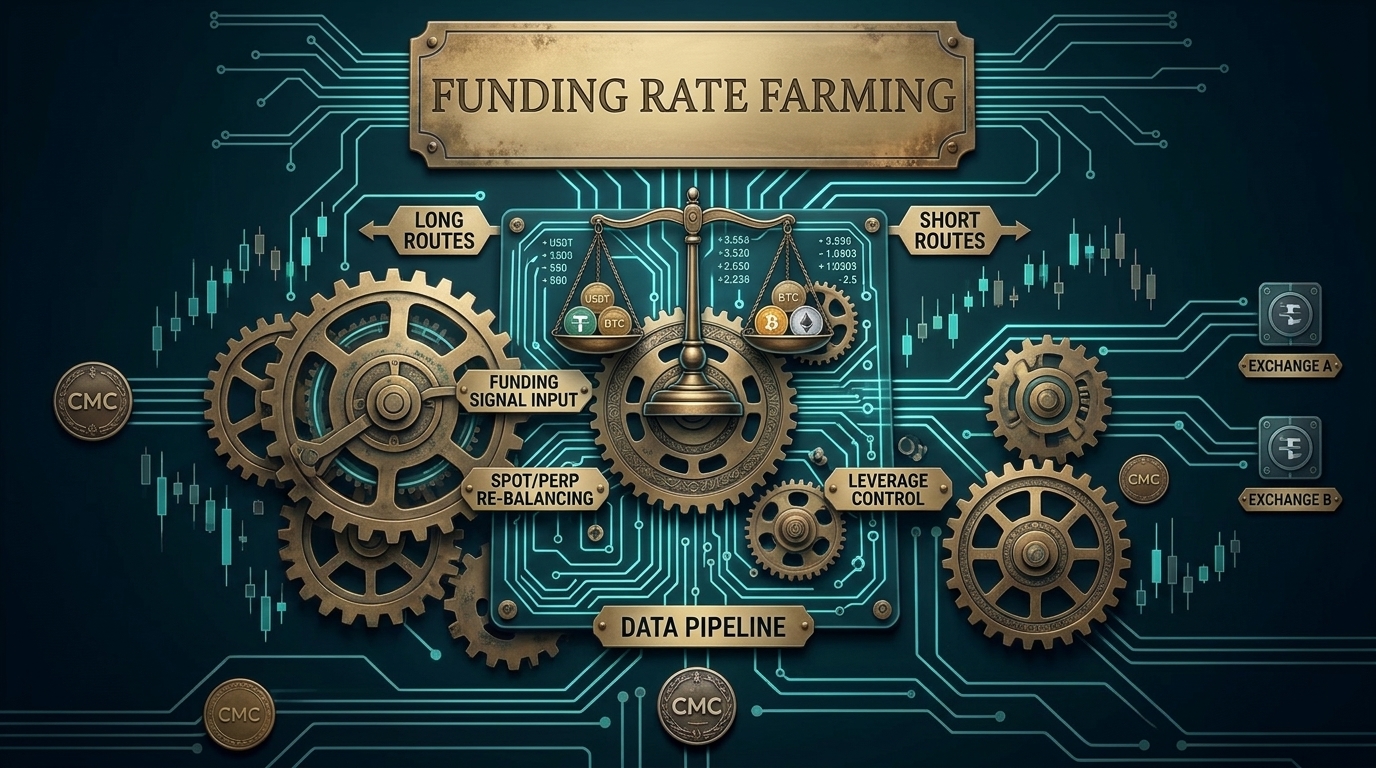
Now that we know how Funding Rates work, let's build a working bot out of it. Consider the case where the perp of an asset is in a strong premium. The FR rises. If you (aka your bot) have access to both the perp and a spot market for this asset, you can buy the asset on spot while "at the same time" opening a short on the perp with the same size. Best case is an execution where you open the short at a higher price than your spot buy. Since the perp is at a premium (otherwise the FR wouldn't be high), this has a high probability. So the best case is already a small profit on the entry of the position. Now you have a "delta neutral" position, which means that you do not care about the movement of the asset price at all. If it goes up, your spot position rises by the same value that your short loses. If it goes down, your short position profits the same amount that your spot position loses. You only care about PnL as far as needing enough collateral for the short if the asset price rises a lot.
Is this "arbitrage"?
Some do not consider this a real "arbitrage" as you open a position and have to close it to really benefit from the delta. But while you have the position open, you farm the FR. A positive FR means your short position gets paid every x hours. As long as the perp is in a premium, you cannot close the position at a profit, but a premium also means that the FR stays high and you get paid for waiting. If the FR goes down, it means the premium is gone and you can get out of the position with a low spread (or even a positive delta) again.
How it supports the system
As mentioned, FRs serve the purpose of keeping the perp price close to the spot price. High FRs mean that there is not enough supply in the market (aka it's missing shorts). By opening short positions, the strategy actively supports the stability of the perp price. And since we close the short when the FR goes down, the short supply normalizes again when it's no longer necessary.
Risks involved
Nothing is totally risk free, so let me talk about the risks involved in this strategy.
First, the strategy-specific risks:
Execution slippage can lead to losses during the opening and closing of the position
If the FR drops shortly after opening the position, we need to close it before a lot of FR accumulates
High fees might kill the profit margin
Besides strategy-specific topics, real-world bots face additional risks:
Delisting of assets on either of the exchanges (you have to work on spot and perp). If a spot asset gets delisted, you have to find a way to sell the spot again; otherwise, you are stuck with the asset and might need to write the whole position off as lost. If a perp gets delisted, your short is closed at market, which leaves your spot position unhedged -> can again lead to losses
Issues with connectivity of exchange APIs. Can lead to wrong states in your bot which might lead to bad actions (when your bot thinks the position is unhedged and tries to hedge it, while it was hedged already), or bad executions = slippage
Counterparty risk, as you have it with any funds on exchanges
Additionally, you have the positions open, so the funds are locked. If there are no high FR assets, your funds sit at the exchange idly. In my real-world experience, getting low 5-digit funds deployed even in a bear market is possible within a few days. So in the right exchange setup, this is not a real issue. But you need the right exchange with a big enough basket of assets.
Real world experience
For me, the main profit in this strategy comes from farming the FR. The entry and exit deltas can be an additional benefit, but I rarely managed to get more than the fees (so net 0 delta).
Currently, I have been running the bot for over a year already. And it made about 25% APR on average on USD during the bear market. Early numbers indicate that double that can be possible during the bull market.
One big benefit is that you do not need crazy infrastructure or big funds. The limiting factor regarding funds is the minimum position size. With $10 min size on perps, the strategy works with as little as $100. Infrastructure-wise, I currently have two bots running on a VPS that costs $6/month. So with 25% APR, I need at least $300 in the bot to at least cover the infra.
But as mentioned before, this is only possible on good exchange pairs. I ran it on a Bybit/KuCoin combination (Bybit perps, KuCoin spot), where the bot monitors 440+ assets. Currently, I am also running a version on BloFin (both perp and spot on the exchange), where it's only 170 pairs. I am not sure yet how the BloFin version will perform; early numbers indicate less performance than Bybit/KuCoin, but still solid profits.
That's the theory about the strategy. In reality, running a bot has a lot of additional "boring" details to be solved to be effective and profitable. If people are interested, I might cover that in a follow-up article.