On the first day of #BinanceBlockchainWeek in Bangkok, a presentation about the topic of TradFi assets. As emerging economies accumulate wealth, the next question is where that capital will b
On the first day of #BinanceBlockchainWeek in Bangkok, a presentation about the topic of TradFi assets.
As emerging economies accumulate wealth, the next question is where that capital will be invested.
A decade ago, the financial story of many emerging markets was largely about economic growth: rising incomes, expanding middle classes, increasing consumption, and the gradual development of domestic financial systems. Today, another chapter is beginning. As more households accumulate savings and financial markets mature, a new question is becoming increasingly important: how will this growing pool of wealth be invested?
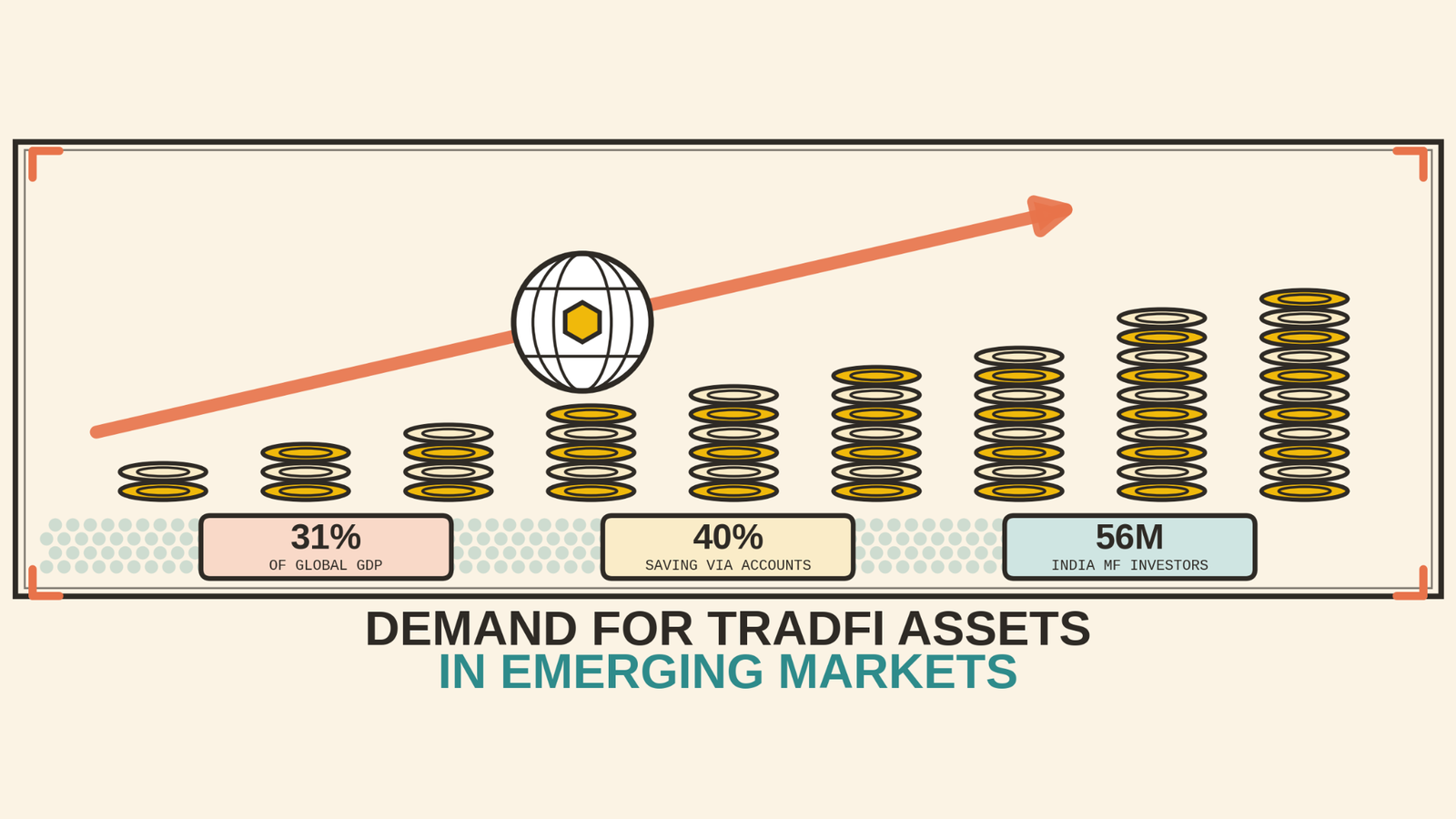
The shift is already visible in household financial behaviour. According to the World Bank's Global Findex 2025, 40% of adults in low- and middle-income economies saved through a financial account in 2024, up from 24% in 2021. This represents a 16-percentage-point increase in just three years, the fastest rise in more than a decade. In Sub-Saharan Africa, the proportion reached 35%, while mobile-money accounts are also becoming an increasingly important savings vehicle.
It signals the gradual formation of a larger pool of formal household savings across developing economies. As basic financial infrastructure improves, the natural next step is for a greater share of these savings to move beyond deposits and into investment products, creating new demand for equities, bonds, funds, commodities, and other financial assets.
But the relationship between growing wealth and investment opportunities is not always straightforward.
1. Growing Wealth, Uneven Investment Opportunities
An expanding economy does not automatically produce an equally developed investment market.
Across emerging economies, the growth of household wealth has often outpaced the development of local capital markets. Some markets offer a broad range of listed companies, liquid securities, and established investment funds. Others remain concentrated in a relatively small number of companies and sectors, with limited secondary-market liquidity and fewer investment products available to retail investors.
Asia illustrates this divergence particularly well. According to the OECD's Asia Capital Markets Report 2025, Asian public equity markets reached a combined market capitalisation of US$34.4 trillion in 2024, accounting for 27% of global equity market capitalisation and 55% of listed companies worldwide. Yet the distribution of market depth is highly uneven. Bangladesh, Pakistan, Sri Lanka, and Cambodia, for example, had domestic stock market capitalisation below 40% of GDP, alongside relatively low numbers of listed companies and limited liquidity.
The contrast is important. Asia has become a major centre of global economic activity, but the investment opportunities available within individual domestic markets do not always reflect the full breadth of that economic growth. Even within the same region, investors face very different levels of market depth, product diversity, and liquidity.
For households, this creates an investment allocation problem. Their savings may be growing, but the range of domestic assets available to deploy that capital remains constrained. A portfolio concentrated in local equities, bank deposits, or property may not provide sufficient exposure to the global industries and companies driving economic growth elsewhere.
This does not mean domestic markets are unattractive. Rather, as investors become more financially sophisticated, they increasingly have reasons to look beyond their home markets.
2. The Global Economy Is Connected. Investment Portfolios Are Not.
Consider the changing structure of the global economy.
A semiconductor manufacturer in Taiwan, a software company in the United States, an automobile producer in Germany, and a commodity exporter in Brazil may all be connected through the same global supply chains and economic cycles. Their businesses are increasingly international, but the investment opportunities available to households remain heavily influenced by domestic market structures.
This creates a disconnect between where economic value is generated and where individual investors can participate in it.
The OECD's research highlights another dimension of this imbalance: while Asian economies account for 31% of global GDP, their share of global public equity market capitalisation was 29% in 2025. More importantly, their presence across different capital-market segments varies considerably. Domestic debt markets, private credit, and institutional investment channels remain less developed in many economies relative to their economic weight.
For investors, this matters because geographical diversification is not simply about buying foreign stocks. It is about gaining exposure to different sources of earnings, industries, currencies, and economic cycles.
An investor whose domestic market is heavily weighted toward financial institutions, property, or traditional industries may want exposure to global technology companies. Someone whose income and business activities are already closely tied to domestic economic conditions may seek assets with different underlying drivers. Others may prefer broad-market ETFs that provide exposure to hundreds of companies rather than concentrating their savings in a handful of local stocks.
The result is a broader investment universe. US equities, global index ETFs, gold, and other internationally traded assets become relevant not merely because they are popular, but because they offer different forms of exposure that may be difficult to replicate within a single domestic market.
The demand for TradFi assets is therefore closely linked to a deeper change in how investors think about portfolios: moving from holding whatever is available locally toward choosing assets based on their role in a broader investment strategy.
3. Currency Risk Makes Global Asset Allocation More Relevant
There is another factor that makes this shift particularly relevant in emerging markets: currency risk.
For investors in advanced economies, currency fluctuations may be one component of portfolio performance. In many emerging economies, however, exchange-rate movements can have a much more direct impact on household purchasing power and financial stability.
The IMF has highlighted this structural difference. Its 2025 analysis found that a 10% depreciation of an emerging-market currency against the US dollar could raise domestic price levels by approximately 2%, several times the pass-through observed in advanced economies. Exchange-rate movements can therefore affect not only the value of foreign assets, but also the cost of imported goods, inflation expectations, and household purchasing power.
This creates an additional reason for investors to pay attention to assets denominated in different currencies.
For someone whose income, savings, and investments are all concentrated in one domestic currency, exposure to international assets may offer a degree of geographical and currency diversification. Dollar-denominated equities, global ETFs, and gold can become part of that consideration.
Of course, foreign assets are not automatic hedges against currency depreciation. A US equity investment still carries market risk, and the return measured in an investor's home currency depends on both the underlying asset performance and the exchange rate. Nor does every emerging market face the same degree of currency pressure.
But the broader point remains: in economies where exchange-rate volatility has a meaningful effect on financial outcomes, investors may have stronger incentives to consider assets beyond their domestic currency and market.
This makes TradFi demand in emerging markets about more than return-seeking. It can also reflect a desire to diversify the risks embedded in household balance sheets.
4. The Capital Is Already Moving. India Offers a Glimpse of What Comes Next
India provides an interesting example of how quickly investment behaviour can change once domestic participation expands.
According to the Indian government's Economic Survey 2024–25, the number of unique mutual fund investors nearly doubled from 29 million in FY2021 to 56 million by December 2024. The industry had accumulated approximately ₹66.9 trillion in assets under management, while systematic investment plan (SIP) accounts exceeded 100 million.
These developments demonstrate something important: investment participation can become a structural household financial habit rather than a temporary response to a rising market.
Monthly SIP contributions provide a particularly useful illustration. Rather than relying entirely on one-off investment decisions, millions of households are increasingly allocating money to financial assets on a recurring basis. This creates a more consistent mechanism through which savings can enter capital markets.
India is not representative of every emerging economy, and its relatively developed investment ecosystem should not be extrapolated to markets with much shallower financial infrastructure. But it demonstrates the potential scale of retail capital formation when income growth, digital distribution, investment products, and market participation develop together.
The next stage of this process may extend beyond domestic equities and mutual funds. As investors become accustomed to allocating savings into financial products, the natural question becomes whether they can also diversify across international markets, asset classes, and currencies.
In other words, the development of domestic investment culture can itself become a foundation for broader demand for global TradFi assets.
5. From Local Savings to Global Investment Demand
These developments point to a structural opportunity.
Emerging markets are not simply large populations waiting to become investors. They are economies undergoing changes in household wealth formation, financial behaviour, capital-market development, and digital financial infrastructure.
These changes do not happen at the same pace everywhere. Some countries are already developing deep domestic investment markets, while others still face considerable constraints around liquidity, regulation, and financial-product availability. Yet the direction of travel is increasingly clear: as more savings enter formal financial systems and investment participation expands, the demand for a wider range of financial assets is likely to grow.
For the global financial industry, this represents an opportunity to reach a new source of investment demand. The next wave of growth may not come exclusively from existing investors increasing their trading frequency or allocating more capital to familiar assets. It may also come from entirely new pools of household savings seeking exposure to markets and instruments that were previously outside their investment universe.
Emerging markets are not just the next frontier for financial consumption. They are becoming an increasingly important source of global investment capital. And as that capital grows, the demand for access to global financial assets will grow with it.