Read this article on bsc.news Comprehensive crypto legislation is unlikely to pass under a Democrat-led Congress, according to Cody Carbone, chief executive of the Digital Chamber (@DigitalCh
Read this article on bsc.news
Comprehensive crypto legislation is unlikely to pass under a Democrat-led Congress, according to Cody Carbone, chief executive of the Digital Chamber (@DigitalChamber). Carbone (@CodyCarboneDC) says the industry now faces a harder path in Washington, particularly if Sen. Elizabeth Warren (@SenWarren) takes a leading role on the Senate Banking Committee.
Industry Turns to Moderate Democrats
Carbone said the Digital Chamber's strategy is to build ties with newly elected Democrats who have told the group they are "crypto curious," according to TradingView News. He described many incoming Democrats as young and tech-forward, while acknowledging that pro-crypto Democrats have been "few and far between."
The group plans to look for allies among junior members and moderates on the Senate Banking Committee. Carbone said no single lawmaker could take on Warren, but a larger group could balance her influence.
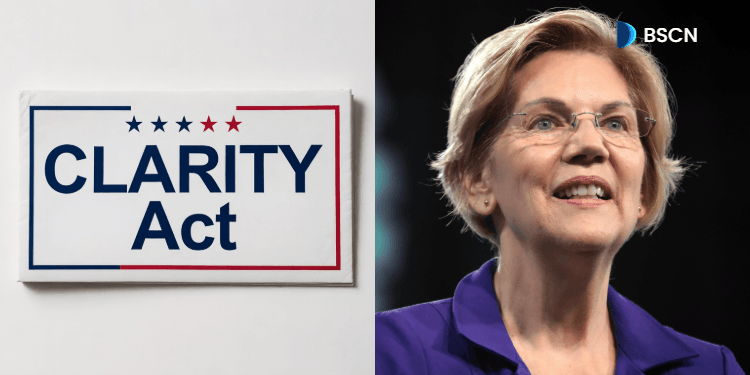
Carbone has also said Democrats in control of Congress would be "very hostile" to crypto, according to Asianet Newsable. Warren is widely seen as one of the CLARITY Act's leading opponents. She is expected to become Banking Committee chair when the new Congress convenes in January 2027, though Democrats have not formally assigned leadership posts.
Where the CLARITY Act Stands
The Digital Asset Market Clarity Act (CLARITY Act), formally H.R. 3633, was already stalled before the midterm shift. According to law firm Troutman Pepper Locke, the Senate rejected cloture on the motion to proceed by a vote of 49 to 50 on September 15, 2026, 11 votes short of the 60 needed to open floor debate. The firm said this effectively ended the bill's prospects for the remainder of the current Congress.
DLA Piper noted that the bill had advanced from the Senate Banking Committee in May 2026, with every Republican member and two Democratic members voting in favor. The two Democrats indicated their votes supported continuing the process but did not signal support for all provisions, the firm said. DLA Piper added that stakeholders may use the period before the 120th Congress to evaluate their 2027 government affairs strategies.
If the bill does not pass before the new Congress begins on January 3, it would need to be reintroduced and go through committee review again.
For the crypto industry, the Digital Chamber's approach reflects a shift from pursuing a single sweeping market structure law to winning over a broader group of lawmakers in a less friendly Congress.
Sources
See more news on bsc.news