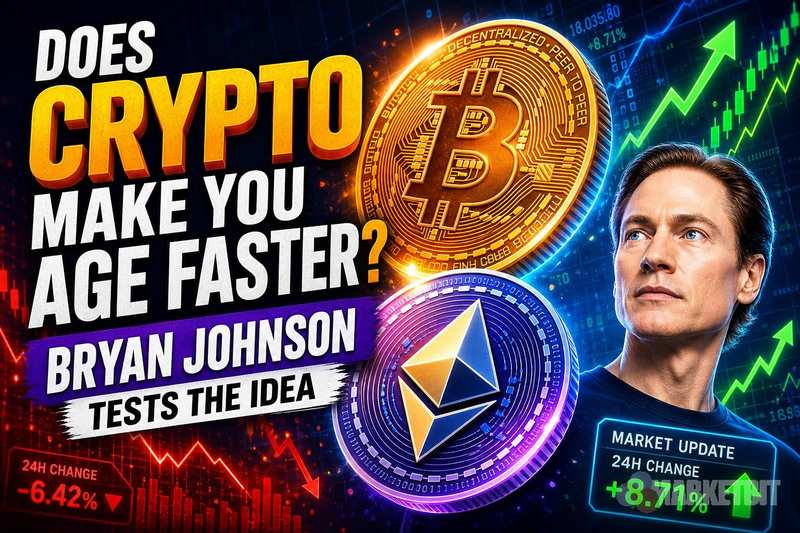
Bryan Johnson, the tech entrepreneur known for spending millions on reversing his biological age, is now turning his attention to whether the crypto lifestyle could accelerate aging. The prem
Bryan Johnson, the tech entrepreneur known for spending millions on reversing his biological age, is now turning his attention to whether the crypto lifestyle could accelerate aging. The premise is provocative but unproven, and the distinction between a question and a conclusion matters here.
Why Bryan Johnson is asking whether crypto can age people faster
What to Know
- Bryan Johnson is investigating whether crypto-related stress could accelerate biological aging.
- This is framed as an open inquiry, not a proven scientific conclusion.
- No published results or experimental data from this investigation are available yet.
The headline frames a question, not a finding. Johnson, whose public commentary frequently centers on longevity protocols and biological age measurement, is exploring whether participation in crypto markets could have measurable effects on how fast a person ages.
Johnson built his reputation on the "Blueprint" protocol, a rigorous anti-aging regimen that tracks dozens of biomarkers. His interest in crypto's effect on aging fits that pattern of treating lifestyle variables as measurable inputs to biological outcomes.
No peer-reviewed study has established a causal link between trading digital assets and accelerated aging. What exists is a plausible hypothesis rooted in stress physiology, and Johnson appears to be the first public figure attempting to formalize it.
How the crypto stress angle fits the longevity debate
The connection between crypto and aging is not about the assets themselves. It is about the behavioral environment surrounding them: volatility-driven anxiety, sleep disruption from 24/7 markets, and screen time that stretches well beyond traditional trading hours.
Chronic psychological stress is a well-documented factor in cellular aging research. Crypto markets, which never close and regularly produce double-digit percentage swings, create conditions that could sustain elevated cortisol levels in active participants. Events like large-scale stablecoin movements on Solana or sudden regulatory developments can trigger intense market reactions that keep traders glued to screens.
Johnson's framework would presumably attempt to isolate crypto-specific stressors from general financial market stress. That distinction is critical. Without it, any finding would simply confirm that financial anxiety affects health, which is already established.
The broader crypto community has seen its share of burnout narratives. From founders working around the clock during bull markets to retail traders watching portfolios collapse in downturns, the lifestyle factors are real even if their aging effects remain unmeasured. The emergence of new products like perpetual futures on additional tokens only increases the surface area for continuous market exposure.
What readers should watch before drawing conclusions
For this premise to move beyond a headline, several things would need to happen. Johnson or his team would need to publish a defined methodology: what biomarkers are being tracked, what constitutes a "crypto participant" versus a control group, and over what time period the measurements are taken.
Without that framework, the claim sits in the category of interesting but unverifiable. Novelty headlines in the crypto space frequently outpace the evidence behind them, and readers should calibrate expectations accordingly.
The intersection of digital asset markets and personal health is a genuinely underexplored area. As crypto infrastructure matures, with developments like stablecoin-based payment systems pushing digital assets further into daily financial life, questions about long-term lifestyle effects become more relevant.
If Johnson does produce data, the crypto community should evaluate it with the same skepticism applied to any early-stage research. The question is worth asking. The answer is not yet available.
Additional source references: source document 1, source document 2.
Disclaimer: This article is for informational purposes only and does not constitute financial or investment advice. Cryptocurrency and digital asset markets carry significant risk. Always do your own research before making decisions.
Read original article on marketbit.net