The Dogecoin price stood at $0.0583 at midday on Monday, November 16, roughly 0.053 euros. In dollar terms that is a loss of 1.6 percent in 24 hours and of just over 14 percent in seven days,
The Dogecoin price stood at $0.0583 at midday on Monday, November 16, roughly 0.053 euros. In dollar terms that is a loss of 1.6 percent in 24 hours and of just over 14 percent in seven days, according to market data from CoinGecko. The more telling figure is in the pair against Bitcoin: one DOGE costs 91 satoshis there, or 0.00000091 BTC. Kraken last recorded a weekly close this low in January 2021, a few days before the big rally of that spring.
What the data shows: Dogecoin is falling with the broader market and is also losing ground against the market leader. Our view on why that is, and what follows from it, is set out in a separate section further down.
Dogecoin price in satoshis: 91 against 1,137 in April 2021
A satoshi is the smallest unit of bitcoin, one hundred-millionth of a BTC. Reading the Dogecoin price in satoshis tells you nothing about whether crypto as a whole is rising or falling. It only shows how DOGE is faring relative to bitcoin. If the number rises, Dogecoin was stronger; if it falls, bitcoin was.
We analysed the weekly candles of the XDG/XBT pair on Kraken, which go back to July 2016. The result is clear:
- The highest weekly close came in the week starting April 29, 2021, at 1,137 satoshis. From there DOGE has fallen 92 percent against bitcoin.
- The annual lows of the weekly closes have dropped year after year since then: 263 satoshis in June 2022, 191 in December 2023, 163 in February 2024, 134 in December 2025.
- 2026 opened at 160 satoshis. The weekly close on November 11 was 91, a fall of 43 percent since the start of the year.
- On Friday, November 14, the pair slipped intraday to 87.8 satoshis. DOGE last traded lower against bitcoin at the end of January 2021.
A year ago one DOGE still cost around 164 satoshis. In dollar terms the gap is even wider: on November 16, 2025, Dogecoin closed at $0.158 on Kraken; today it is $0.058, a drop of 63 percent.
Dogecoin since November 14: from $0.063 to $0.058
On Friday we covered the Dogecoin price at $0.063, with US ETFs that had not booked any inflows for a month. Since then DOGE has lost another 7.5 percent. The slide came the same day: on Kraken the price fell on November 14 from $0.0645 to as low as $0.0554, and trading volume rose to 256 million DOGE. Three days earlier it had been 31 million.
Since Saturday Dogecoin has been moving between $0.0554 and $0.0601. The $0.060 mark, which served as a floor until Friday, has acted as a ceiling since: twice the price came close to it, and twice it turned back. Against bitcoin little has changed, with the pair at around 91 satoshis, as at the weekly close. So DOGE is currently falling in step with bitcoin without recovering any of the lost ground.
The move has also left its mark on the market capitalisation ranking. At $9.1 billion, Dogecoin sits in 13th place on CoinGecko, behind Zcash at $14.8 billion and Monero at $9.5 billion. Monero was ahead of Dogecoin on eight days this month, Zcash on most days since the end of August.
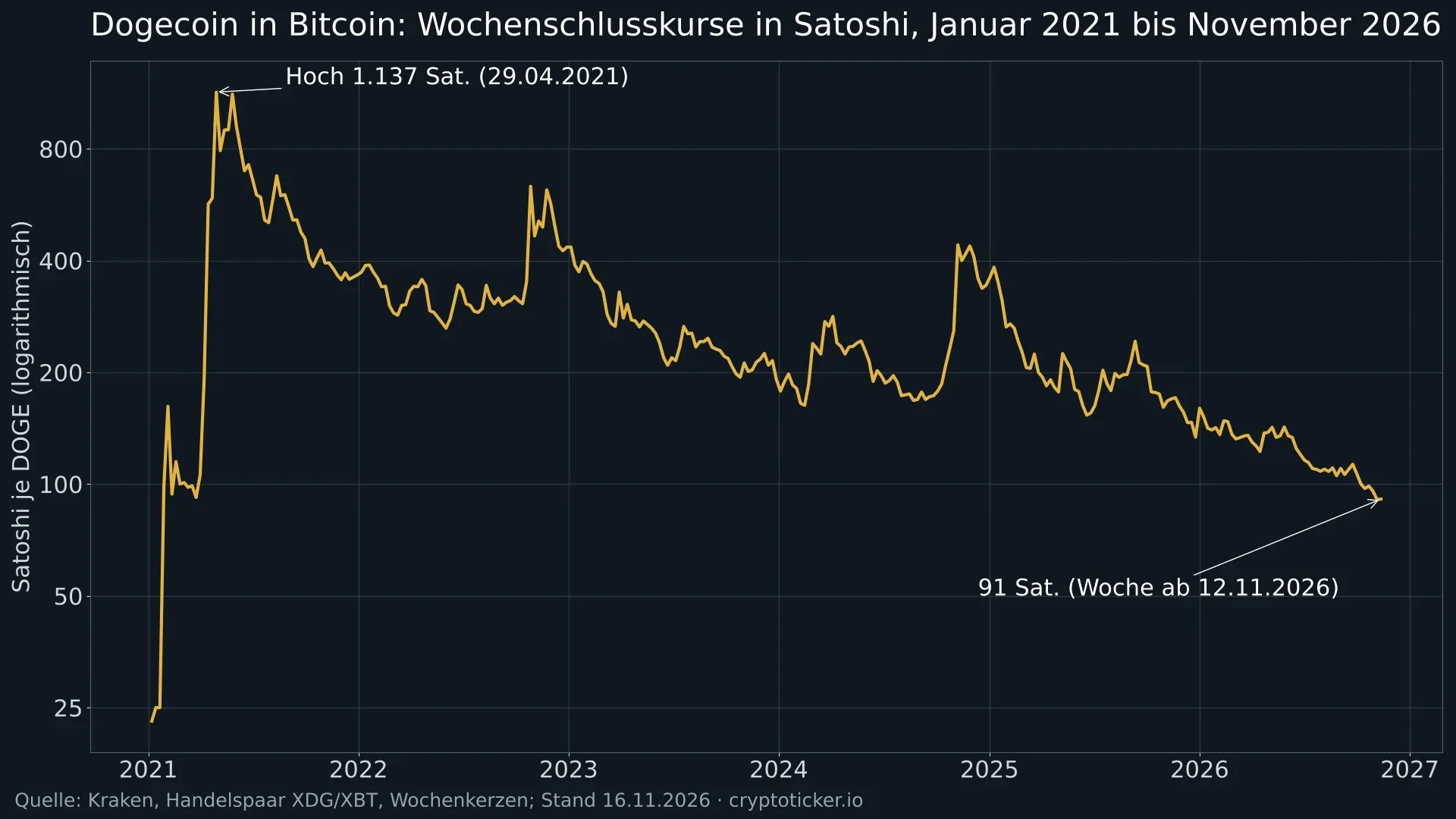
Dogecoin in bitcoin: since the April 2021 high, every annual low has come in below the previous one. Our own analysis of Kraken weekly candles.
Dogecoin inflation: why DOGE keeps losing ground against bitcoin
Part of the weakness is built into the protocol. Dogecoin has no supply cap: each block creates 10,000 new DOGE, and a block follows roughly every minute. That adds up to around 14.4 million new coins a day and about 5.3 billion a year. With around 157 billion DOGE in circulation, derived from market capitalisation and price on CoinGecko, the supply grows by about 3.4 percent a year.
Since the halving in April 2024, bitcoin has produced 3.125 BTC per block; at around 144 blocks a day, that is about 450 BTC. Over a year that comes to just over 164,000 BTC, less than 1 percent of the roughly 20 million coins in circulation. The difference works like a constant headwind: just for the Dogecoin price in satoshis to stand still, around 2.5 percentage points more buying money has to flow into DOGE each year than into bitcoin, relative to each market capitalisation.
In a rally this barely matters, because new buyers easily absorb the extra supply. In a falling market without fresh demand it becomes plain to see. That is exactly where Dogecoin stands now: the US ETFs are booking no inflows, and open interest in the futures market on OKX has shrunk by a quarter since the start of November, as we reported on November 15.
Dogecoin levels in dollars: $0.0554, $0.060 and the 50-day line
The levels below are derived from the lows of past years, those above from the price action since Friday. All values come from Kraken daily and weekly candles in the XDG/USD pair.
Level
Value in dollars
Basis
200-day line
0.0840
Average of daily closes over the last 200 days
50-day line
0.0792
Average of daily closes over the last 50 days
Close before the slide
0.0645
Daily close on November 13
Ceiling since Saturday
0.0600
Daily high on November 15 and 16
Low of November 14
0.0554
matches the June 2023 low at 0.0555
October 2022 low
0.0551
Weekly low in October 2022
June 2022 low
0.0491
lowest weekly value since 2021
The zone between $0.0551 and $0.0555 is therefore a double level: it held in October 2022, in June 2023 and last Friday. If Dogecoin falls below it on a daily closing basis, no other low from the past four years stands in the way down to $0.049. That would be around 16 percent below today's level.
On the upside, DOGE would first have to reclaim $0.060 and then the pre-slide close at $0.0645. The 50-day line at $0.079 sits 36 percent above today's price and is not a realistic target over a matter of days.
Dogecoin futures and leverage: what a negative funding rate signals
The funding rate is the fee that changes hands every few hours between the long and short sides of perpetual futures, contracts with no expiry date. When it is negative, shorts pay longs. In other words, more traders are using leverage to bet on falling prices than on rising ones. For Dogecoin, the rate on OKX was negative according to our analysis of November 15.
That can cut both ways. If the price rises, shorts have to close their positions and buy back Dogecoin, which lifts the price in the short term. If the price stays weak, the shorts cost little and the pressure persists. On November 13, longs in DOGE lost $7.7 million in liquidations within a single day. If you trade with leverage, you should know the liquidation level of your position in dollars: at five times leverage, a drop of just under 20 percent is enough to wipe out a long position, at ten times leverage around 10 percent.
Swapping DOGE for bitcoin can be a taxable disposal, depending on the country where you pay tax. A crypto tax tool imports your transactions and works out the holding period for each lot.
Buying Dogecoin in Germany: MiCA exchange, Xetra ETP or broker
If you want to buy Dogecoin or add to a position at this level, there are three routes in Germany. Buying directly through an exchange licensed under the EU's MiCA crypto regulation gets you actual coins that you can withdraw to your own wallet. Which providers hold the licence and what they charge is shown in our comparison of regulated crypto exchanges. Not every exchange offers its own order book for buying against bitcoin, the DOGE/BTC pair; the swap then often runs via euros or a stablecoin, with two fees instead of one.
The second route is an exchange-traded product on Dogecoin, an ETP, which can be traded on the Xetra exchange through an ordinary securities account. You then hold a debt security of the issuer and no coin of your own. We compared what that means for fees and tax on November 14. The third route is brokers with crypto trading, which often sell only a claim on the price and do not allow coins to be withdrawn.
Common to all three routes: since its 2021 peak, Dogecoin has lost more than 90 percent against bitcoin. A position in DOGE should be small enough that a further 16 percent fall to the June 2022 low does not force you to sell.
Editorial view: Dogecoin's weakness is rooted in supply
In the editorial team's view, the fall to 91 satoshis is more than a market whim. Three documented points support this. First, the annual low in the DOGE/BTC pair has come in below the previous year's every year since 2023, four years in a row. Second, Dogecoin's supply grows by just over 3 percent a year, bitcoin's by less than 1 percent. Third, the demand that offset this difference in earlier years is missing: the US ETFs have attracted no money for a month, and the futures market is shrinking.
The coin's history argues the other way. In 2021 and at the end of 2024, Dogecoin showed that it can gain many times its value against bitcoin in a short period when attention returns; between the end of September and early November 2024 the pair jumped from around 170 to over 400 satoshis. Such surges have so far come from outside the protocol. No trigger of that kind is in sight at the moment, and even the news that DogeOS was close to launch did not support the price last week.
Our conclusion: as long as no new wave of demand arrives, a Dogecoin price in satoshis that keeps sinking slowly is the more likely picture than a quick recovery. This is an assessment of the data and not a recommendation to buy or sell. Dogecoin remains a high-risk coin, up to and including total loss.
Dogecoin in satoshis: only above 100 does the losing streak end
DOGE last closed a week above 100 satoshis in mid-October. As long as the pair stays below that, the downtrend against bitcoin continues, even if the dollar price rises in between. Three steps help you sort out the situation for your own holdings:
- Check purchase dates: Note the date and price of every DOGE purchase. A portfolio tracker with tax report does this for all exchanges together.
- Watch the $0.0554 mark: If Dogecoin closes a day below it, the double bottom from June 2023 and November 2026 is broken. Most crypto exchanges offer a price alert free of charge.
- Choose your buying route deliberately: If you want to add to your position, compare fees and licences of the providers beforehand, for instance through our comparison of crypto brokers, and decide whether actual coins or an ETP better suit your own tax situation.
(As of November 16, 2026. This article is not investment advice. Prices and fee structures change; check the terms with the provider before you buy.)