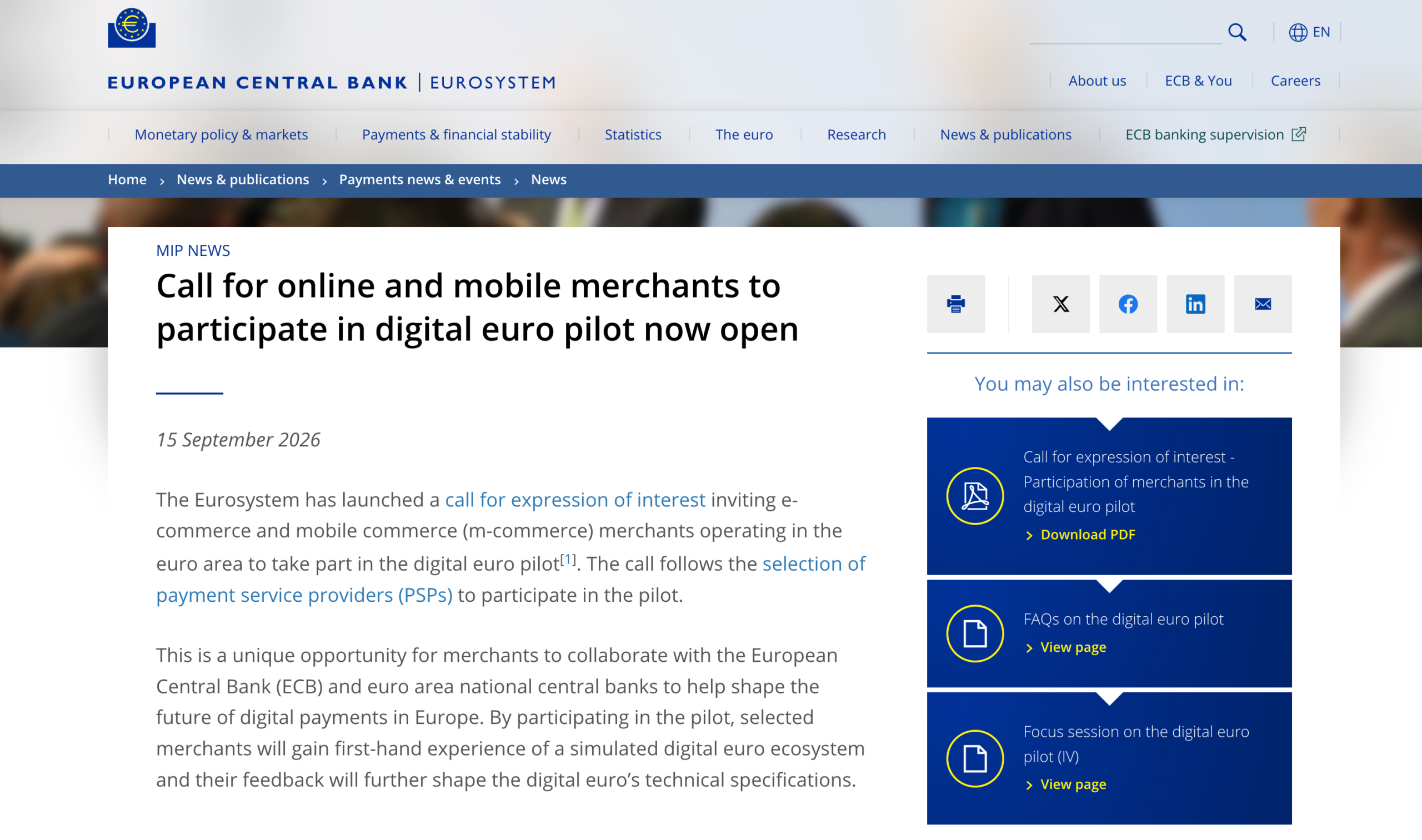
The European Central Bank has opened a new phase of its digital euro pilot by inviting e-commerce and mobile commerce merchants across the euro area to participate in testing. The 12-month pi
The European Central Bank has opened a new phase of its digital euro pilot by inviting e-commerce and mobile commerce merchants across the euro area to participate in testing.
The 12-month pilot is expected to begin in the second half of 2027. Selected merchants will test a beta version of the digital euro with the ECB, national central banks, and participating payment service providers. The test version will resemble the proposed digital euro but will not have legal tender status.
The ECB says the exercise will help assess payment functionality, operational processes, merchant integration, and user experience. However, the technical progress also raises questions about whether the digital euro can offer strong privacy protections by design.
Source:
ECB websiteALT TXT: ECB announcement Source:ECB website
Can the digital Euro deliver on privacy?
The ECB has repeatedly described privacy as a central design priority. Its published privacy framework says the Eurosystem would not be able to directly link online payments to identifiable individuals. It also says offline payments would provide cash-like privacy because transaction details would remain between the payer and recipient.
The ECB’s technical documents describe pseudonymous identifiers, separated data flows, encryption, and distributed processing. The proposed system would still involve payment service providers, which would retain information needed for anti-money laundering and know-your-customer obligations.
This is where the criticism fromTorben Schwark becomes relevant. Responding to the ECB’s merchant-pilot announcement, Schwark argued that statements excluding programmable money or preventing direct user identification are not enough.
His concern is not limited to what the law permits today. He asks what the technology could technically enable in the future, what data it generates, who can access that data, and whether payments could later be tracked, blocked, or tied to conditions.
That distinction is important to the digital euro debate. A system can prohibit certain uses through legislation while retaining technical features that could support those uses under a future policy or emergency framework.
For critics, privacy therefore needs to be enforced through system design, limited data collection, independent oversight, and transparent technical documentation. Legal safeguards remain necessary, but they may not be sufficient to create public confidence.
Why critics still worry about programmability
The ECB and European policymakers have rejected the idea that the digital euro would be programmable money in the sense of allowing authorities to dictate where or when people spend it.
The concern persists because digital payment systems can technically support restrictions, conditional transfers, spending controls, and automated rules. Those features may have legitimate uses in commercial payments, but they can also raise questions about financial autonomy if imposed by a public authority.
The ECB’s position is that the digital euro would be a general-purpose means of payment and would complement cash. The European Commission also states that cash would remain available.
The practical test will be whether those commitments appear in the pilot’s architecture. Can offline payments remain genuinely private? Can users understand which party sees each category of data? Can the system operate without creating a central record of ordinary spending?
These questions should be answered before a final issuance decision, not after the system becomes widely used.
What the pilot needs to prove
The merchant trial gives the ECB an opportunity to demonstrate that privacy, resilience, and usability can coexist. It also gives civil-society groups, technical researchers, merchants, and users a reason to demand more detail about the system’s operation.
DeFi Planet has previously examinedthe regulatory grey areas surrounding tokenized equities andthe risks that digital financial products can create for investors. The digital euro raises a related issue from a public-money perspective.
The ECB’s pilot is an important technical milestone. Its success, however, should not be measured only by transaction speed or merchant adoption. The more difficult test will be whether Europeans can verify that privacy and freedom of payment are integrated in the system rather than left to future political assurances.
Enjoyed this? BookmarkDeFi Planet, explore related topics, and follow us onTwitter,LinkedIn,Facebook,Instagram,Threads, and CoinMarketCap Community for seamless access to high-quality industry insights
Take control of your crypto portfolio with DEFI PLANET PRO, DeFi Planet’s suite of analytics tools.
The post ECB Says the Digital Euro Won’t Be Programmable, but Its Architecture Draws Scrutiny appeared first on DeFi Planet.