There's a moment in every token's life when storytelling stops being enough. For restaking tokens, that moment arrives with vesting cliffs — when narratives about shared security and ecosyste
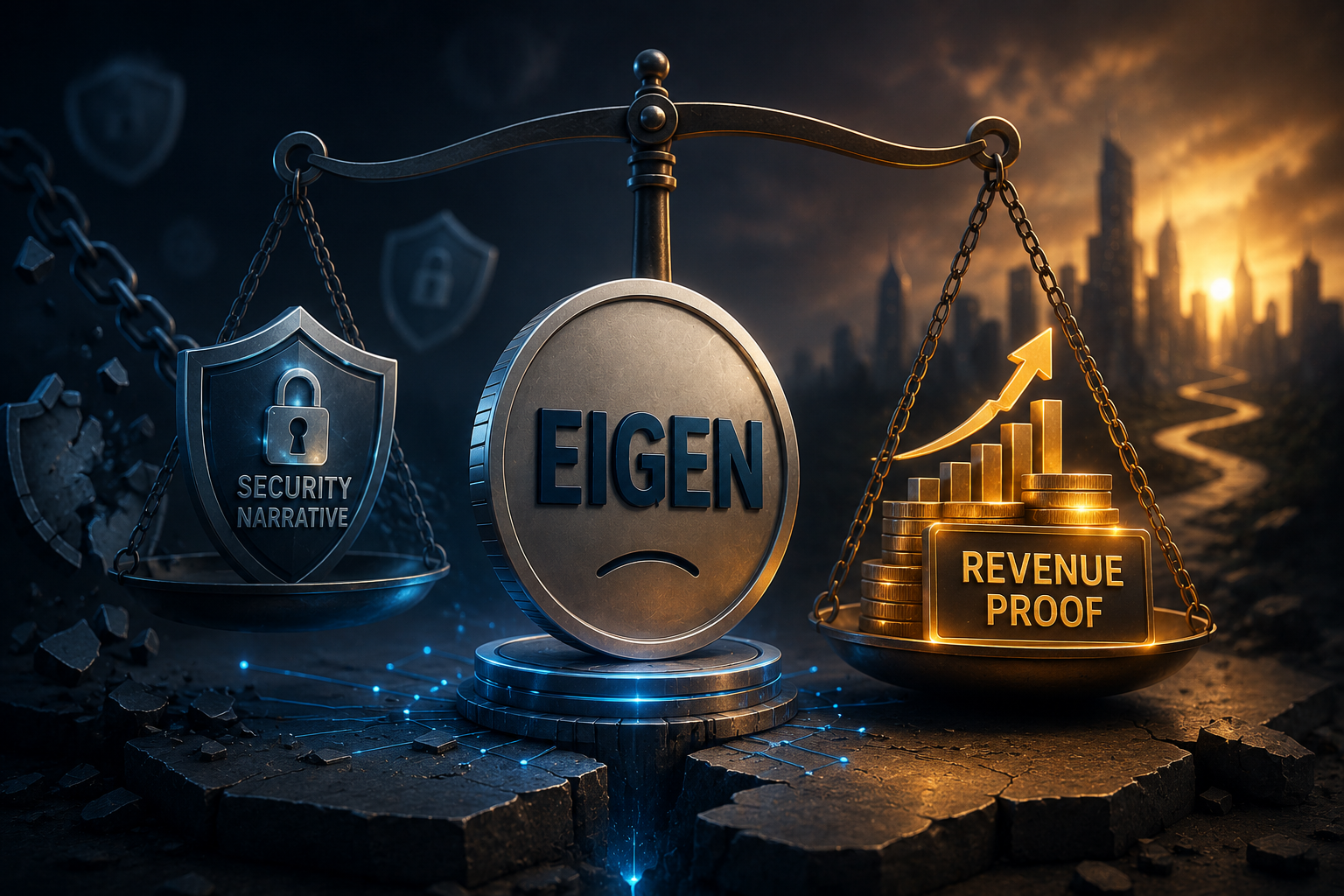
There's a moment in every token's life when storytelling stops being enough. For restaking tokens, that moment arrives with vesting cliffs — when narratives about shared security and ecosystem breadth have to start translating into something more concrete: actual paying customers and fees that flow back to holders.
EigenLayer's EIGEN has reached that point. The ecosystem has real scale behind it — billions in total value locked and dozens of Actively Validated Services running on top of the protocol. But the question investors are increasingly asking isn't whether EigenCloud has reach. It's who is actually paying for that security, how much, and where the money goes once it's collected.
The Gap Between TVL and Real Revenue
The numbers tell an uncomfortable story for anyone evaluating EIGEN purely on ecosystem size. EigenCloud's total value locked sits around $4.5 billion, which sounds substantial until you look at the revenue side of the ledger. Annualized protocol revenue is currently recorded at zero, while annualized incentives — token emissions used to bootstrap activity — run around $53.6 million. Over the trailing 30 days, fees came in at roughly $1.06 million against incentives of about $1.02 million.
That gap matters because it reveals what's actually driving current yields. Most of what restakers and operators are earning right now comes from emissions designed to attract capital, not from AVSs paying real money for security and validation services. It's not a flaw in the architecture — every infrastructure category goes through this bootstrapping phase. But it does mean the next chapter for EIGEN depends on something emissions can't manufacture indefinitely: actual customers writing actual invoices.
Why This Distinction Actually Matters
Conflating incentives with fees produces a misleading picture of yield. Incentives are finite and dilutive by design — they're meant to attract activity early, then taper off. Fees are the durable component, the part that scales only if AVSs genuinely need the security they're purchasing and are willing to pay market rates for it.
The ecosystem currently counts more than 20 active AVSs and over 200 operators, which demonstrates breadth. What it hasn't yet demonstrated at scale is depth — AVSs with committed budgets and recurring fee payments rather than experimental integrations still finding product-market fit. The most promising revenue models within this category tend to involve data availability services charging by capacity, oracle networks selling subscription-based price feeds, and compute coprocessors metering verifiable AI inference or zero-knowledge proof generation. Each of these has a plausible path to a paying customer base — the question is execution speed.
The July 1 Unlock and What It Tests
EIGEN's circulating supply currently sits around 741 million tokens, with the next scheduled unlock landing on July 1, 2026. Unlocks aren't inherently bearish events — they're supply tests. What actually happens to price around an unlock date reveals whether existing demand is durable or whether it was largely mercenary capital chasing incentive yield that's about to become less attractive.
How the market absorbs that July unlock will say something real about EIGEN's underlying demand. A token that holds steady through a meaningful supply increase is telling you something different than one that sells off sharply — and that signal is more informative than almost any other near-term data point available to EIGEN holders right now.
What to Actually Watch Going Forward
The clearest signal of genuine progress would be a sustained crossover where 30-day fees start exceeding 30-day incentives — a regime shift rather than a brief data anomaly. Beyond that headline number, rising operator revenue without a corresponding increase in emissions would suggest real demand is finally showing up rather than being manufactured through token subsidies.
Governance proposals around fee routing are also worth tracking closely. Even if AVS revenue scales meaningfully, token value doesn't automatically capture that growth — it depends entirely on whether the protocol formalizes mechanisms like revenue sharing, buyback-and-burn, or staking contracts with routed fees. Without those explicit links, fee growth could accrue mainly to operators while token holders watch from the sidelines.
EIGEN isn't unique in facing this test. Every infrastructure category in crypto — rollup sequencers, oracle networks, data availability layers — eventually confronts the same question: do customers pay, and does that payment find its way back to the token. Restaking is simply the latest category old enough to have its vesting cliffs arrive and force the conversation.