Warren draws a line on industry-friendly crypto bill Senator Elizabeth Warren (@SenWarren) is not against federal crypto regulation. She is against this particular bill. Speaking to Forbes, t
Warren draws a line on industry-friendly crypto bill
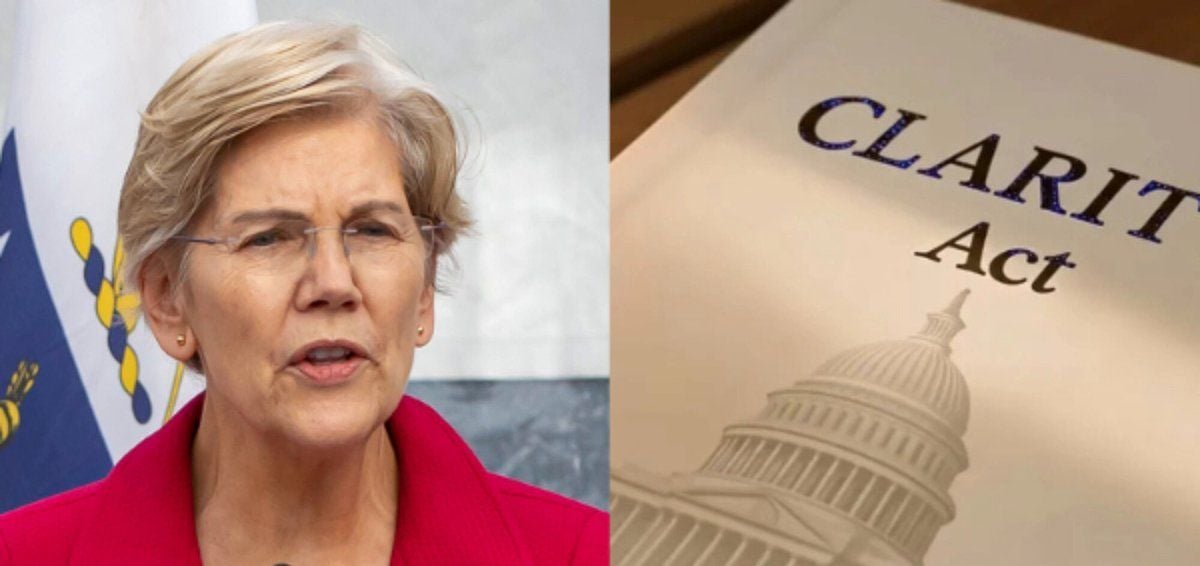
Senator Elizabeth Warren (@SenWarren) is not against federal crypto regulation. She is against this particular bill. Speaking to Forbes, the Massachusetts Democrat characterized the Digital Asset Market Clarity Act as a piece of legislation written by and for the crypto industry, calling it a giveaway that leaves consumers, investors, and national security exposed.
Warren went further on President Trump than her usual messaging, describing a president who she says appears to be "taking bribes out in public," a reference to his extensive crypto interests. Federal filings show Trump made more than $1.4 billion from cryptocurrency ventures in 2025 alone, nearly two-thirds of his income that year. Warren argues the bill does nothing to close off that avenue of enrichment. Senate Banking Committee minority staff released an analysis concluding that the latest version of the CLARITY Act is riddled with loopholes and does nothing to prevent the president from making his next $1.4 billion in crypto profits.
She also flagged Minnesota as a state where crypto money is actively trying to influence a congressional race, framing it as evidence of the industry's broader political reach.
Bill's path to 60 votes remains uncertain
Warren said talks have not resolved her three core objections: corruption safeguards, consumer protection, and national security. She has also raised alarms about the bill's implications for sanctions enforcement. Warren has described the CLARITY Act as a potential loophole for sanctions evasion, citing analysis from sanctions policy expert Richard Nephew, who previously served as Director for Iranian affairs at the National Security Council.
The Senate Banking Committee advanced the bill by a vote of 15 to 9 in May 2026. All 13 Republicans were joined by two Democrats, though those two indicated their committee votes did not guarantee floor support without further progress on outstanding issues. Because the legislation requires 60 Senate votes to overcome a filibuster, bipartisan agreement is mathematically required.
Republicans have pushed back, arguing that Democrats keep shifting the goalposts. Senate Majority Leader John Thune has said a floor vote would happen before the August recess. Senator Thom Tillis acknowledged that negotiators are "not quite there" on an ethics agreement, and without that resolution, the Democratic vote count needed to reach 60 likely does not exist. The White House has since begun engaging directly on ethics provisions with both parties, hinting at a possible breakthrough before any Senate vote.
A failed vote before recess would push the realistic timeline for comprehensive crypto market-structure legislation into mid-2027 at the earliest, as post-recess calendar compression coincides with government funding negotiations and a sharpening midterm environment.
Sources:Senator Warren Statement on New Text of the CLARITY Act, Senate Banking CommitteeCLARITY Act Senate Vote Locked In, But 60-Vote Hurdle Looms Large, CryptoNewsElizabeth Warren Says Updated Crypto Bill Does Nothing to Stop Trump From Cashing in, Benzinga