Equinor, an international energy company headquartered in Norway, said on November 17, 2026, that some of its IT systems were under cyberattack. Oil and gas production remains normal, and the
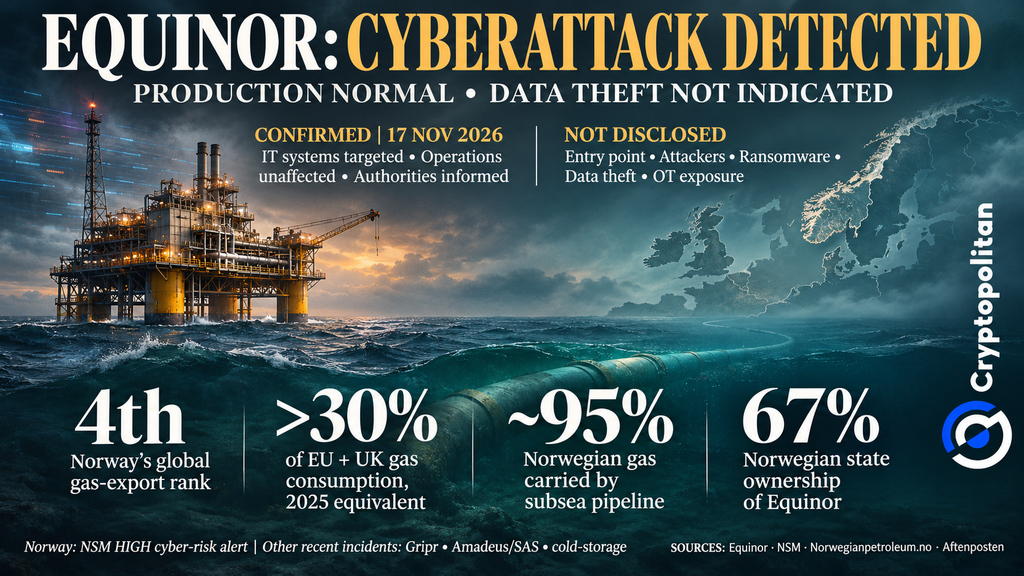
Equinor, an international energy company headquartered in Norway, said on November 17, 2026, that some of its IT systems were under cyberattack. Oil and gas production remains normal, and the company has seen no signs of stolen data. The incident has received significant attention because Norway is a major supplier of gas for Europe.
What Equinor has confirmed, and what it hasn’t
In its November 17 statement, Equinor described the cyberattack as ongoing. The company said it had mobilised resources to stop the attack and was notifying relevant authorities. Equinor also stated:
There are no indications that data has been stolen. The attack has not affected Equinor’s operations and production.
The statement did not mention who the attackers were, how they got in, or whether malware was involved. Equinor also did not say anything about whether its industrial control systems had been affected in any way. While the company said that nothing indicated any data theft, the initial assessment did not exclude the possibility of it happening.
Equinor IT cyberattack: Norway gas production unaffected
Where an IT breach can still reach the machinery
Equinor confirmed an attack on its information technology (IT) systems, which handle email, business software, and company data. However, it has not said whether the attackers reached the systems controlling its machinery. Those systems fall under operational technology (OT), which includes sensors, controllers, and engineering systems. An attack on IT systems does not automatically give attackers control of OT systems.
IT and OT systems have different purposes, but that does not mean their networks are entirely separate from each other. Shared login credentials, contractor connections, and weak network security can give attackers a way to move between them. A 2026 Dragos assessment indicate that 29% of companies within the oil and gas sector were severely lacking in IT/OT separation. A broader cyberattacks study by Verizon in 2026 shows that vulnerabilities in software were used to obtain initial access in 31% of attacks.
Neither of the reports detailed what transpired at Equinor. An assault on IT systems does not, in itself, indicate that operations were disrupted or that the attackers were able to seize control of any machines. Such developments would require different proof.
Norway on its highest openly declared cyber alert
Norway was already on high cyber alert when Equinor disclosed the attack. On October 27, the National Security Authority (NSM) raised the country’s cyber-risk level to HIGH, the second-highest of five levels. The agency made its assessment public for the first time. It also reported that successful cyber operations against Norwegian organisations had tripled over six months.
Aftenposten reported other incidents involving data stolen from Gripr, leaked SAS passenger records through Amadeus, and manipulated refrigeration temperatures at an Enebakk warehouse. No evidence publicly links these incidents to Equinor or one another.
Why a Norwegian outage would be a European problem
The consequences could extend beyond Norway if a cyberattack disrupted gas production. Norway is the world’s fourth-largest gas exporter. Its 2025 exports equalled more than 30% of EU and UK gas consumption. About 95% of Norwegian gas travels through subsea pipelines. The Norwegian state also owns 67% of Equinor.
No supply disruption has been reported. However, the IEA warned that Europe entered the 2026–27 winter with unusually low gas storage. A prolonged outage could tighten supplies and drive prices higher. That remains a potential risk, not an observed consequence of Equinor’s cyberattack.
Echoes of Colonial Pipeline
The Colonial Pipeline incident illustrates how an attack in a company’s IT system can affect the delivery of oil and gas without the interference of industrial controls. After a ransomware attack in 2021, the operator of the pipeline stopped its operations temporarily as a precaution. As reported by Cryptopolitan, Colonial paid $4.4 million in Bitcoin. U.S. officials later recovered $2.3 million of that amount.
Cybersecurity reports suggest industrial companies continue to face considerable pressure. Dragos recorded 1,266 industrial ransomware incidents in Q3 2026, up 11% from the previous quarter. However, it found no cases of ransomware operators directly manipulating industrial controls.
The report from Zscaler indicated an increase of more than 275% in data theft due to ransomware between April 2025 and March 2026. Neither report provides any information on what transpired in the case involving Equinor. It still needs to be determined how widespread the attack was.
If you're reading this, you’re already ahead. Stay there with our newsletter.
