Erebor, the crypto-focused national bank backed by Palmer Luckey, has raised more than $7 billion in deposits and attracted over 500 customers since its opening, according to the Financial Ti
Erebor, the crypto-focused national bank backed by Palmer Luckey, has raised more than $7 billion in deposits and attracted over 500 customers since its opening, according to the Financial Times on October 6.
This returns technology and cryptocurrency deposits to a specialized bank just three years after Silvergate’s demise. The main question now is whether Erebor will be able to steer clear of a similar disaster, with depositors racing to withdraw their cash.
So far, Erebor is taking a cautious approach. It is keeping much of that money liquid instead of lending it aggressively.
The cash-heavy balance sheet that sets it apart
Erebor’s Q2 2026 filings show just how unusual that model is. According to Bank Data Insights, the bank held $4.06 billion in deposits. It also had $4.17 billion in cash and interbank balances. Gross loans stood at just $77.8 million.
The recently reported deposit amount of $7 billion indicates how rapidly Erebor might be expanding. But the overall approach to business remains unchanged. Money is being taken in much quicker than it is lent out.
The reason for such caution can be partly explained by the requirements set by the OCC. Approval by OCC obliges Erebor to have a very liquid balance sheet and keep its Tier 1 leverage ratio no lower than 12% during the first three years of its existence. In the second quarter of this year, the ratio was indicated as 38.81%.
Profitability is the trade-off. Erebor reported a $16.3 million loss. Return on assets was negative 1.03%, while its net interest margin was 0.71%.
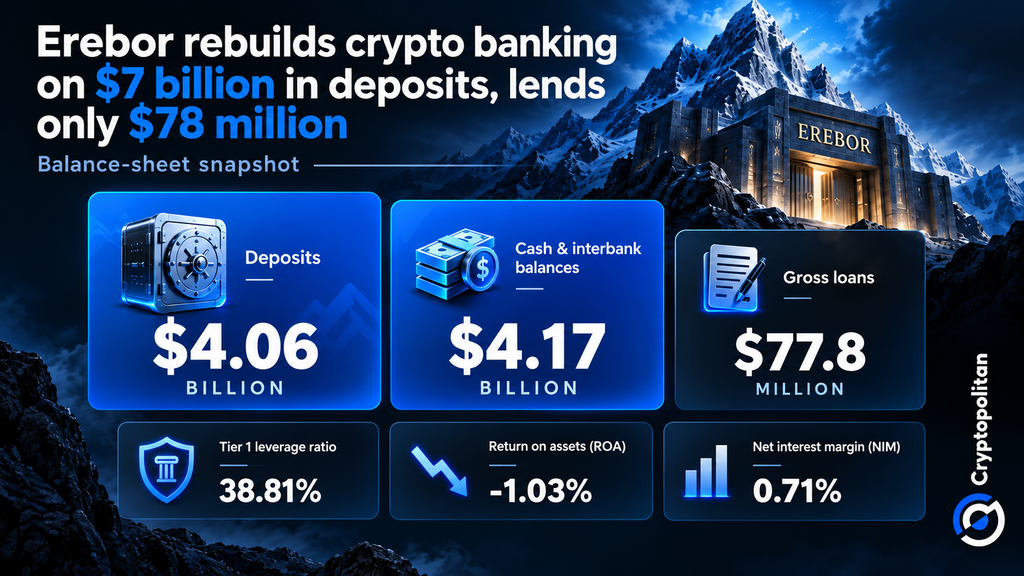 Erebor Bank holds $4.17B in cash as deposits top $7B
Currently, it appears that the behavior of Erebor suggests it is acting less like a traditional lending institution and more like a bank that is operating with an objective of being able to make funds available quickly.
What sank Silvergate three years ago
This presents a sharp contrast to Silvergate’s case.
According to the Federal Reserve’s inspector general, before its liquidation in 2023, Silvergate had reached assets worth over $16 billion. The bank was highly reliant on crypto customers. It also grew rapidly, was poorly governed, and depended largely on uninsured, non-interest-bearing deposits.
When confidence broke, deposits disappeared quickly. Silvergate lost 68% of its deposits in the fourth quarter of 2022. It then had to sell securities at heavy losses to meet withdrawals.
Erebor is trying to avoid that trap by keeping much more of its balance sheet immediately available.
A bridge to always-on dollar settlement
Erebor’s ambitions go beyond conventional banking. Its regulatory framework allows limited crypto holdings for network transaction fees. Its wider strategy also includes blockchain-based settlement and round-the-clock payments.
That could put Erebor between regulated deposits, stablecoins and 24/7 digital markets.
The BIS estimates stablecoin market capitalization reached about $320 billion by May 2026. It also warns that wider adoption could affect bank funding, liquidity and demand for dollar assets.
Why Asia makes the stakes global
The opportunity is increasingly international. The OECD found that blockchain-based crypto transactions in Asia grew 69% year over year through June 2025. That was the fastest growth of any region.
Erebor has built a much thicker liquidity cushion than Silvergate had. But the core risk has not disappeared. Tech and crypto deposits can move fast.
The real test will come when they do.
Don’t just read crypto news. Understand it. Subscribe to our newsletter. It's free.