The European Union’s markets watchdog wants to regulate the gateways into decentralized finance rather than the code itself. In its MiCA review response, the European Securities and Markets A
The European Union’s markets watchdog wants to regulate the gateways into decentralized finance rather than the code itself. In its MiCA review response, the European Securities and Markets Authority (ESMA) proposed a new regulated crypto-asset service for firms that give customers access to DeFi protocols.
The proposal has the potential to transform the method in which exchanges, wallet applications, and other intermediaries link users to decentralized finance in Europe.
Additionally, ESMA desires additional information when it comes to distinguishing between a decentralized protocol and a system that still depends on human input in order to continue operating properly.
Why the access point, not the protocol
Instead of going after the underlying software or permissionless networks themselves, ESMA is focusing on the companies and other intermediaries that give users access to DeFi, whether through an interface, transaction routing, or another customer-facing service.
It calls for limiting the scope of the DeFi exemption:
The ‘DeFi’ exemption should be as narrow as possible to avoid being used as a way of circumventing the application of the MiCA regime.
– ESMA, MiCA review response.
An EBA-ESMA report in 2025 estimated that DeFi’s share of the overall value of the global crypto-asset market was approximately 4%, and the share of transactions conducted on decentralized exchanges was approximately 10% of global crypto trading volume. It identified application interfaces, self-custody wallets, and centralized platforms as primary avenues into DeFi.
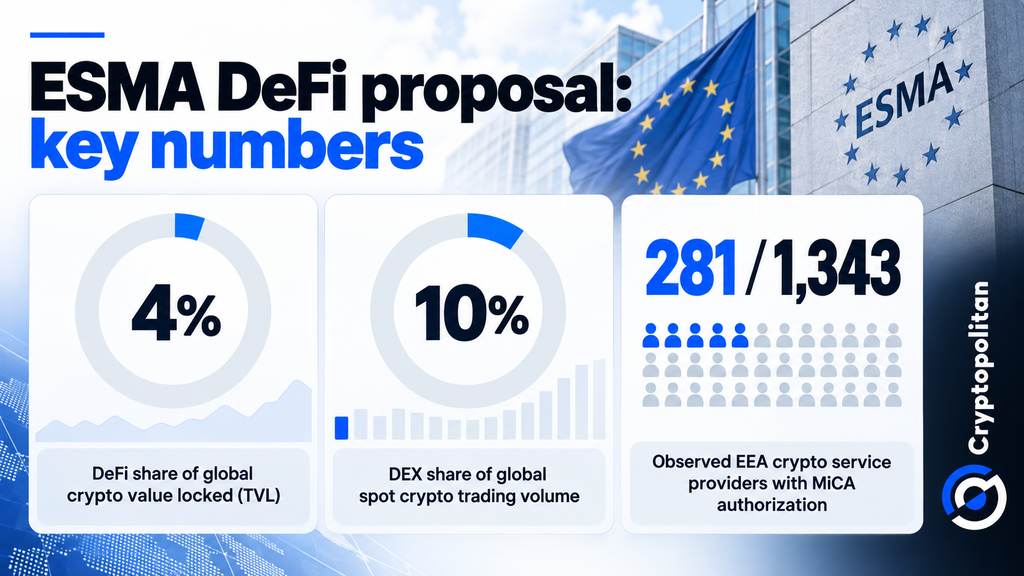
ESMA DeFi Proposal: 4% TVL, 10% DEX Volume and 281 MiCA-Authorized Firms
Disclosure, marketing and the stablecoin line
ESMA has also suggested stricter regulations for marketing by influencers and third parties, improved transparency in terms of costs, and proportionate requirements for staking, borrowing and lending. The EBA’s proposal also requested the regulation of crypto lending, especially DeFi-related lending practices, and for greater consistency in token classification.
Moreover, ESMA is looking for greater powers in order to take down fraudulent websites, seize cryptoassets linked to possible market manipulation or terrorist activities, take action against unauthorized third-country entities, and impose limitations on exchanges of stablecoins with non-compliant status.
What the market reaction tends to look like
The wider cryptocurrency market could be hardly affected. A study conducted in January 2026 showed that announcements about new regulations have an impact on particular tokens instead of the entire market, with the governance tokens and those of decentralized exchanges being among the most sensitive to it.
This is part of Europe’s larger attempt to determine when DeFi is truly decentralized and when someone has meaningful control over it. However, this is complicated by the fact that a protocol may still appear to be decentralized while important decisions are made by a small group of people.
In an earlier report, Cryptopolitan mentioned that an ECB report had made this clear in a number of major DeFi projects. The proposal by ESMA is yet another attempt to clarify this distinction.
Whether the effects travel
This effect will certainly extend beyond Europe. According to the report by the Bank for International Settlements, decentralized finance usually performs some of the functions characteristic of conventional finance, yet with potentially greater risks of transparency, information gaps, and financial instability.
The Financial Stability Board has also warned that if countries apply different rules, companies can move their activities to places which offer them better conditions, making cross-border monitoring more difficult.
Europe’s switch to MiCA illustrates how the new regulations are already reducing competition in the market. According to TRM Labs, only 281 among the 1,343 monitored crypto service providers in the EEA had obtained MiCA authorization before the transition period came to an end on July 1.
Establishing a new regulated service for companies providing access to users for DeFi could heighten the compliance requirement even more, particularly for service providers operating across borders.
The smartest crypto minds already read our newsletter. Want in? Join them.