Espresso Foundation Confirms Major Network Change The team behind this network confirmed a major change this week. The Espresso Mainnet Upgrade brings transaction finality under one second, f
Espresso Foundation Confirms Major Network Change
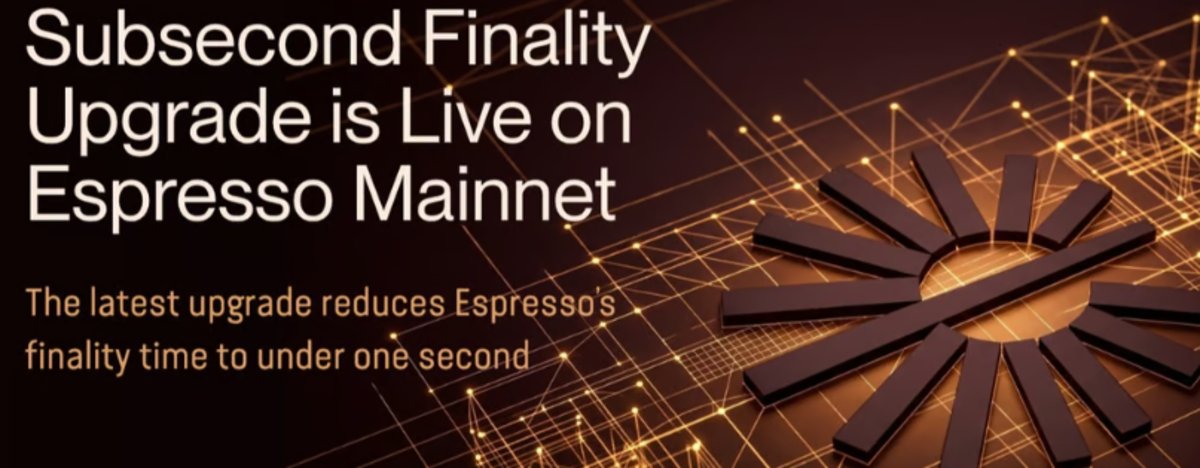
The team behind this network confirmed a major change this week. The Espresso Mainnet Upgrade brings transaction finality under one second, following a coordinated rollout by roughly 100 validators on September 9, 2026.
The Espresso Foundation detailed the Espresso Mainnet Upgrade in an official post published September 14, 2026, describing it as a ground-up redesign of consensus, networking, block building, and data availability.
Source:Official Announcement
What Changed in This Release
The foundation said reaching finality in under a second required rewriting several core parts of the system rather than adjusting existing settings. It also said the Espresso Mainnet Upgrade lowers the cost of running a validator node and strengthens overall resilience.
The rebuild touches four main areas.
Finality path: Cuts the network hops needed to finalize a block from seven or more down to three and removes chaining, so a stalled or faulty leader in a later round no longer delays a block that already has votes.
Validator networking: Replaces the earlier relay and gossip setup with a fully connected, encrypted mesh called cliquenet, so every consensus message reaches its destination in one hop instead of several.
Block building: Moves block construction inside the leader node itself, pulling from that leader's own transaction pool instead of querying outside builder services over HTTP.
Data encoding: Adopts a new erasure coding method built on XOR operations, switches to a faster Reed-Solomon library, and replaces the prior hashing method with BLAKE3 for share commitments.
Fewer Hops, Faster Blocks
Component
Before
After
Hops to finality
7 or more
3
Networking model
Relay plus gossip
CliqueNet mesh
Block builder location
External service
Inside leader node
Hashing for commitments
Keccak
BLAKE3
The foundation said the combined changes cut the block building, data availability, and voting work required per finalized block by roughly two-thirds.
Peer discovery also moved on-chain as part of this rollout, with validators registering their address and encryption key directly on the stake table contract rather than relying on separate discovery infrastructure.
Why the Timing and Design Choices Matter
This chain positions itself as a settlement layer for other blockchains and applications that need institutional-scale throughput without giving up sovereignty over their own architecture. Faster finality sits at the center of that pitch, since apps built on top depend on quick, reliable confirmation.
The foundation pointed to lower hardware and bandwidth requirements for node operators as a deliberate part of the Espresso Mainnet Upgrade, not a side effect. Garbage collection for old consensus data, votes, and partial blocks now runs promptly, keeping memory use bounded even under heavy load.
That combination of faster finality alongside a lighter operating footprint is unusual, since networks often trade one for the other during a major rewrite.
Expert Take
Engineers reviewing rollups and modular blockchain design generally treat sub-second finality as a meaningful threshold, since it starts to match the response times users expect from centralized apps.
Removing sequential steps from the critical path, rather than simply adding more validator hardware, is typically viewed as the more durable way to gain speed, since it does not depend on validators running increasingly expensive machines to keep pace.
Whether other base layers follow with a similar consensus and networking rewrite of their own will likely depend on how the Espresso Mainnet Upgrade performs under sustained load rather than in benchmarks alone.
Conclusion
The foundation says the code behind this release is public and available on its GitHub repository, including the specific release branch used for the rollout.
Detailed benchmark figures from live conditions have not been published yet, with the team saying those are expected soon. Validators currently secure the chain by staking its native token, and the Espresso Mainnet Upgrade does not change that requirement.
YMYL Disclaimer: This article is for educational purposes only and does not offer financial or investment advice. Readers should verify technical claims against the official source before relying on them for development or investment decisions.