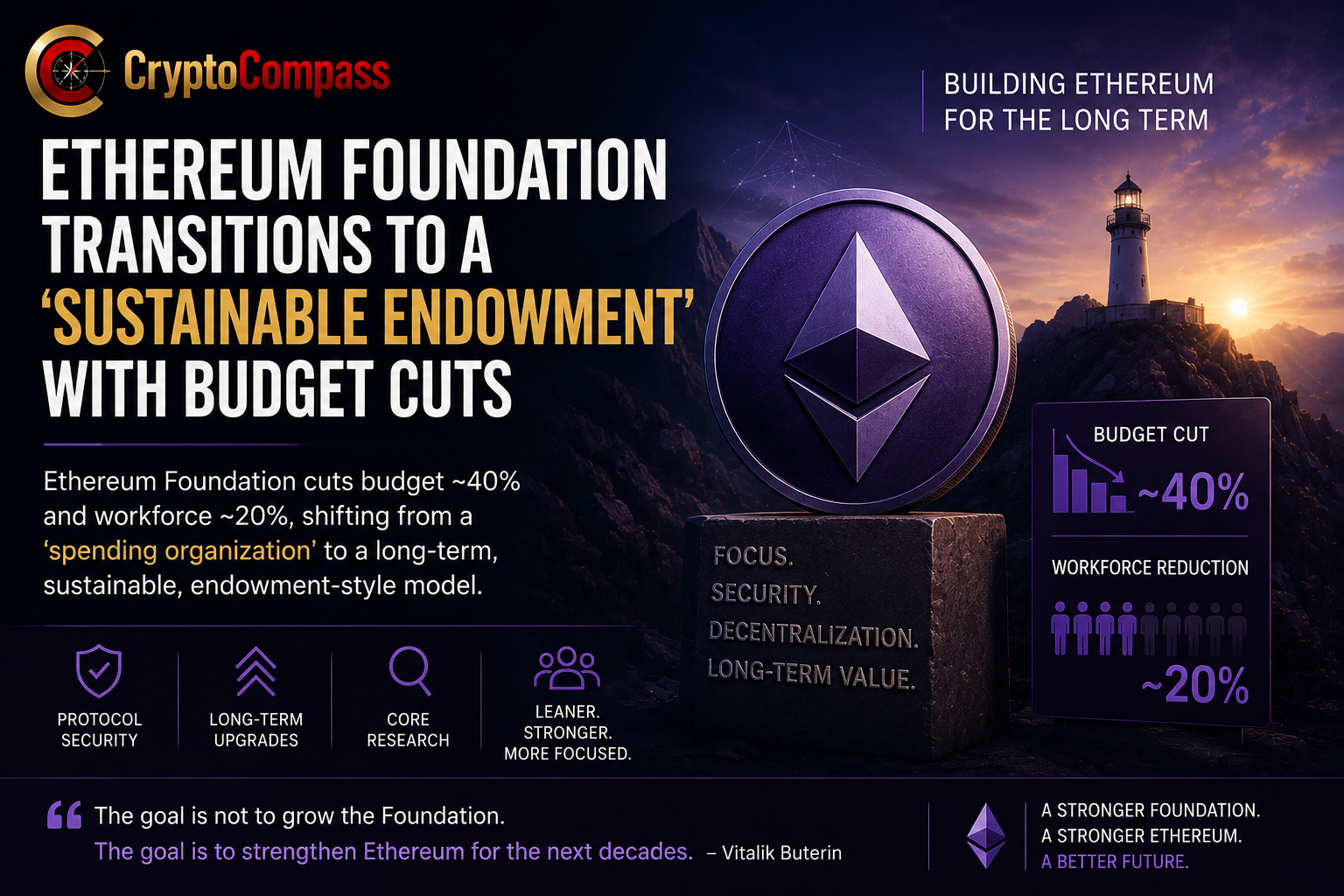
The Ethereum Foundation is cutting its budget by roughly 40% and reducing its workforce by 20%. At first glance, the move appears defensive. In reality, it may signal something more important: Ethereum is entering a new phase where long-term sustainability matters more than rapid
For years, the Ethereum Foundation played the role of ecosystem builder.
It funded research.
Supported developers.
Backed experimental projects.
And helped transform Ethereum from an ambitious blockchain idea into the dominant smart contract platform in the industry.
Now, the organization is preparing for a different future.
The Ethereum Foundation is reportedly reducing its budget by approximately 40% while cutting around 20% of its workforce.
To some observers, the announcement looks like a cost-cutting exercise.
To others, it may represent one of the strongest signals yet that Ethereum is maturing.
From Growth Mode To Sustainability Mode
According to Ethereum co-founder Vitalik Buterin, the Foundation is transitioning away from what he described as a "spending organization" toward a more sustainable long-term model.
The distinction matters.
Young ecosystems prioritize growth.
Mature ecosystems prioritize resilience.
For much of its history, Ethereum operated like a startup.
The objective was expansion.
More developers.
More applications.
More experimentation.
More adoption.
Today, Ethereum secures hundreds of billions of dollars in value and serves as the foundation for stablecoins, tokenized assets, decentralized finance, and large portions of the digital asset economy.
The priorities are changing.
The Foundation Is Becoming Less Important
Paradoxically, one of the healthiest signs for Ethereum may be that the Foundation no longer needs to be the center of everything.
In truly decentralized ecosystems, growth does not depend on a single organization.
Developers build independently.
Companies invest independently.
Communities organize independently.
Capital flows independently.
A reduction in Foundation spending may force the ecosystem to become more self-sufficient.
That process is rarely comfortable.
But it is often necessary.
The ultimate goal of decentralization was never to create a stronger foundation.
It was to create a system that could thrive without one.
A Smaller Foundation, A Stronger Protocol
The Ethereum Foundation's future focus appears increasingly concentrated on core protocol responsibilities.
Security.
Research.
Infrastructure.
Long-term upgrades.
These are the areas where centralized coordination remains most valuable.
At the same time, ecosystem development may gradually shift toward independent organizations, Layer 2 networks, venture-backed startups, DAOs, and private builders.
The result could be a leaner Foundation focused on protecting Ethereum's foundations rather than driving every aspect of its expansion.
The Investment Perspective
For investors, the implications are nuanced.
In the short term, reduced Foundation spending may mean fewer grants, fewer experimental initiatives, and potentially slower ecosystem growth in some areas.
Some projects that previously relied on Foundation support may face greater challenges raising capital.
That is the obvious risk.
The less obvious opportunity is that Ethereum may emerge financially stronger.
Markets often reward sustainability.
Especially in uncertain economic environments.
A Foundation that spends less aggressively extends its operational runway and reduces long-term dependency on treasury liquidation or ecosystem support.
The trade-off is slower growth today in exchange for greater stability tomorrow.
Ethereum's New Role
Ethereum is no longer trying to prove it deserves a place in the market.
It already has one.
The network now serves as the settlement layer for a large portion of the digital asset economy.
Stablecoins settle on Ethereum.
Tokenized assets increasingly launch on Ethereum.
Institutional blockchain initiatives continue to build around Ethereum-compatible infrastructure.
The challenge is no longer expansion at all costs.
The challenge is maintaining security, neutrality, and reliability for decades.
That requires a different mindset.
CryptoCompass View
Many investors will interpret the Ethereum Foundation's budget cuts as a sign of weakness.
That may be the wrong conclusion.
The more interesting interpretation is that Ethereum is entering a phase normally associated with mature institutions.
Less focus on rapid expansion.
More focus on durability.
Less emphasis on growth at any cost.
More emphasis on long-term stewardship.
Not every ecosystem survives long enough to face this transition.
Ethereum has.
The Foundation's decision suggests that leadership increasingly sees Ethereum not as a startup racing toward adoption, but as critical infrastructure preparing for the next decade.
Growth built Ethereum.
Sustainability may define what comes next.
—
By Suttermill
CryptoCompass Editorial Desk