Markets7 min read
Why Is Dash (DASH) Price Down Today?
TLDR Keypoints Dash (DASH) is trading at $35.38, down 4.09% in the past 24 hours, according to CoinGecko data as of 08:52 UTC on November 28, 2026. The decline comes after MEXC delisted both
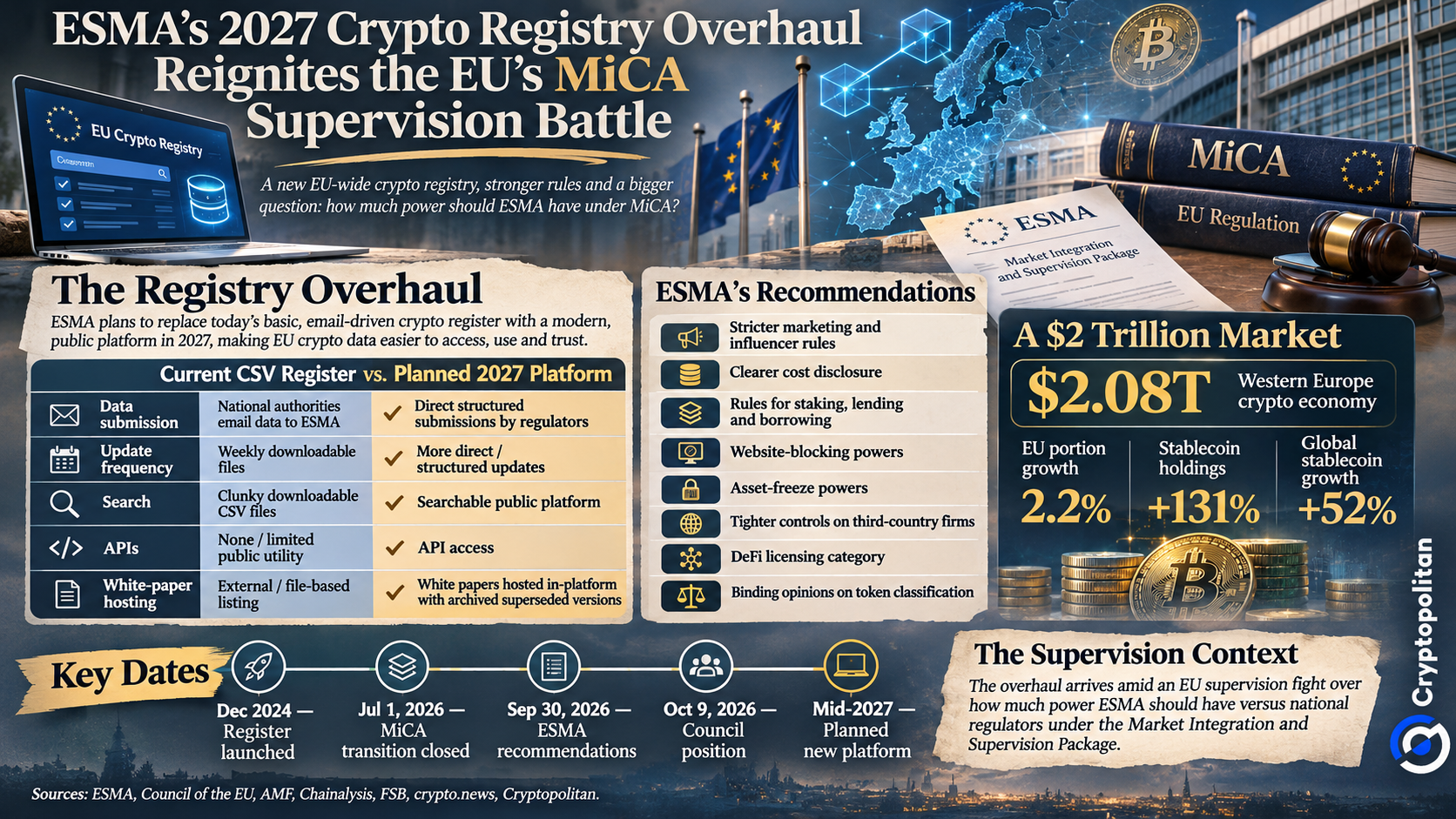
The European Securities and Markets Authority (ESMA) plans to replace its temporary database with a searchable online crypto registry by the middle of next year. The upgrade comes as European
The European Securities and Markets Authority (ESMA) plans to replace its temporary database with a searchable online crypto registry by the middle of next year. The upgrade comes as European Union (EU) lawmakers debate whether ESMA or national regulators should oversee crypto businesses.
ESMA is the EU’s financial markets regulator and supervisor, while theMarkets in Crypto-Assets Regulation(MiCA) sets common rules for crypto issuers and service providers.
A representative from ESMA reportedly announced its plan to replace the temporary crypto registry with a searchable online platform. The current registry has been in use since December 2024.
National regulators currently email data to ESMA. The agency manually consolidates the information and publishes five downloadable comma-separated values (CSV) files weekly. These cover authorized crypto-asset service providers (CASPs), non-compliant entities, token issuers, and crypto white papers.
A CASP is a business that professionally provides crypto services, such as trading, exchange, or custody.
UnderArticle 3 of MiCA, asset-referenced tokens (ARTs) seek to maintain stable values by referencing other assets or rights, while e-money tokens (EMTs) reference a single official currency.
The new platform will make it possible for regulators to upload records directly, as well as have these records automatically checked against external databases. This will also make it possible for regulators to search the database and export CSV files, as well as retrieve data via application programming interfaces (APIs).
ESMA will also host white papers directly and archive previous versions, as Article 109 of MiCA requires. The agency said the launch date depends on technical development rather than the regulatory review.
Beyond the crypto registry upgrade, EU lawmakers are debating whether ESMA or the financial regulators of individual EU member states should oversee crypto businesses operating across the bloc.
The debate revolves around the Market Integration and Supervision Package (MISP). The package is intended to reduce fragmentation across EU financial markets by placing under the direct supervision of ESMA major trading venues, securities depositories and clearinghouses.
Under Article 9 of the proposed MISP regulation, the European Commission also plans to transfer the authorization and supervision of all crypto-asset service providers (CASPs) from national regulators to ESMA. However, the Council of the EU took a different approach on October 9, 2026, when it agreed on key elements of its negotiating position. It favored limiting ESMA’s direct supervision to certain crypto businesses.
The Council stated:
“To ensure proportionality, only the most significant cross-border crypto-asset service providers (CASPs) would become immediately subject to ESMA supervision.”
The position of the Council is reflective of the concerns raised by several EU member states. A May 2026 working document revealed that some member states are worried that placing the supervision of all CASPs under the ESMA could increase compliance costs and bureaucracy. Others emphasized the importance of keeping smaller crypto businesses under national regulators, given their familiarity with local market conditions.
Despite the concerns about the level of supervisory powers being given to ESMA, there is still support for common regulations over cryptoassets across the EU. In a speech on February 3, 2026, Marie-Anne Barbat-Layani, chair of France’s financial markets authority (AMF), defended MiCA. She emphasized the importance of a common regulatory framework in building a unified European crypto market rather than having businesses operate under separate national rules.
While EU lawmakers debate who should supervise crypto businesses, ESMA wants to change some of the rules these businesses must follow. In its September 30, 2026 recommendations, ESMA called for stricter marketing rules, including those covering influencer promotions. It also wants crypto firms to be more transparent about costs and follow rules on staking, lending and borrowing based on the risks each activity poses.
Alongside the proposed changes to crypto business rules, ESMA wants stronger enforcement powers. These would allow the agency to block fraudulent websites and freeze assets linked to suspected market abuse. ESMA also wants to tighten restrictions on crypto firms outside the EU that target European investors without authorization.
Other proposals include a new licensing category for businesses that provide access to decentralized finance (DeFi) protocols. ESMA also wants the authority to issue legally binding opinions on how crypto tokens should be classified.
However, some industry participants favor amending existing rules rather than introducing separate regulatory frameworks. As Cryptopolitan previously reported, the Cardano Foundation opposed separate rules for DeFi and staking. In its September 30 consultation response, the foundation argued that regulation should focus on the activities involved, their risks and who controls the assets, rather than the technology used.
 ESMA’s 2027 MiCA crypto registry overhaul and EU crypto supervision proposals
The scale of Europe’s crypto market puts the proposed regulatory changes into perspective. According to Chainalysis, Western Europe recorded $2.08 trillion in crypto transaction volume between July 2025 and June 2026. This made it the world’s second-largest regional crypto market.
Crypto activity within the EU grew by 2.2% during the period. Meanwhile, Western Europe’s stablecoin holdings increased by 131%, far exceeding the global growth rate of 52%.
However, differences in crypto regulation across jurisdictions remain a concern. The Financial Stability Board’s October 2025 review identified uneven implementation of crypto regulations and weaknesses in cooperation between regulators in different countries. Within the EU, MiCA’s final transition period ended on July 1, 2026. ESMA is now focusing on how authorized crypto businesses comply with existing rules. Its 2027 priorities include reviewing how firms manage operational disruptions, outsourced services, and liquidity. The agency will also assess whether authorized firms maintain sufficient business operations within the EU.
The smartest crypto minds already read our newsletter. Want in? Join them.