European Parliament lawmakers have adopted a formal policy position on digital assets, urging the European Commission to examine whether key areas of the crypto ecosystem should be brought mo
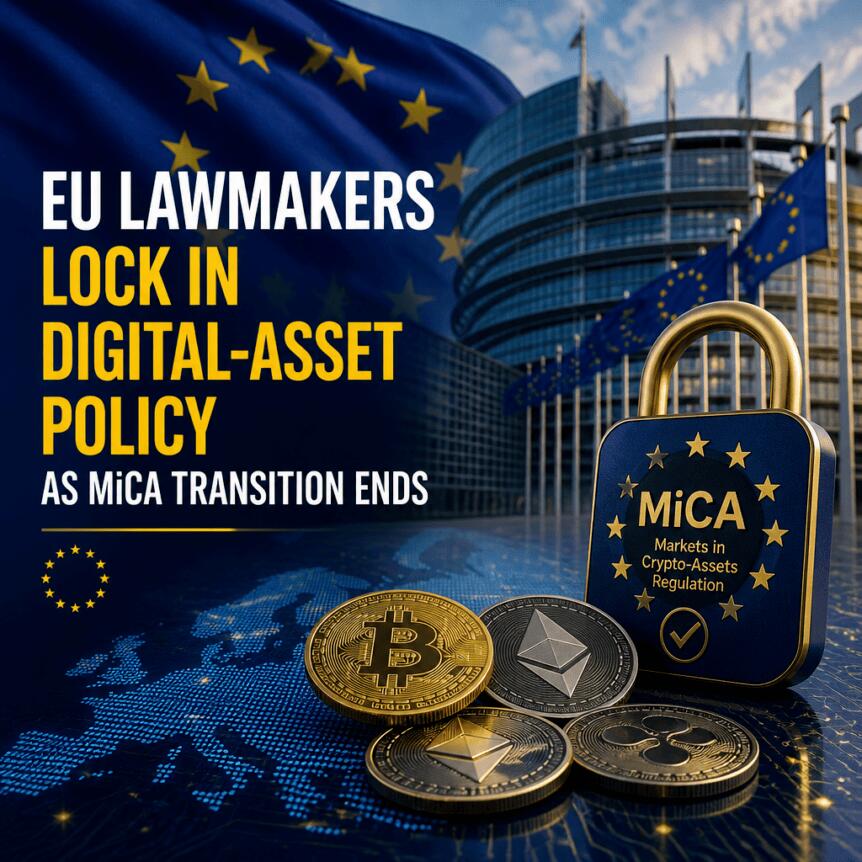
European Parliament lawmakers have adopted a formal policy position on digital assets, urging the European Commission to examine whether key areas of the crypto ecosystem should be brought more clearly within the EU’s regulatory framework following the rollout of the Markets in Crypto-Assets (MiCA) regime.
The Parliament’s stance, approved Tuesday in a vote on the report “Digital assets – challenges for the competitiveness and integrity of the European Union’s financial system,” does not itself amend MiCA or impose new direct legal duties on market participants. Instead, it signals the direction EU legislators want regulators and the Commission to consider as MiCA’s initial implementation period concludes.
Key takeaways
- Parliament calls for clearer regulatory coverage of activities such as DeFi, crypto lending and borrowing, staking, and NFTs, subject to an EU-wide review.
- Lawmakers stress the need for consistent MiCA application across member states to avoid fragmented rules for the digital asset market.
- The vote turns the report into the Parliament’s official policy position, without directly changing MiCA legislation.
- MiCA’s transitional period for covered providers ended on July 1, increasing the importance of how regulators treat activities outside the current framework.
Policy position after MiCA’s rollout
MiCA provides a licensing and conduct framework for crypto-asset service providers and issuers of certain token types. However, the Parliament report reflects an ongoing debate in Brussels about how the EU should approach parts of the sector that are not fully addressed under the current scope of MiCA.
In particular, lawmakers asked the European Commission to assess whether activities including decentralized finance (DeFi), crypto lending and borrowing, staking, and non-fungible tokens (NFTs) should be brought more explicitly into the EU’s regulatory perimeter. The report also raises the question of how tokenized financial assets fit within the broader regulatory architecture.
Beyond expanding the regulatory gaze, the paper warns against the emergence of national rules that could break the EU’s single market for digital assets into separate regimes. That point matters for companies operating cross-border: inconsistent interpretations across member states could complicate compliance planning and product rollout, even where MiCA is formally meant to harmonize rules.
DeFi, staking, lending and NFTs remain central questions
Although MiCA established baseline requirements for certain crypto actors, policymakers have continued to discuss how to regulate or classify decentralized and hybrid models—especially where services are offered through protocols rather than clearly identifiable intermediaries. The Parliament’s push to examine DeFi, staking, and crypto lending suggests lawmakers want a more structured approach to these activities as market participation grows.
The report also signals that NFTs and other tokenized forms of digital assets remain politically salient. While tokenized assets can span everything from collectibles to financial representations, the Parliament’s call for an assessment indicates that legislators want clarity on when existing rules adequately protect users and when regulatory gaps remain.
Commission review and the stability-stablecoin debate
The European Commission has already been exploring whether MiCA should be adapted. In May, the Commission opened a public consultation on potential changes to the framework, including whether additional crypto activities should fall within scope. The consultation also covered whether restrictions on interest-bearing stablecoins should be revisited.
By adopting Tuesday’s position paper, Parliament effectively adds legislative weight to that review. The report’s emphasis on expanding the regulatory perimeter where needed—and keeping implementation consistent—fits the broader narrative that MiCA is both a foundation and a starting point rather than a final endpoint.
Lawmakers also framed the discussion in terms of EU competitiveness. The Parliament’s report takes a more supportive tone toward tokenization and euro-denominated stablecoins, arguing that well-regulated digital assets could strengthen the competitiveness of EU financial markets if rules are applied consistently across the bloc.
What MiCA transition ending changes for compliance
One practical driver behind the timing is MiCA’s implementation timetable. According to Cointelegraph’s earlier coverage, MiCA’s transitional period ended on July 1, meaning crypto-asset service providers covered by MiCA can no longer rely on the transition to continue operations across the EU without authorization under the new licensing framework.
This matters in the policy debate because authorization processes and conduct rules already create immediate compliance obligations for covered providers. At the same time, activities that sit outside MiCA’s current scope—such as parts of the DeFi stack or certain token types—can become more controversial as regulated entities seek clarity and as market participants test the boundaries of existing rules.
Parliament’s warning about fragmented national approaches therefore lands with particular force as companies navigate both the MiCA licensing regime and unresolved questions about how the framework will treat broader categories of crypto activity.
Over the coming months, market participants should watch for how the European Commission responds to the consultation process and to Parliament’s newly adopted position—especially around whether DeFi, staking, lending, and NFTs move closer to MiCA’s regulatory perimeter, and how Brussels plans to maintain consistent application across member states as providers transition fully to the authorization model.
This article was originally published as EU Lawmakers Lock in Digital-Asset Policy as MiCA Transition Ends on Crypto Breaking News – your trusted source for crypto news, Bitcoin news, and blockchain updates.