EU MiCA Regulation News: EBA Pushes New Stablecoin and DeFi Rules The European Banking Authority (EBA) has published its formal response to the European Commission's targeted consultation on
EU MiCA Regulation News: EBA Pushes New Stablecoin and DeFi Rules
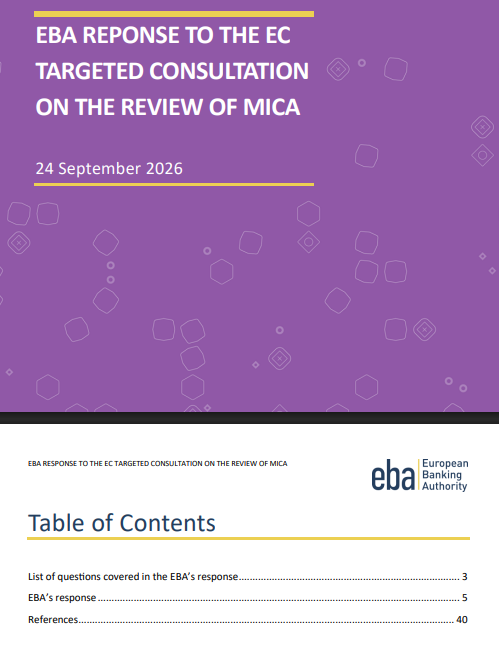
The European Banking Authority (EBA) has published its formal response to the European Commission's targeted consultation on reviewing the Markets in Crypto-Assets Regulation (MiCA).
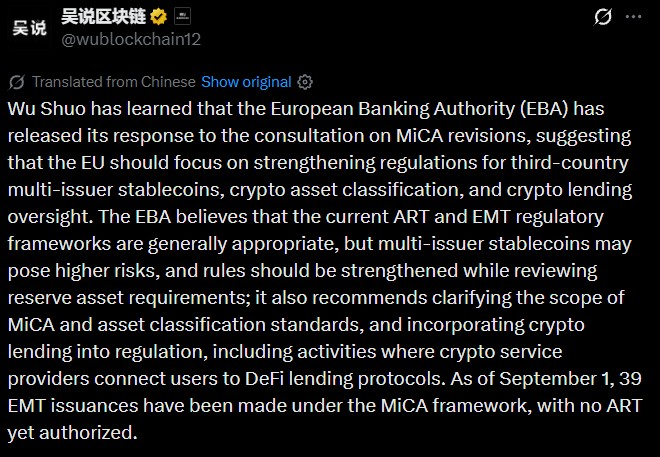
Released on September 24, 2026, the response outlines three priority areas the EU should address as it revisits its crypto framework: third-country multi-issuer stablecoin schemes, crypto-asset classification standards, and oversight of crypto lending activities, including certain services linked to decentralized finance (DeFi).
This EU MiCA Regulation News update matters because it signals where regulators may tighten rules next, even though nothing here changes existing law yet.
At a Glance
The EBA published its MiCA review consultation response on September 24, 2026.
Current rules for asset-referenced tokens (ARTs) and electronic money tokens (EMTs) are broadly appropriate.
Third-country multi-issuer stablecoin schemes may need stronger safeguards.
The EBA wants clearer definitions and classification standards under MiCA.
Crypto lending, including some DeFi-facilitation services, could fall under future regulation.
As of September 1, 2026, 39 EMTs had been issued and zero ARTs had been authorised.
EBA Calls for Stronger Rules for Multi-Issuer Stablecoins
According to the European Banking Authority, the existing requirements governing ART and EMT issuers under MiCA are generally sound and don't need an overhaul. The concern lies elsewhere: stablecoin schemes run by multiple issuers based outside the EU.
The authority views these third-country multi-issuer arrangements as carrying significant to very significant risk, largely because oversight becomes harder to coordinate across jurisdictions.
To address this, the EBA is recommending that the European Commission consider regulatory changes that specifically target these cross-border schemes.
Part of that review would involve revisiting reserve asset requirements, particularly how much of an issuer's reserves must be held as deposits, while still preserving sound risk management practices already built into MiCA.
 Source: EBA Europe
MiCA Crypto-Asset Classification Rules Need More Clarity
A recurring theme in the EBA's response is that classifying crypto-assets under MiCA remains genuinely difficult, both for firms and their supervisors.
When a token's category isn't clear, companies face delays and added costs before they can bring products to market, which works against innovation and weakens the EU's competitive position globally.
Much of this confusion stems from blurry boundaries between MiCA and other financial services laws, including the Markets in Financial Instruments Directive (MiFID) and the Capital Requirements Directive (CRD).
The EBA is urging the Commission to clarify MiCA's scope and definitions so that businesses and regulators are working from the same playbook.
EBA Wants Crypto Lending and Some DeFi Services Covered by MiCA
One of the most notable recommendations concerns crypto lending, an activity that currently sits outside MiCA's scope entirely. The EBA is asking the Commission to consider bringing crypto-asset lending under crypto regulation oversight, specifically including cases where crypto-asset service providers connect users to decentralized lending protocols.
It's worth being clear that this is a recommendation, not a rule change. Nothing currently regulates DeFi-linked lending activity. The EBA's rationale centers on consumer protection, arguing that as more people access lending through intermediaries that route funds into DeFi protocols, the risks to everyday users grow without a supervisory framework in place.
MiCA Stablecoin Market: 39 EMTs Issued, No ARTs Yet
Category
Status as of Sept.1, 2026
What It Covers
Electronic Money Tokens (EMTs)
39 issued
Crypto-assets referencing the value of one official currency
Asset-Referenced Tokens (ARTs)
0 authorised
Crypto-assets referencing other assets or asset combinations
These figures reflect the EBA's own reference date and aren't a live, real-time count. Still, the gap between EMT issuance and the complete absence of authorised ARTs suggests the market has gravitated toward simpler, single-currency-linked tokens so far.
 Source: Wu Blockchain
MiCA Review Timeline: From Implementation to EBA Recommendations
Date
Development
June 30, 2024
The requirements for ARTs and EMTs began applying
December 30, 2024
Regulation fully entered into application
September 1, 2026
EBA's reference date: 39 EMTs issued, 0 ARTs authorised
September 24, 2026
It has published its MiCA's review consultation response
September 25, 2026
Coverage of the EBA's recommendations circulated widely
EBA Also Seeks Better Reporting and Supervisory Oversight
Beyond stablecoins, classification, and lending, it is also pushing for a review of the reporting framework that applies to issuers and crypto-asset service providers.
Better reporting, the authority argues, would give supervisors sharper tools for monitoring risk as the market evolves. The response also briefly touches on related areas, including how multi-function crypto groups should be treated, interactions between MiCA and the PSD2/PSD3/R payment services rules, and the treatment of tokenised deposits.
Conclusion
The EBA's response gives the European Commission a clear set of priorities without dictating final outcomes. Multi-issuer stablecoins, asset classification, and crypto lending, particularly DeFi-linked lending, now sit at the center of the review conversation.
Whether or how these recommendations become binding rules will depend on the Commission's next steps, but the direction of travel suggests the EU's crypto framework is far from finished evolving.
Disclaimer: This article is for informational purposes only and does not constitute financial, legal, or investment advice. The recommendations are not enacted law and may change during the legislative process. Readers should consult official EU regulatory publications or a qualified professional before making financial, legal, or compliance decisions. Not financial advice. Cryptocurrency markets are volatile and carry risk; always do your own research.