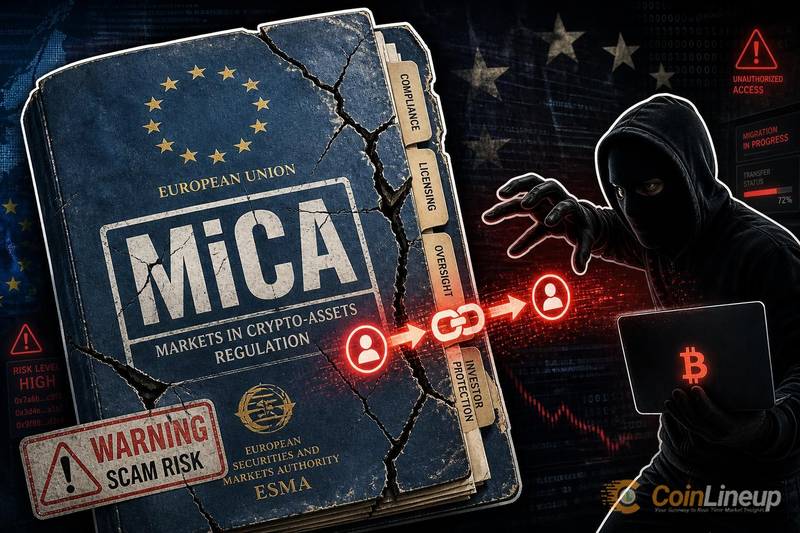
EU regulators are warning that scammers are exploiting MiCA account migrations, using the confusion around the bloc's crypto transition to impersonate exchanges and official bodies. The alert
EU regulators are warning that scammers are exploiting MiCA account migrations, using the confusion around the bloc's crypto transition to impersonate exchanges and official bodies. The alerts urge users to treat unexpected migration instructions as a fraud risk.
Why EU regulators are flagging MiCA migration scams
MiCA, the EU's Markets in Crypto-Assets Regulation, is the bloc-wide rulebook that sets licensing and conduct requirements for crypto-asset service providers. As firms move into compliance, many are migrating customers onto newly authorized entities, changing the accounts and communications users interact with. For related coverage, see Sono Group Q2: $4.11M in Bitcoin, $166K in Cash.
An account migration means a user's holdings, login, or service relationship is shifted to a different regulated entity or platform structure. Malta's financial regulator warned that this transition is being used as cover for crypto-related impersonation scams, in a notice on the MiCA transition. For related coverage, see Public Firm's BERA Treasury Drops From $70.2M to $16.4M, Raising Nasdaq Delisting Risk.
The European Securities and Markets Authority has flagged that transitional periods under MiCA are ending, in a statement on the end of those periods. Scammers exploit exactly these regulatory hand-offs, mimicking official notices and support outreach while users are unsure which messages are genuine. For related coverage, see Bitcoin slips as U.S. inflation misses, ETFs log August's first two-day drawdown.
How scammers may exploit migration notices and user confusion
Migration periods typically involve a surge of emails, in-app prompts, identity re-verification requests, and account action deadlines. That volume of legitimate messaging gives fraudsters cover to slip in phishing emails, fake login pages, and impersonated support messages. For related coverage, see Harvard Keeps BlackRock IBIT Stake Unchanged in Q2 Filing.
Reports point to a rise in crypto scams tied to the MiCA deadline in the EU, according to security reporting from Tangem. Scam messages often reference compliance deadlines or threaten service interruptions to pressure users into acting quickly.
Users should never share seed phrases, passwords, or one-time verification codes in response to a migration prompt. No legitimate exchange or regulator asks for those credentials, and any urgent request to move funds or click an "updated account" link should be treated as a red flag.
The risk is not hypothetical for European users, who have already seen third-party exposure in the region, such as when Israeli broker Bits of Gold investigated a customer data breach tied to an outside vendor.
Users need a reliable way to confirm whether migration instructions are real. The safest approach is to verify any update only through the platform's official app or website, typed in directly rather than reached through a link in an email or message.
Before acting on a migration request, check the platform's own announcements page for a matching notice. If an instruction cannot be confirmed through an official channel, users should assume it is fraudulent until proven otherwise.
On the platform side, the guidance points to centralizing announcements and avoiding mixed messaging, which reduces the ambiguity scammers depend on. Clear, consistent communication paired with anti-phishing reminders makes it harder for impersonators to blend in during the transition, a point reinforced by the European Securities and Markets Authority.
Disclaimer: This article is for informational purposes only and does not constitute financial or investment advice. Cryptocurrency and digital asset markets carry significant risk. Always do your own research before making decisions.
Read original article on coinlineup.com