TLDR BofA Securities dropped FICO’s rating from Buy to Neutral and cut the price target from $1,400 to $700. The Federal Housing Finance Agency eliminated VantageScore’s pricing disadvantage,
TLDR
- BofA Securities dropped FICO’s rating from Buy to Neutral and cut the price target from $1,400 to $700.
- The Federal Housing Finance Agency eliminated VantageScore’s pricing disadvantage, creating a level playing field with Classic FICO.
- Fair Isaac shares have plunged approximately 60% in 2026 and are hovering near 52-week lows.
- TransUnion’s commitment to $0.99 VantageScore pricing until 2028 intensifies competitive pressure.
- FICO maintains an 85% gross margin and 17.8 P/E ratio despite significant market value erosion.
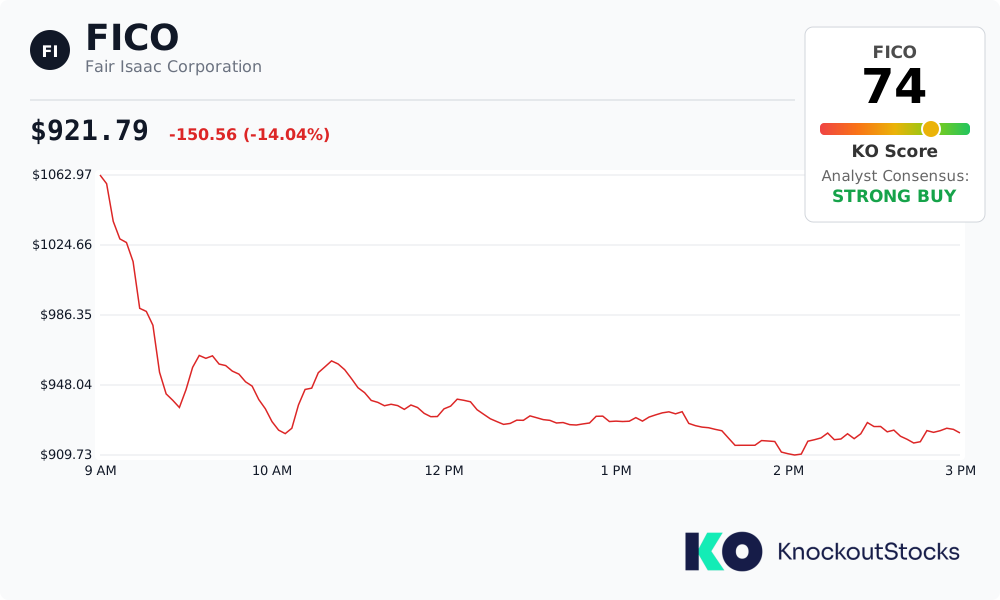
BofA Securities downgraded Fair Isaac (FICO) from Buy to Neutral this week, delivering a dramatic blow to investor confidence. The investment firm simultaneously reduced its price objective from $1,400 to just $700.
 Fair Isaac Corporation, FICO
The catalyst for this reassessment stems from significant regulatory changes affecting mortgage credit scoring. FHFA Director Bill Pulte revealed that government-sponsored enterprises Fannie Mae and Freddie Mac would implement a unified pricing structure for mortgages.
Under this new framework, VantageScore 4.0 receives identical pricing treatment as Classic FICO. The previous system had imposed a 20-point adjustment on VantageScore to account for its tendency to generate higher numerical scores than FICO’s model.
How Regulatory Shifts Impact FICO’s Business
Eliminating this differential carries substantial implications. The change effectively strips away a longstanding competitive advantage that FICO enjoyed in the mortgage scoring marketplace.
According to BofA analysts, the standardized pricing grid introduces uncertainty around FICO’s score volume projections, pricing authority, and ability to defend market position. The analysts also warned that intensified regulatory oversight may constrain the company’s flexibility to increase score prices.
Two strategic programs—FICO 10T and the Direct Lender Program—remain in regulatory limbo. Both initiatives had been viewed as promising avenues for future revenue expansion.
Market participants reacted immediately to the news. FICO shares plummeted 20% during premarket hours following the FHFA’s policy announcement.
TransUnion escalated competitive dynamics by announcing it would cap VantageScore 4.0 mortgage pricing at merely $0.99 per score until December 2028, providing lenders with predictable cost structures.
The combined effect produced one of FICO’s most dramatic trading sessions in recent history. While the stock has experienced 31 separate moves exceeding 5% over the previous twelve months, this decline was particularly severe.
Current Valuation Metrics
Fair Isaac currently changes hands around $654.71 per share. This represents a staggering 65% decline from its 52-week peak of $1,880, reached in October 2025.
Since the beginning of 2026, shares have surrendered approximately 60% of their value. The past seven trading days alone have witnessed nearly 30% erosion.
This marks the second major setback this month. Twenty-five days earlier, FICO dropped 15% when the FHFA initially granted VantageScore 4.0 approval for all lenders working with Fannie Mae and Freddie Mac.
However, certain fundamental metrics remain attractive. The company exhibits a price-to-earnings ratio of 17.8 and a PEG ratio of 0.48.
FICO’s gross profit margin stands at an impressive 85%. Several InvestingPro analysts identify the stock as potentially undervalued based on these fundamentals.
Not all Wall Street analysts have abandoned bullish positions. Jefferies retained its Buy recommendation with a $1,675 target, while Mizuho continues rating the stock Outperform with a $1,344 objective.
Raymond James similarly maintained its Outperform stance with a $1,750 target, though acknowledging continued headline risks. Barclays adjusted its target downward from $1,950 to $1,700 while preserving an Overweight rating.
Rocket Mortgage has embraced VantageScore 4.0 as its primary scoring model for qualifying mortgage applications. Shares of Equifax and TransUnion also experienced declines after the FHFA’s comprehensive VantageScore endorsement, though FICO’s losses have proven most severe.
Despite recent turbulence, long-term shareholders maintain gains. An investment of $1,000 in FICO stock five years ago would currently be valued at approximately $1,638, even accounting for this month’s significant losses.
The post Fair Isaac (FICO) Stock Plummets Following BofA Downgrade Amid Regulatory Headwinds appeared first on Blockonomi.