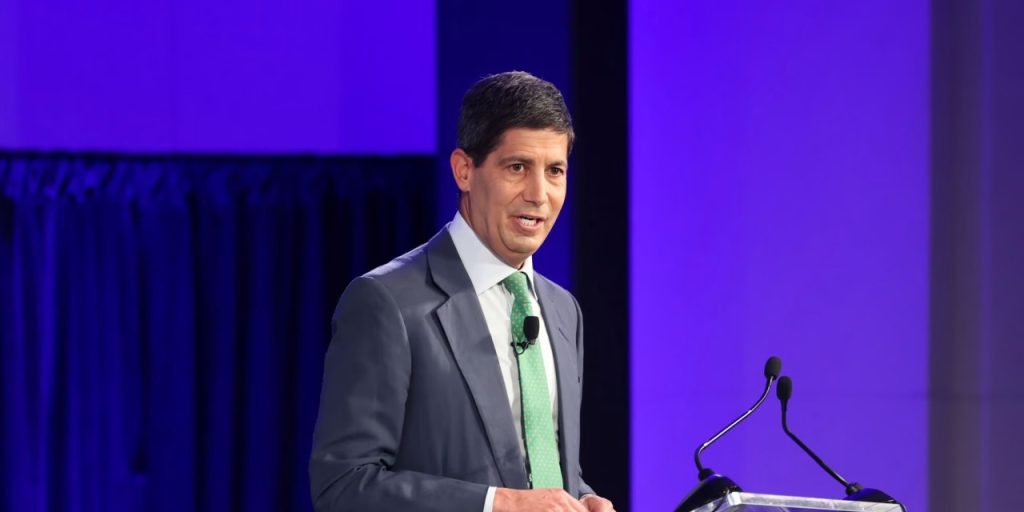
Federal Reserve Chairman Kevin Warsh stated that the Fed’s dual mandate of price stability and full employment is not contradictory, adding that controlling inflation would encourage employer
Federal Reserve Chairman Kevin Warsh stated that the Fed’s dual mandate of price stability and full employment is not contradictory, adding that controlling inflation would encourage employers to create new jobs.
During the session, Warsh, while commenting on the US economy, stated that economic activity remains strong and financial markets are generally functioning healthily. However, he noted a mixed picture in the housing market, adding that inflation remaining above the Fed’s target for an extended period is putting pressure on housing finance and affordability.
Warsh stated that the Fed could mitigate the effects of this problem by ensuring price stability, and added that the labor market was also showing “remarkable resilience.”
Warsh stated, “The two elements of the Fed’s dual mandate are not conflicting. The more successful we are in controlling inflation, the more willing employers will be to hire workers.”
Warsh emphasized that there is still work to be done regarding inflation, and reiterated the Fed’s commitment to its 2% inflation target and price stability. He stated that the central bank has the necessary policy tools to bring inflation back to the target.
Related News: Watch Out: Claims of Manipulation Regarding an Altcoin Are Circulating
No Forward Guidance on Interest Rates
It was noteworthy that Warsh’s remarks contained limited direct signals regarding interest rate policy. The Fed chairman maintained his approach of not providing forward guidance on the future course of interest rates.
Warsh said that the more the Fed focuses on its duties, the more it can stay away from political debates.
“The more we focus on our duties, the further we can stay away from politics,” Warsh said, adding that the Fed will continue to make its monetary policy decisions independently.
When asked how he would act if US President Donald Trump tried to interfere with Fed policy, Warsh stated that he would continue to fulfill his duties and insist on the independent determination of monetary policy.
Warsh stated that the Fed will review its current inflation framework in order to better understand the root causes of inflation and to evaluate policies that can be implemented to combat price pressures.
Warsh stated that the working groups formed for this purpose are still in the research and evaluation phase, and that the discussions will initially take place among the Fed’s 19 policymakers.
Warsh noted that the process would be conducted in an open and transparent manner, and that research findings and policy recommendations would be regularly shared with the public.
Warsh, also commenting on the Fed’s balance sheet policy, said that the central bank’s balance sheet is not only a part of financial market operations but also a direct part of monetary policy.
Warsh stated that his views on the Fed’s massive balance sheet were well-known, but he did not want to prejudge the decisions that the newly formed balance sheet working group would make.
Warsh emphasized that any changes to balance sheet policy would be communicated to the markets in advance.
“I guarantee that if there is a change in balance sheet policy, we will provide prior notification, announce decisions, and discuss them publicly. Both the Federal Open Market Committee and financial markets will have the necessary preparation time,” he said.
Warsh also stated that the Fed could seriously consider when to begin purchasing Treasury bonds. However, he emphasized that the central bank should avoid interfering in fiscal policy.
“We Don’t Want to Save Anyone, Including Crypto”
Warsh stated that the FED should not be involved in bailout operations, adding that this approach also applies to the cryptocurrency sector.
“We want to be in a position where we don’t have to bail out anyone, including those in the crypto sector,” Warsh said, conveying the message that the consequences of risks taken in the financial system should be borne by investors and market participants.
Warsh also stated that they were not concerned about economic growth supported by artificial intelligence and technological advancements.
“We are not afraid of growth driven by productivity increases,” Warsh said, pointing out that strong productivity gains can support economic growth and employment without creating inflation.
Market Expectations for Interest Rate Hikes Have Declined
Welch, an investment expert from SignatureFD, said that markets are pricing in a higher probability of the Fed raising interest rates than it actually is.
While weak consumer price index data for June reduced the likelihood of a near-term interest rate hike in futures markets, CME Group data indicated that the possibility of at least one rate hike by the end of the year has not been entirely ruled out.
Welch noted that despite fluctuations in fuel prices, inflation has generally been on a downward trend.
“We haven’t seen wage growth strong enough to support sustained, broad-based inflation across the entire economy,” Welch said, adding that Warsh, through his statements, was trying to keep long-term inflation expectations close to the Fed’s 2 percent target.
*This is not investment advice.
Continue Reading: Fed Chair Kevin Warsh Testified Before Congress—He Made Hot Comments, Including on Cryptocurrencies