The Federal Reserve Bank of San Francisco recently released a study paper that highlighted that China, among other foreign governments, has increasingly divested of its holdings in the U.S. T
The Federal Reserve Bank of San Francisco recently released a study paper that highlighted that China, among other foreign governments, has increasingly divested of its holdings in the U.S. Treasuries.
But there is a silver lining: stablecoin issuers have been buying more Treasury holdings, partly offsetting the drop in demand from foreign governments.
Related: China, Japan, UAE, India sell billions in U.S. Treasuries
On Sep. 28, the central bank released a paper titled "Stablecoin Issuers’ Growing Appetite for Treasury Securities."
The paper, authored by economists Sylvain Leduc, Luiz Edgard Oliveira, and Aleisha Sawyer, warned that the rising federal debt raises concern about the U.S. government being able to finance its debt at relatively low interest rates.
Over the past 20 years, the debt held by the public has increased from about 35% of GDP in 2006 to roughly 100% today in 20 years.
Who owns the debt is changing too.
A sign is posted in front of the Federal Reserve Bank of San Francisco on March 16, 2023 in San Francisco, California.
Getty Images
China trims U.S. Treasury holdings
Both the domestic and the foreign demand for U.S. debt has risen over the past 20 years.
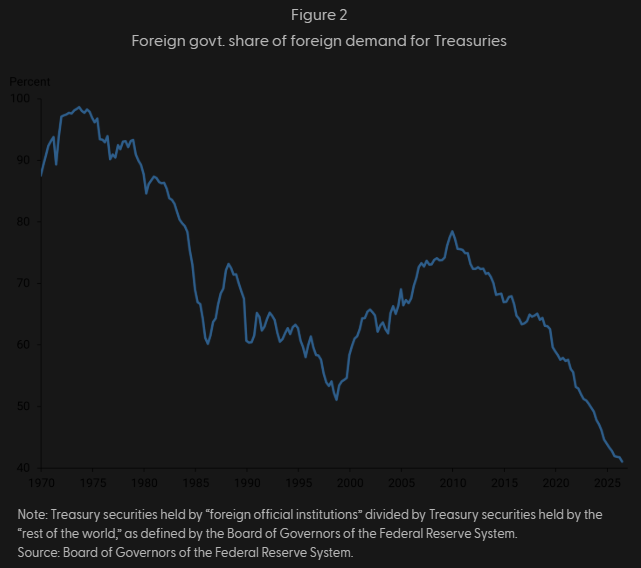
But during the same period, the share of Treasury securities held by foreign governments has fallen substantially from the peak of nearly 100% around the 1970s to 40% in early 2026.
In fact, the Chinese government has been trimming its Treasury holdings since the late 2000s, the paper highlighted. The Asian superpower wants to diversify its portfolio across a broader range of global assets.
Popular on TheStreet Roundtable:
As China sells U.S. debt, stablecoin issuers are picking up some of the slack
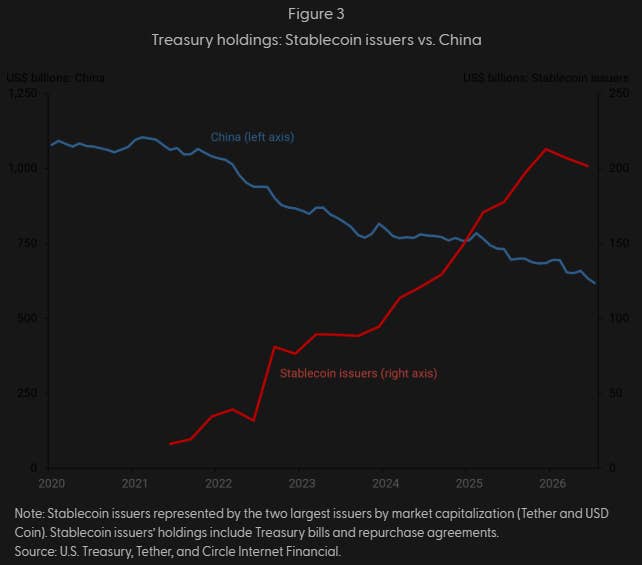
In contrast, stablecoin issuers are increasing their Treasury holdings, the paper said.
A stablecoin attempts to keep its value stable by being pegged to a so-called stable asset like the U.S. dollar. In fact, the value of one stablecoin is the same as that of one dollar.
This is why the U.S. dollar-pegged stablecoins like Tether's USDT and Circle Internet Group's (NYSE: CRCL) USDC are also called "digital dollars."
These issuers back their stablecoins with U.S. liquid assets. They mostly hold short-term U.S. Treasuries, in addition to cash, bank deposits, and repurchase agreements.
Tether and Circle's holdings of Treasury securities have grown more than tenfold over the past five years, even surpassing the growth in Treasury holdings of foreign governments.
The demand for U.S. debt from stablecoin issuers could double to roughly $400 billion by the end of 2030, the paper predicted.
The paper also argued that "increasing appetite" for U.S. Treasuries among stablecoin issuers may "partially offset" the falling demand from China.
Stablecoin issuers have increased their Treasury security holdings by about $200 billion over the past five years. That's more than 40% of what China cut over the same period.
But there is a catch.
The decline in China’s holdings is mostly in the form of longer-term U.S. debt. But stablecoin issuers are increasing their holdings of short-term debt, the paper cautioned.
Related: Major consulting firm issues $230 billion warning to banks