Federal Reserve Governor Lisa Cook said she is ready to support higher interest rates if inflation does not keep falling, emphasizing that the balance of risks still skews toward the inflatio
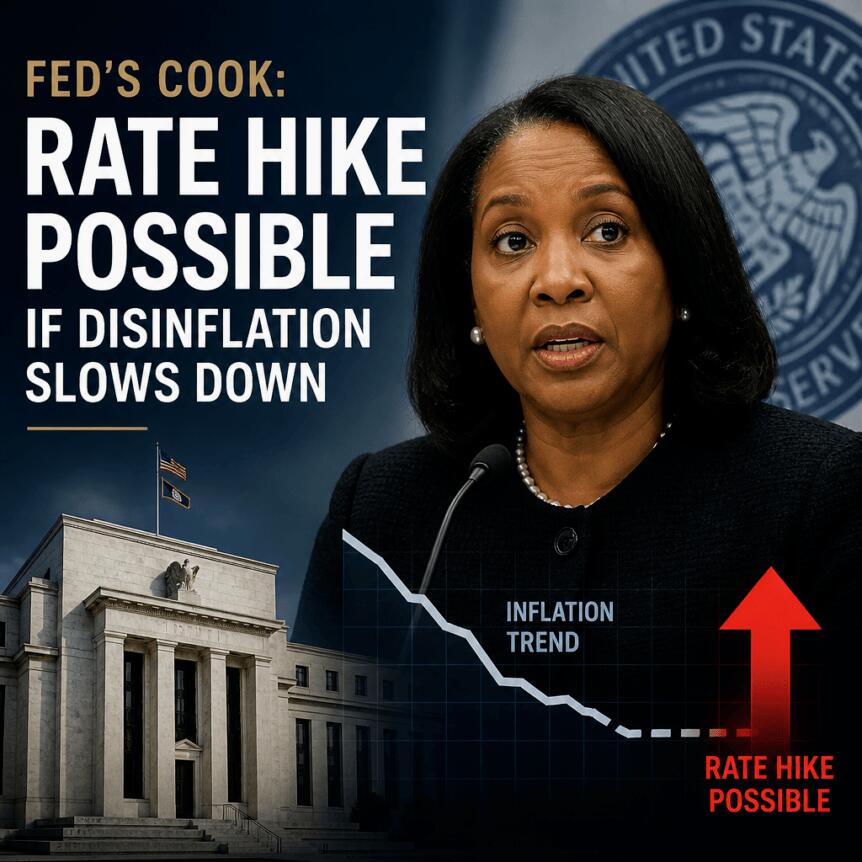
Federal Reserve Governor Lisa Cook said she is ready to support higher interest rates if inflation does not keep falling, emphasizing that the balance of risks still skews toward the inflation side of the Fed’s dual mandate. Her remarks come amid uneven disinflation signals, a backdrop that can weigh on crypto and other “high-risk” assets that tend to be sensitive to shifts in rate expectations.
Speaking at a luncheon hosted by the Anchorage Economic Development Corporation, Cook noted that some disinflationary forces are present, but she stressed that she would act if progress stalls. “As such, I am prepared to act by raising rates, if necessary,” she said, adding that she considers the risks to inflation higher than the risks to employment at this point.
Key takeaways
- Fed Governor Lisa Cook said she could back additional rate increases if disinflation slows or reverses.
- She highlighted concerns about inflation becoming entrenched in price- and wage-setting behavior if above-target levels persist.
- Cook cautioned against overreacting to a single inflation reading in a highly uncertain data environment.
- While inflation has eased recently, she pointed to the PCE measure remaining far above the Fed’s 2% long-run target.
Cook signals conditional support for higher rates
Cook’s core message was conditional: she expects some disinflationary momentum, but she is prepared to respond if it fails to continue. Her remarks were framed around the Fed’s commitment to driving inflation back toward the long-run 2% goal while monitoring labor market conditions.
Inflation, Cook said, is still “too high,” and she described the risk outlook as tilted toward inflation rather than employment. That framing matters for markets because it suggests policy may stay restrictive until inflation progress is clearly sustained—an environment that typically pressures speculative or duration-sensitive segments of the market, including parts of crypto.
Recent inflation prints, but Cook warns against overconfidence
Cook acknowledged that disinflationary forces are in play, but she urged investors not to assume a trend is secure based on one month’s data. Trading Economics reports the annualized inflation rate fell to 3.5% in June 2026, marking the first decline in five months. That improvement, however, did not translate into a “mission accomplished” signal from the Fed governor.
Instead, Cook pointed to the personal consumption expenditures (PCE) price index, noting that it rose 3.7% over the 12 months through June—nearly double the 2% target. She characterized this gap as evidence that inflation persistence remains a real risk even if some headline figures improve.
“If I do not see signs of continued disinflation soon, I am prepared to act,” Cook said, underscoring that the Fed’s reaction function is tied to the trajectory of inflation rather than any isolated print.
The persistence risk: why above-target inflation matters
A major theme in Cook’s speech was the danger that prolonged above-target inflation could alter how firms and households set prices and wages. She warned that five years of above-target inflation increases the likelihood that higher inflation becomes embedded in routine economic behavior, which would make it more difficult to bring down later.
“With five years of above-target inflation, the risk grows that higher inflation may become entrenched in price- and wage-setting behavior, leading to persistence that would be much harder for us to attack,” Cook said. “The longer inflation is above target, the more likely this scenario becomes.”
This kind of messaging tends to matter beyond near-term rate decisions because it signals the Fed is thinking in terms of medium-term inflation psychology—an area where policy delays can raise the eventual cost of returning to target. For crypto traders and investors, that translates into the practical question: how quickly does inflation need to show sustained improvement to reduce the probability of further tightening?
What investors should watch next
Cook’s remarks highlight that the Fed is likely to remain responsive to the pace of disinflation, not just occasional improvements in headline inflation. Readers should focus on upcoming inflation data—especially measures aligned with the PCE trend referenced by Cook—and on whether new readings reinforce continued progress toward the Fed’s 2% goal or increase the risk that inflation persistence becomes harder to reverse.
This article was originally published as Fed’s Cook: Rate Hike Possible If Disinflation Slows Down on Crypto Breaking News – your trusted source for crypto news, Bitcoin news, and blockchain updates.