This month, the Federal Reserve Bank of Cleveland released a working paper on the behavior of American investors and revealed some astonishing findings. On July 14, the central bank's Clevela
This month, the Federal Reserve Bank of Cleveland released a working paper on the behavior of American investors and revealed some astonishing findings.
On July 14, the central bank's Cleveland headquarters released a paper written by Bernardo Candia, Michael Weber, Olivier Coibion, and Yuriy Gorodnichenko in which they studied the crypto investment decisions and motives of U.S. households relative to households investing in other financial assets.
Related: Exclusive: Billionaire Mark Cuban pours cold water on Bitcoin's comeback
Candia is a research economist in the Research Department at the Federal Reserve Bank of Cleveland. Weber is a finance professor at Purdue University and ESMT Berlin.
Coibion is an economics professor at the University of Texas at Austin and is affiliated with the National Bureau of Economic Research (NBER). Gorodnichenko is also an economics professor at the University of California, Berkeley, and is similarly affiliated with the NBER.
Holders' behavior shows crypto is a unique asset,
The paper, titled "Do You Even Crypto, Bro? Cryptocurrencies in Household Finance," argues that cryptocurrency is a unique financial asset as per the study based on repeated large-scale surveys of approximately 25,000 U.S. households.
In the introduction, the paper mentions both Elon Musk's embrace of Bitcoin, “I am late to the party but I am a supporter of Bitcoin" and Warren Buffett's rejection, “Bitcoin was probably rat poison squared.”
The point is that the leading cryptocurrency is highly polarizing but those investing in the asset have a unique mindset.
Positive returns on crypto investments attract new participants, which in turn raises the price further, the paper revealed.
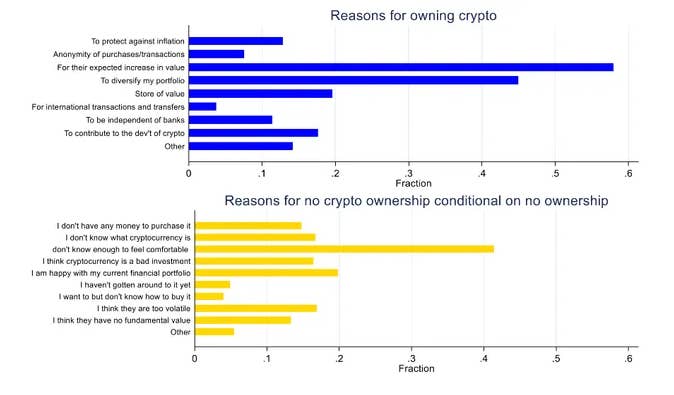
Crypto investors tend to find it less risky than those who don't invest in it. In addition, crypto holders expected an average return of 22% over the following year, compared with just 7% among non-owners.
Among crypto investors, expectations about returns and risk reveal more variation than observable demographic factors such as age, income, and gender.
In contrast, demographic factors are far more crucial to reveal the patterns of those investing in traditional assets like stocks and bonds, the study found.
"Do You Even Crypto, Bro? Cryptocurrencies in Household Finance," Source: Federal Reserve Bank of Cleveland
However, it doesn't mean that the demographic profile of crypto investors doesn't matter at all.
Crypto holders tend to be young, male, and more libertarian relative to non-crypto holders. Men are about 4% points more likely than women to own crypto.
Those under 40 were 13% points more likely to own crypto than those over 60. Wealthier households are most likely to own crypto than modest households.
Trending on TheStreet Roundtable:
What a random experiment revealed about crypto investors
The paper also uses a random information experiment to demonstrate that if people are given information about Bitcoin’s recent performance, it can increase both their expected crypto allocation and their future purchases.
For instance, researchers randomly sent information about Bitcoin, stocks, GameStop, or inflation to households in 2025. Those who received details about Bitcoin's 12-month return raised their desired crypto portfolio allocation by roughly 2 percentage points. Real crypto purchases in the future also rose by about 2.5 percentage points.
So, some households got tempted to buy crypto after accessing the information related to returns. However, those already holding a negative view of cryptocurrency didn't have any positive response.
The researchers conclude that crypto investors form very different views about its prospects, and fresh information about its past returns can change both their expectations and behavior.
"Price volatility will continue to be one of the most defining characteristics of this new asset for the foreseeable future.”
The total crypto market cap rose nearly 13% in the last seven days to $2.42 trillion at the time of writing.
Related: Billionaire Ray Dalio recommends portfolio rebalancing to beat economic crisis