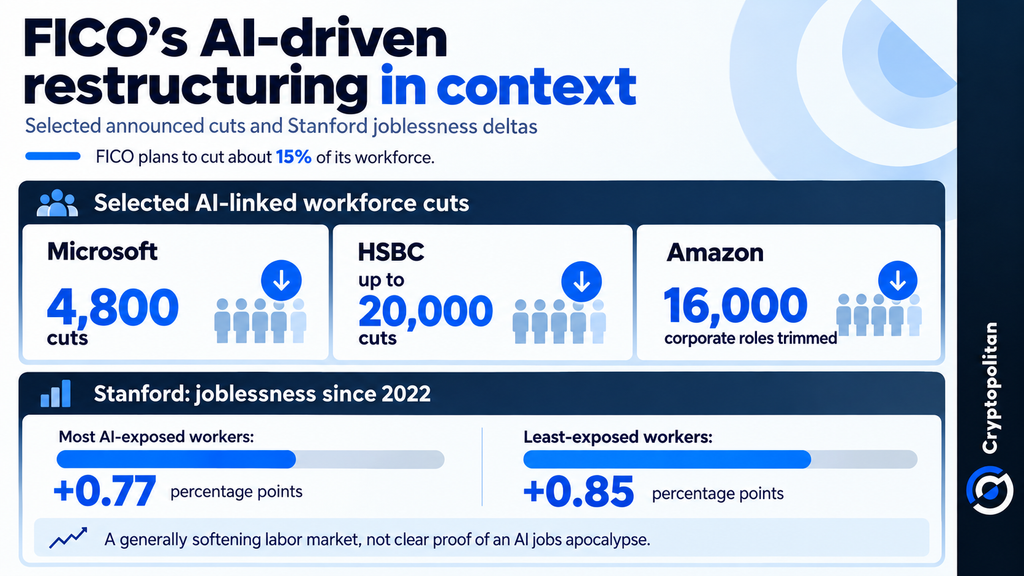
Fair Isaac, the credit-scoring firm behind FICO, is reducing its workforce by almost 15% as part of a bigger restructuring focused on AI. The move could affect roughly 570 employees. FICO tol
Fair Isaac, the credit-scoring firm behind FICO, is reducing its workforce by almost 15% as part of a bigger restructuring focused on AI. The move could affect roughly 570 employees. FICO told Reuters the changes should help it “operate and bring innovations to market faster.”
The moment is remarkable. Corporations are investing a lot in AI technology but at the same time we cannot observe any signs that it causes mass displacement in the labor market.
What FICO is cutting and why its shares are under pressure
The number of employees of FICO amounted to 3,811 at the end of September 2025. It projects approximately $27 million in pre-tax restructuring charges in the fourth quarter of financial year 2026, mostly for severance. The company aims to complete the program by Q3 of financial year 2027. According to Reuters, FICO’s stock has dropped by approximately 58% this year.
Part of the stress is also due to the modifications in the process of determining mortgage credit scores. The Federal Housing Finance Agency has recently permitted lenders to employ the VantageScore in addition to FICO when issuing mortgage loans to customers who wish to sell their mortgages to Fannie Mae or Freddie Mac. Thus, FICO will now face tougher competition in a segment where it has always been the leader.
A corporate trend increasingly called “restructuring”
FICO is not the only company to do so. Several companies in technology, banking, and other industries are laying off, while making investments in automation and AI.
Reuters reveals that the trend is growing among major employers, and Programs.com estimates that over 170,000 positions are affected by layoffs connected to AI by the end of 2026. The numbers are striking but do not state how many positions were eliminated due to the implementation of AI.
An analysis from Nexford finds that more firms are classifying job cuts related to artificial intelligence as part of broader “restructuring” plans. FICO is no exception to this trend. The company stated its “simplified structure” would enable it to “operate and bring innovations to market faster,” while generating higher value for its customers.”
However, this kind of wording blurs the picture. This makes it difficult to ascertain which portion of the cuts can be attributed to the implementation of automation technologies and which can be attributed to standard cost-reduction measures.
FICO AI restructuring: How its job cuts compare with Microsoft, HSBC and Amazon
The case that AI is finally paying off
There is also a stronger business case for keeping the spending going.
Boston Consulting Group found that nearly half of the companies it surveyed are now generating measurable value from AI.
At the same time, Gartner expects worldwide AI spending to reach about $2.7 trillion in 2026, up 49.5% from last year, with infrastructure taking the biggest share.
Why the layoffs still don’t prove an “AI jobs apocalypse”
The contradiction is that highly visible corporate cuts have not yet translated into clear evidence of mass AI-driven unemployment.
Stanford research points to a generally weaker labor market, but not one where AI clearly stands out as the main cause. The pressure appears more concentrated among younger workers and entry-level roles.
Economists Alex Imas and Jacob Schaal reach a similar conclusion. AI may already be weighing on junior hiring, but broader disruption has yet to appear clearly in the data.
Cryptopolitan previously reported on economists pushing back against Silicon Valley’s more dramatic job-loss forecasts.
FICO’s restructuring matters. But for now, it is still one piece of a much bigger debate over whether AI is eliminating jobs or simply changing where companies spend and hire.
Don’t just read crypto news. Understand it. Subscribe to our newsletter. It's free.
