Key Takeaways Second-quarter revenue reached an all-time high of $117.7 million, representing a 659% increase compared to the same period last year The company’s adjusted loss per share of 42
Key Takeaways
- Second-quarter revenue reached an all-time high of $117.7 million, representing a 659% increase compared to the same period last year
- The company’s adjusted loss per share of 42 cents surpassed Wall Street forecasts
- Contracted backlog surged to a new peak of $1.5 billion, rising from $1.3 billion in the previous quarter
- Firefly secured two additional lunar missions and won a contract for NASA’s $13 million Mars SkyFall project
- Management maintained its full-year 2026 revenue forecast of $420 million to $450 million
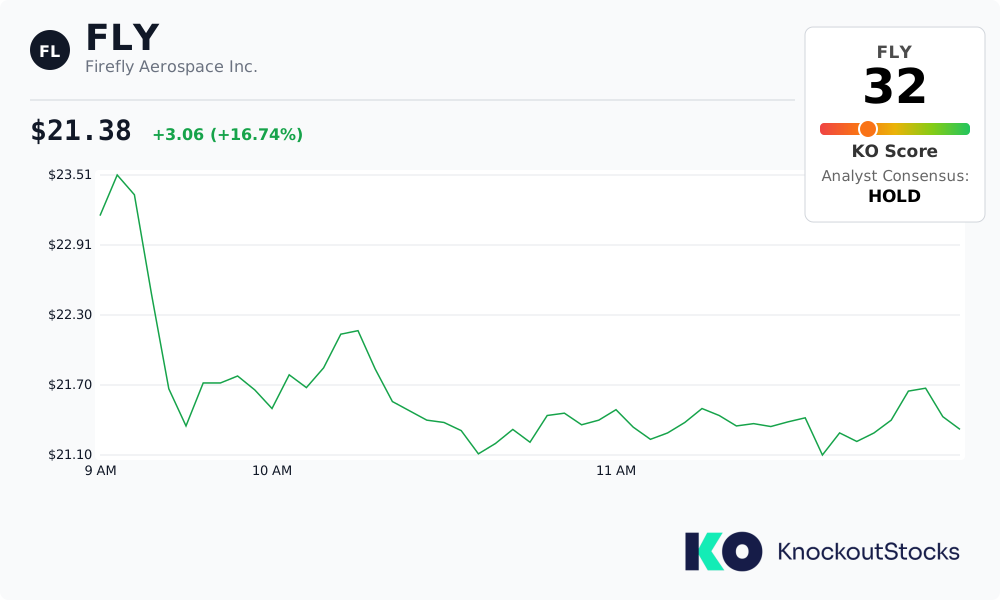
Shares of Firefly Aerospace (FLY) climbed 4.17% during pre-market hours Wednesday following the release of exceptional second-quarter financial results. The stock finished Tuesday’s session at $26.36, gaining 2.33%, and has advanced approximately 11% since the start of the year.
 Firefly Aerospace Inc., FLY
The company achieved quarterly revenue of $117.7 million, crossing the $100 million threshold for the first time in its history. This performance reflects a massive 659% increase from the year-ago period and a sequential gain of 45.5% compared to the first quarter of 2026.
The spacecraft segment generated the lion’s share of sales at $108.3 million, with launch services adding another $9.4 million. The company’s gross margin registered at 20.3%, down modestly from the previous quarter’s 21.6%.
Firefly reported an adjusted loss of 42 cents per share, outperforming consensus analyst projections. Under generally accepted accounting principles, the net loss totaled $92.3 million, representing an improvement from the first quarter’s $96.7 million deficit.
The company’s total backlog climbed to an unprecedented $1.5 billion, expanding from $1.3 billion in the prior three-month period. This robust pipeline provides substantial visibility into future revenue streams as the year progresses.
Major Contract Announcements
Chief Executive Jason Kim highlighted that the quarter included more than half a dozen contract awards spanning rocket systems, spacecraft platforms, and software solutions.
Notable wins included two supplementary NASA lunar exploration missions, a $75 million MoonFall subcontract agreement, and a $94 million GBARD contract with the U.S. Space Force.
The company also earned a spot on NASA’s SkyFall initiative, a Mars exploration program valued at $13 million. Firefly will handle the manufacturing, testing, and delivery of the aeroshell—the critical heat shield component used during planetary entry. The spacecraft is slated for launch in late 2028.
Lockheed Martin expanded its multi-launch partnership with Firefly, extending the agreement through 2031, while most of the 2027 Alpha rocket launch schedule has already been booked.
Financial Metrics and Future Guidance
The company recorded negative free cash flow of $106.3 million during the second quarter, compared to $78.9 million in Q1. Management noted that the final payment related to the SciTec acquisition contributed to the increase.
Capital spending expanded to $24.8 million from $16.3 million in the preceding quarter. The company maintains total liquidity of $940.3 million, with $635.3 million held in cash and short-term investment securities.
The Alpha launch schedule for 2026 has been adjusted to three missions, with the eighth flight now targeted for the fourth quarter.
Development of the Eclipse next-generation launch vehicle remains on track. The Miranda engine system has successfully completed over 150 hot-fire test sequences and passed a comprehensive flight-like mission duty-cycle evaluation.
During the quarter, Firefly completed its acquisition of Space-ng, incorporating advanced AI-driven vision navigation and autonomous guidance technology into its portfolio.
The company reaffirmed its full-year 2026 revenue outlook in the range of $420 million to $450 million.
The post Firefly Aerospace (FLY) Shares Surge 4% After Record-Breaking Q2 Results and NASA Contract Wins appeared first on Blockonomi.

 Revenue: $117.7M (Est. $88.2M)
  ; +659% YoY