Pope Leo XIV is the first American to lead the Roman Catholic Church in its 2,000-year history. Born Robert Prevost in Chicago in 1955, he spent two decades as a missionary and bishop in Peru
Pope Leo XIV is the first American to lead the Roman Catholic Church in its 2,000-year history.
Born Robert Prevost in Chicago in 1955, he spent two decades as a missionary and bishop in Peru before his election in May 2025. And since taking the chair of St. Peter, he has made one subject his signature more than any other: the technology coming out of his home country.
Catholic steward has two-word blunt response to Trump’s tariffs (2:02)
Artificial intelligence, the first American pope keeps telling the world, is a threat the Church cannot ignore.
His latest shot came Oct. 2, aimed at AI-generated art.
Related: 95-year-old luxury carmaker shuts down iconic project
'Algorithms lack the spark of humanity'
"Algorithms lack the spark of humanity," the pontiff wrote. "It is becoming urgent to distinguish human art from what machines produce."
Pope's argument is that art generated by AI is built from statistical patterns extracted from millions of images other people created. In his view, that strips away the thing that makes art art.
AI tools now generate paintings, compose music and draft books from a one-line text prompt, and they're flooding into exactly the creative fields the Church spent centuries funding.
A UNESCO monitoring report covering more than 120 countries projects that AI-generated content will cut music creators' revenues by 24% and audiovisual workers' incomes by 21% by 2028. A global economic study commissioned by CISAC, the body representing 5 million creators worldwide, puts the cumulative loss at 22 billion euros over five years, while the market for AI-generated music and video balloons from about 3 billion euros to 64 billion euros in 2028.
Popular on TheStreet Roundtable:
Who exactly is Pope Leo XIV?
For readers meeting him for the first time:
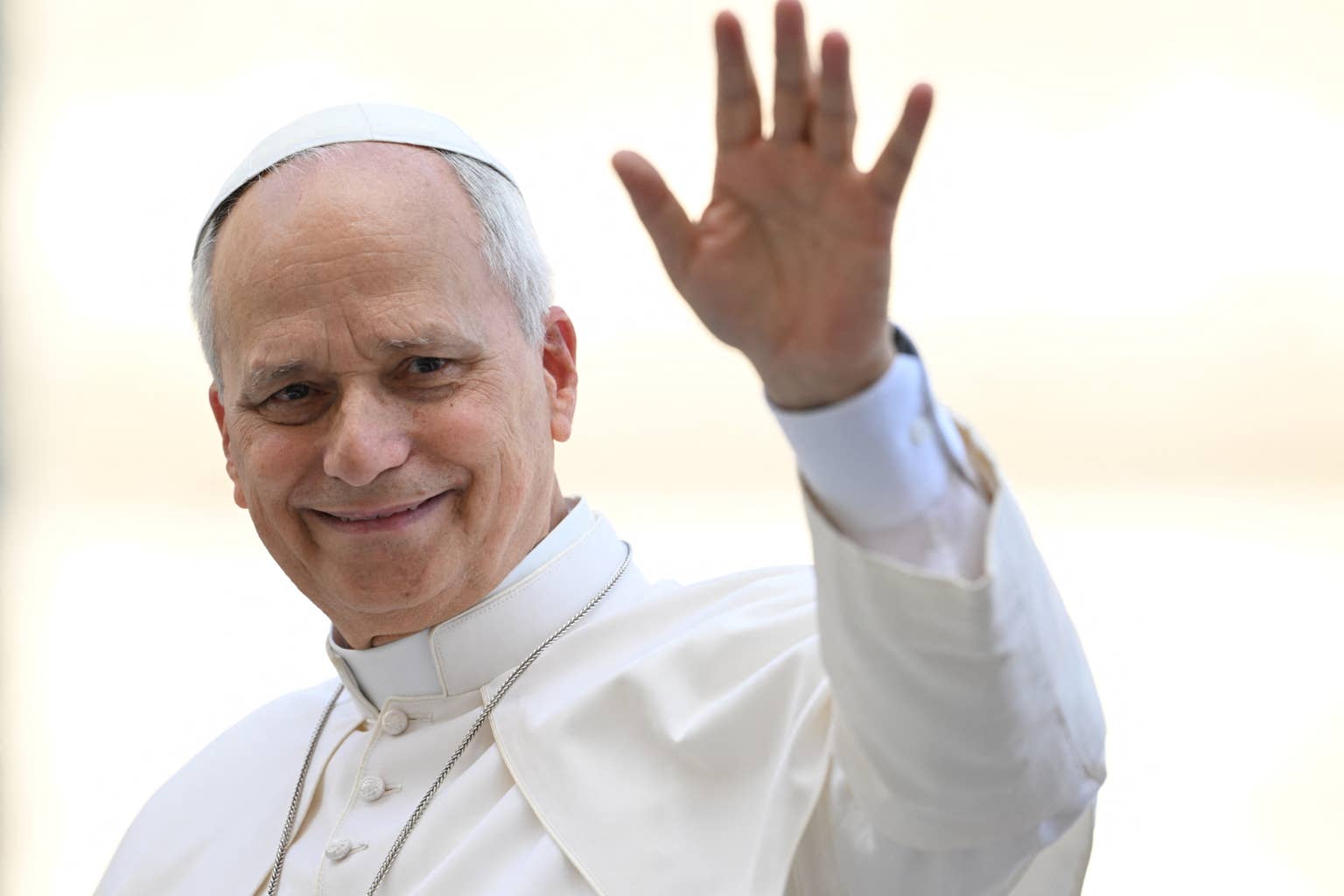
Pope Leo XIV waves as he leaves at the end of the weekly general audience at St Peter's Square in The Vatican on September 30, 2026.
• Born in Chicago, 1955. Robert Francis Prevost grew up on the city's South Side, the son of a school superintendent and a librarian.
• A math guy, unusually for a pope. He earned a degree in mathematics at Villanova University before entering the Augustinian order — making him arguably the most scientifically trained pope in modern history, now opining on algorithms.
• Two decades in Peru. He spent much of his career as a missionary and later bishop of Chiclayo, and holds Peruvian citizenship alongside his American passport.
• Elected May 2025, after the death of Pope Francis — the first U.S.-born pontiff in the Church's 2,000-year history.
• The name is a mission statement. He chose "Leo" after Leo XIII, the pope who confronted the first industrial revolution and defended workers against the machines of the 1890s. Leo XIV has cast AI as the new industrial revolution, and himself as the sequel.
This has been his theme from day one
The Oct. 2 warning wasn't a one-off. It's the thread running through his whole papacy.
In May, Leo issued his first encyclical, the most authoritative document a pope writes, called Magnifica Humanitas, or "Magnificent Humanity." Its focus was protecting human dignity, labor and agency in the age of AI.
A new pope gets one first encyclical to tell the world what his papacy is about. The first American pope spent his on artificial intelligence.
His predecessor saw this coming too
Leo isn't the first pope to square up to the tech industry. Pope Francis spent his final years increasingly focused on it:
• The Rome Call for AI Ethics (2020). The Vatican got Microsoft and IBM to sign a pledge for transparent, accountable AI — the Church's first formal move into AI governance, years before ChatGPT.
• First pope at the G7 (2024). Francis addressed world leaders specifically on AI, warning that humanity would be "condemned to a future without hope" if people lost the ability to make decisions for themselves, and calling for a ban on autonomous weapons.
• He knew deepfakes personally. The 2023 AI-generated image of Francis in a white puffer jacket fooled millions — making him one of the first global figures turned into viral AI misinformation. He later warned against the "perverse" dangers of fabricated media.
Francis set the Church's AI agenda. Leo turned it into the centerpiece of a papacy.
The Valley keeps coming to Rome
In May, Anthropic co-founder Christopher Olah met with Vatican leadership to discuss ethical guardrails for AI systems, the tech side asking the Church's help in giving machines a human-centered moral framework.
Not everyone thinks the Pope is reading the moment right.
In a UNESCO blog post, professor Ahmed Elgammal argued that:
"the advent of photography was similarly perceived as a threat to artistic expression in the 19th century. Yet it spurred new movements and gained recognition as an art form itself. In a similar fashion, AI could usher in a new creative era."
Editor's take
The Pope's call to "distinguish human art from what machines produce" is, stripped of the theology, the same demand regulators are writing into law.
"The EU's AI Act requires AI-generated content to be labeled. U.S. lawmakers have floated similar disclosure rules. Watermarking standards are being negotiated across the industry. Leo is arguing for the moral version of a policy that governments are already building the technical version of,"
Mehab Qureshi, TheStreet, Senior Editor.
Related: Fed finds a silver lining as China sells U.S. Treasuries