FlightAware, the aviation data company behind real-time flight tracking and status updates, has sued Kalshi in New York federal court over Kalshi’s use of FlightAware’s “data and name” to pow
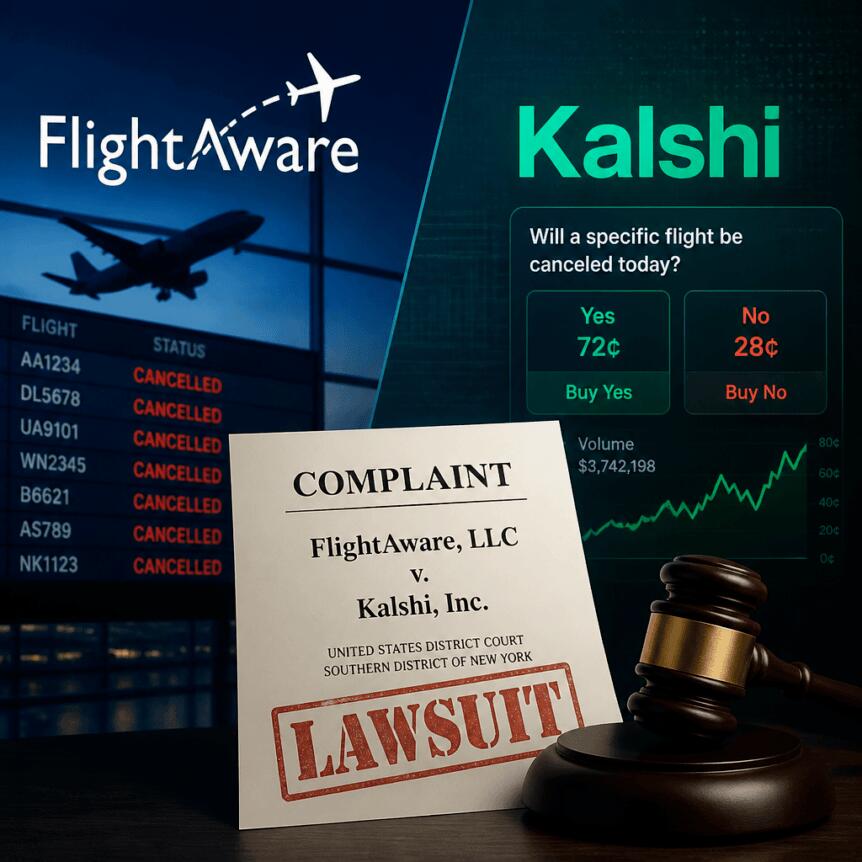
FlightAware, the aviation data company behind real-time flight tracking and status updates, has sued Kalshi in New York federal court over Kalshi’s use of FlightAware’s “data and name” to power prediction market contracts tied to flight cancellations. The complaint, filed in the US District Court for the Southern District of New York on Monday, accuses Kalshi of continuing to list event contracts using FlightAware’s registered trademark and purportedly “verified” flight-cancellation information despite repeated demands to stop.
The lawsuit adds a reputational and safety dimension to the broader legal battle already surrounding prediction markets in the US. FlightAware argues that wagering tied to flight disruptions could create incentives for manipulation and even interfere with air travel, while also positioning FlightAware as being involved in alleged “illicit” activity through unauthorized branding and data use.
Key takeaways
- FlightAware sued Kalshi in New York federal court, alleging continued use of FlightAware’s trademark and flight-cancellation data in prediction market contracts.
- The complaint frames flight events as safety-relevant, arguing wagers could incentivize participants to interfere with cancellations or pressure aviation workers to cut corners.
- Regulatory pressure on prediction markets is escalating, with states and federal regulators already contesting whether event contracts function as illegal gambling.
- FlightAware says customers may assume involvement due to the way Kalshi presents “verified by FlightAware” information and FlightAware branding.
Trademark and data-use claims put FlightAware at the center
According to the Monday filing in the Southern District of New York, FlightAware contends that Kalshi kept publishing event contracts related to flight cancellations even after FlightAware demanded Kalshi stop using its registered trademark. FlightAware also claims Kalshi continued to advertise those markets as being “verified by FlightAware’s data,” effectively tying FlightAware’s brand and information to the trading activity.
FlightAware’s lawsuit asserts multiple legal theories, including trademark infringement, breach of contract, harm to its reputation, and unfair competition. The company characterizes the expansion of Kalshi’s trading into commercial flight operations—reported as starting in July—as amplifying the reputational stakes of unauthorized association.
“[T]here was widespread outrage and concern that the markets would incentivize unsafe tactics to impact cancellations, threatening public safety and creating the potential for massive disruption of air travel. Airlines condemned the markets,” said the lawsuit. “And due to Kalshi’s unauthorized use of FlightAware’s data and mark, customers immediately assumed that FlightAware was involved in the scheme.”
The complaint describes FlightAware’s requested remedy as preventing “harm to public safety” before any alleged damage grows—an argument that goes beyond branding disputes and into how flight-event markets might influence behavior.
Why flight-cancellation markets are central to the safety argument
While the lawsuit is anchored in trademark infringement and related business claims, it also makes a broader case that some prediction market structures can distort incentives—especially when participants may have information before it becomes public.
FlightAware’s filing points to concerns about manipulation in event contracts generally—particularly cases where traders might know more than the public until an event is formally disclosed. The filing references public reporting that has highlighted unusual betting activity in other contexts, including claims tied to political speech wording and allegations involving alleged nonpublic information.
On flight disruptions specifically, FlightAware argues Kalshi’s model risks creating incentives to affect outcomes that are operationally complex and safety-sensitive. In its complaint, FlightAware contends that:
“A market that allows the public to wager on whether flights will be delayed or cancelled creates an incentive for participants to interfere with air travel—including by causing or contributing to flight cancellations—to profit from their wagers.“
“Worse, wagers on flights being timely may incentivize airline, airport, or other aviation workers to cut corners to keep a flight on time.“
The practical implication for investors and users of prediction markets is that the debate is not only about legality; it’s also about whether these markets create behavioral pressures that regulators and consumers should treat differently from, say, entertainment-focused or purely informational forecasts.
Prediction markets face a wider legal showdown in the US
FlightAware’s suit arrives amid intensifying legal scrutiny of prediction markets such as Kalshi and Polymarket. The company’s complaint is described as another step in a pattern of court challenges where gaming authorities have asked judges to halt or block event contracts for residents in their states.
Earlier coverage cited in the source notes that Michigan has sought to block Kalshi’s sports betting contracts. More broadly, the continuing legal conflict is expected to develop into a standoff between federal regulators and state officials over whether certain prediction markets amount to illegal gambling under state law, with attention often focused on sports-betting-adjacent products.
Within that landscape, FlightAware’s complaint is notable for targeting the infrastructure behind a specific market type: the data feeds and branding used to connect aviation status information to tradable events. Even if a court ultimately decides the “wager” question in a different frame, the trademark and reputational claims could still materially affect how prediction markets partner with, or reference, data providers.
Market dominance and scale add pressure
The source also points to a report from Predicted’s “State of Prediction Markets – Q2 2026,” which says Kalshi and Polymarket combined controlled more than 90% of all prediction market volume, and together had more than $90 billion in second-quarter notional volume. While this figure is not part of FlightAware’s lawsuit, it helps explain why disputes involving major platforms and data sources attract immediate attention: the potential impact of any court outcome is amplified by the scale at which these venues operate.
At the same time, scale can cut both ways. For data providers and industry stakeholders, widely used prediction products increase the cost of getting the compliance picture wrong—especially when branding and “verified” claims link a company’s name to markets that may be perceived as encouraging unsafe interference or manipulation.
Cointelegraph reported that it reached out to Kalshi for comment on the lawsuit but did not receive an immediate response.
Readers should watch how courts address both strands of this conflict—whether event contracts are treated as wagers under relevant laws, and whether unauthorized trademark and data-use claims can force changes to how prediction platforms source and present verified information. The next developments in the case could determine how far prediction markets can go in partnering with real-world data providers without triggering safety and compliance concerns.
This article was originally published as FlightAware Sues Kalshi Over Use of Flight Cancellation Data on Crypto Breaking News – your trusted source for crypto news, Bitcoin news, and blockchain updates.