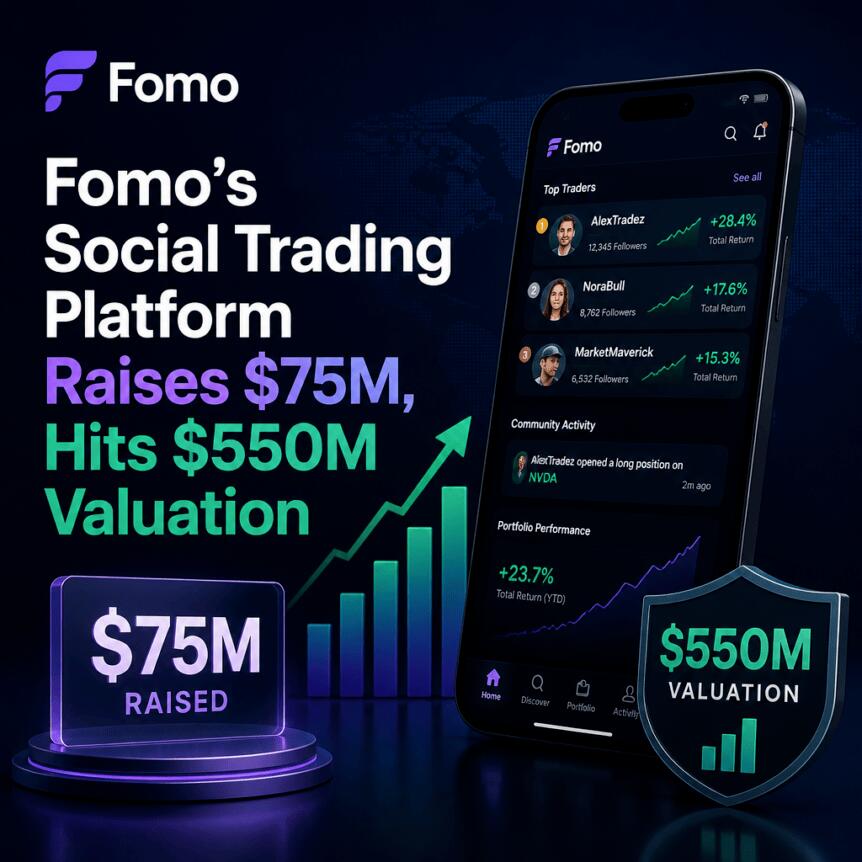
Fomo, a social trading and token discovery platform, has secured $75 million in a Series B funding round led by Index Ventures. The round values the company at $550 million, with participatio
Fomo, a social trading and token discovery platform, has secured $75 million in a Series B funding round led by Index Ventures. The round values the company at $550 million, with participation from Union Square Ventures and existing investor Benchmark, according to Fomo’s announcement on Monday via its website: https://fomo.family/blog/fomo-series-b.
The deal comes as crypto venture activity continues despite digital asset prices sitting below recent peaks. RootData reported that crypto startups raised $4.1 billion across 147 funding rounds during the second quarter.
Key takeaways
- Fomo raised $75 million in a Series B round led by Index Ventures, valuing the company at $550 million.
- Fomo says it has attracted more than 625,000 traders since launch, generating $4 billion in trading volume and 110 million social interactions.
- The platform claims 68,000 users made their first crypto purchase using Apple Pay, totaling about $25 million in transaction volume.
- Fomo’s core product blends social feeds with multi-chain trading, aiming to eliminate manual bridging and separate wallet management.
- The company is also expanding its product surface, including launching perpetual futures powered by Hyperliquid for users outside the U.S.
Series B funds a multi-chain social trading experience
Fomo’s business centers on making crypto trading feel less like technical execution and more like consuming content. The company enables users to trade across multiple blockchains without manually bridging funds or dealing with gas fees themselves—an abstraction it frames as lowering friction for new and returning participants.
In its funding announcement, Fomo also pointed to user traction. Since launching a year ago, the company said it has surpassed 625,000 traders, with $4 billion in trading volume and 110 million social interactions generated on the platform.
For investors and operators watching crypto’s “onboarding” challenge, this matters because social layers can change how users decide what to trade—shifting discovery from charts and listings toward peer activity and repeated patterns. Fomo’s pitch aligns with that direction: users can view what others are trading in real time and replicate those actions without running a separate operational process per chain.
Apple Pay onboarding and “feed-like” trading
Beyond engagement metrics, Fomo highlighted payments as part of its growth story. The company said 68,000 users made their first cryptocurrency purchase on the platform using Apple Pay, representing roughly $25 million in transaction volume.
Crypto research firm Delphi Digital has previously suggested that the product’s social design is helping it attract users by making trading feel more intuitive. In a December X post, Delphi Digital wrote that Fomo’s social features may make trading “more like scrolling a feed than sitting at a terminal.” The firm also claimed that in November, @fomo_family generated more monthly fees than Moonshot—even though Fomo was younger and had lower fees—according to the post shared on X: https://x.com/Delphi_Digital/status/1998483824049795573/photo/1.
While those remarks are not a full market analysis, they provide a useful lens for understanding how Fomo positions itself within a crowded execution-and-discovery landscape: reducing the perceived complexity of trading could be as important as route optimization or additional liquidity.
Copy trading is crowded—Fomo focuses on cross-chain execution
Fomo is not the first exchange-style product to incorporate copy trading and social visibility. The article notes that other platforms offering similar functionality include Binance, Bybit, OKX, Bitget, BingX, MEXC, Gate.io, KuCoin, Phemex and BitMart.
What distinguishes Fomo’s approach, based on the company’s description, is the emphasis on multi-chain execution without manual bridging or separate wallet handling. The promise here is operational simplicity: a user sees activity, then follows it in a way that is designed to work across chains more smoothly than typical self-custody workflows.
That framing becomes more relevant as copy trading strategies increasingly require reliable settlement across heterogeneous networks. Even when social copy features are easy to deploy, the “last mile”—actually executing the trade as users expect—can determine whether followers stay or churn.
Product expansion: referral payments and perpetual futures
Fomo’s funding news also connects to broader product development. On June 11, Fomo launched perpetual futures contracts powered by Hyperliquid for users outside the United States, according to an announcement shared on X by https://x.com/PaulErlanger/status/2065102992278171791.
Separately, on June 2 the company said it had surpassed $2 million in referral fees paid to users, based on a post from https://x.com/fomo/status/2061828121976861056.
Taken together, these moves suggest Fomo is trying to convert social engagement into monetization and stickiness—using both direct trading activity and incentive mechanics to keep users active. For market observers, the key question is whether the platform can maintain its onboarding and social-driven discovery advantages as it adds more financial products, particularly those that tend to increase complexity and risk for end users.
With Fomo’s Series B now in the books, the next things to watch are whether the company can scale its multi-chain execution experience reliably, sustain user growth without relying disproportionately on incentives, and demonstrate that social-driven trading translates into durable trading revenue rather than one-off spikes.
This article was originally published as Fomo’s Social Trading Platform Raises $75M, Hits $550M Valuation on Crypto Breaking News – your trusted source for crypto news, Bitcoin news, and blockchain updates.