Key Takeaways U.S. Transportation Secretary Sean Duffy expressed serious concerns in a letter to Ford CEO Jim Farley regarding the automaker’s partnerships with Chinese tech firms. Duffy’s le
Key Takeaways
- U.S. Transportation Secretary Sean Duffy expressed serious concerns in a letter to Ford CEO Jim Farley regarding the automaker’s partnerships with Chinese tech firms.
- Duffy’s letter specifically highlighted Ford’s battery licensing agreement with CATL, a Geely collaboration in Europe, Lincoln manufacturing delays, and potential BYD hybrid component discussions.
- Ford responded forcefully, describing itself as America’s top automaker and dismissing the letter as an effort to generate media attention.
- Shares of Ford declined 4.2% Tuesday, with the majority of losses occurring prior to the letter’s release, primarily due to rising oil prices.
- UBS analysts maintained their Buy recommendation with a $17 price target, suggesting approximately 20% potential gains from the current $14.09 level.
Shares of Ford dropped 4.2% Tuesday following the release of a letter from Transportation Secretary Sean Duffy to CEO Jim Farley highlighting serious concerns about the company’s business relationships with Chinese firms. With Ford stock hovering near $14.09, UBS continues to project a $17 target price, indicating potential upside of roughly 20%.
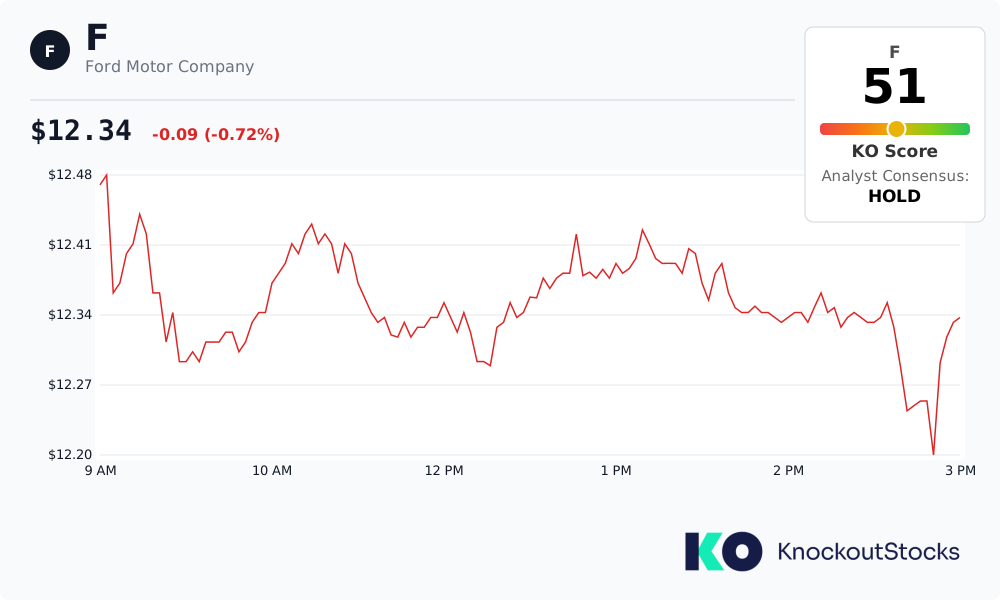 Ford Motor Company, F
Duffy’s correspondence identified four key issues: the battery technology licensing agreement with CATL, a collaborative venture with Geely in Europe, delayed transition of Lincoln manufacturing from Chinese facilities to American soil, and discussions with BYD concerning hybrid vehicle components.
The Transportation Secretary cautioned that Ford’s partnership with Geely might enable Chinese manufacturers to establish a significant presence in Western automotive markets. Additionally, he expressed concern that expanded cooperation with BYD could introduce heavily subsidized foreign technology into Ford’s manufacturing ecosystem.
The automaker didn’t hesitate to issue a rebuttal. Ford characterized the letter as misleading and emphasized its status as America’s leading domestic automaker, citing its assembly operations and hourly workforce numbers as proof.
Regarding the CATL partnership, Ford stood by its decision. The licensing arrangement supports battery manufacturing at the company’s Marshall, Michigan plant and underpins both the UEV platform and energy storage initiatives. Ford maintains confidence that this agreement meets the requirements for both Production Tax Credits and Investment Tax Credits.
UBS Maintains Confidence
UBS reaffirmed its Buy recommendation following analysis of the situation. The firm estimates Ford’s battery energy storage operations contribute approximately $2 per share to its overall price target framework. This valuation indicates UBS views the CATL partnership as value-creating rather than problematic.
Wall Street sentiment remains generally favorable. InvestingPro data reveals 14 analysts have recently increased their earnings projections for the next reporting period.
Following Tuesday’s decline, Ford shares rebounded 0.9% in Wednesday’s early session. During the same timeframe, the S&P 500 declined 0.3%, indicating Ford’s relative strength versus the benchmark index.
Prior to this week’s events, Ford stock had gained 22% year-over-year. This performance stands in sharp contrast to BYD’s 23% decline and SAIC Motor’s 42% drop during the identical timeframe.
European automotive manufacturers have experienced similar challenges. Mercedes-Benz shares have fallen 10% over twelve months, while Volkswagen has declined 22%. American automakers have benefited from U.S. tariff policies that provide insulation from the pricing pressures and excess manufacturing capacity affecting Chinese and European competitors.
Morgan Stanley maintained its Equalweight stance with a $14 price target on Ford shares, remaining unchanged. This rating followed the announcement of Dave Carroll’s appointment as president of Ford Energy, effective August 31.
Ford Motor Credit recently completed a $2.5 billion note offering, distributed between 2029 and 2033 maturity dates, as standard financing operations.
President Trump’s announcement of a 50% tariff on Canadian automotive imports, scheduled to begin January 1, 2027, introduces additional uncertainty into Ford’s near-term business planning.
The post Ford (F) Stock Dips as Transportation Chief Questions Chinese Tech Partnerships appeared first on Blockonomi.