France has become the latest country to crack down on crypto-based prediction market platform Polymarket, ordering internet service providers (ISPs) to block access to the website over allege
France has become the latest country to crack down on crypto-based prediction market platform Polymarket, ordering internet service providers (ISPs) to block access to the website over alleged violations of the country’s gambling laws.
The order was issued by France’s National Gambling Authority (ANJ) on July 16, 2026, with the regulator stating that Polymarket offers gambling services without the licenses required under French law. Authorities also cited concerns over consumer protection, gambling addiction, and the potential for market manipulation in certain prediction contracts.
Why France Blocked Polymarket
According to the Reuters, Polymarket allows users to speculate on the outcomes of real-world events using cryptocurrency without obtaining authorization to operate as a licensed gambling platform in France. The regulator argued that some event-based contracts, including weather-related markets, could be susceptible to insider information or manipulation.
French authorities said the website will remain inaccessible through domestic internet service providers until the platform complies with national gambling regulations.
Part of a Broader Global Regulatory Trend
France’s action is the latest in a series of regulatory measures targeting prediction market platforms worldwide. Governments are increasingly treating event-based prediction contracts as gambling products rather than financial instruments.
Most recently, Indonesia blocked access to Polymarket after authorities classified the platform as an online gambling service. The Ministry of Communication and Digital Affairs (Komdigi) ordered internet service providers to restrict access, arguing that prediction markets fall under the country’s strict anti-online gambling regulations.
Earlier this year, Spain temporarily blocked access to Polymarket and rival platform Kalshi while investigating whether the companies were operating without the country’s required gambling licenses.
Argentina also ordered internet providers to block Polymarket and instructed Apple and Google to restrict access to the platform’s mobile applications, citing unauthorized gambling operations.
In India, authorities have expanded enforcement against offshore betting platforms, directing VPN providers to make reasonable efforts to prevent users from accessing banned services, including Polymarket.
Polymarket Is Restricted in More Than 30 Countries
According to Polymarket’s official geographic restrictions policy, the platform currently blocks users from 33 countries and jurisdictions. The list includes France, the United Kingdom, Germany, Italy, Belgium, Poland, Australia, Singapore, Thailand, Taiwan, Japan, Brazil, Cuba, Belarus, Russia, Syria, Iran, Iraq, Lebanon, Myanmar, North Korea, and several African nations such as Libya, Somalia, Sudan, South Sudan, Ethiopia, Burundi, the Democratic Republic of the Congo, and the Central African Republic.
Some jurisdictions, including Spain, Argentina, Indonesia, and India, have also imposed regulatory or ISP-level restrictions that may not yet appear on Polymarket’s official blocked-country list.
Why Regulators Are Targeting Prediction Markets
Regulators across multiple jurisdictions have cited several reasons for taking action against prediction market platforms like Polymarket, including:
- Operating without the gambling or betting licenses required under local laws.
- Limited consumer protection measures compared to regulated gambling operators.
- Risks of gambling addiction and financial losses for retail users.
- Potential insider trading or market manipulation in event-based contracts.
- Insufficient Anti-Money Laundering (AML) and Know Your Customer (KYC) compliance.
- Prediction markets tied to elections, geopolitics, public health, sports, and weather are viewed by many authorities as unregulated gambling rather than regulated financial products.
- Cross-border operations that allow platforms to offer services without obtaining country-specific licenses.
Why It Matters
France’s decision marks another significant regulatory challenge for Polymarket as governments tighten oversight of decentralized prediction markets. The move suggests that regulators are increasingly willing to use ISP-level website blocking, alongside app store restrictions and licensing enforcement, to limit access to platforms operating outside national gambling frameworks.
With more than 30 jurisdictions already restricting access and additional investigations underway, the global regulatory landscape for crypto-powered prediction markets is becoming increasingly restrictive. The outcome could shape how platforms like Polymarket expand internationally and whether they pursue local licensing or exit regulated markets altogether. Indonesia’s decision further demonstrates that regulators in Asia are joining Europe and Latin America in treating crypto prediction markets as online gambling services rather than financial platforms.
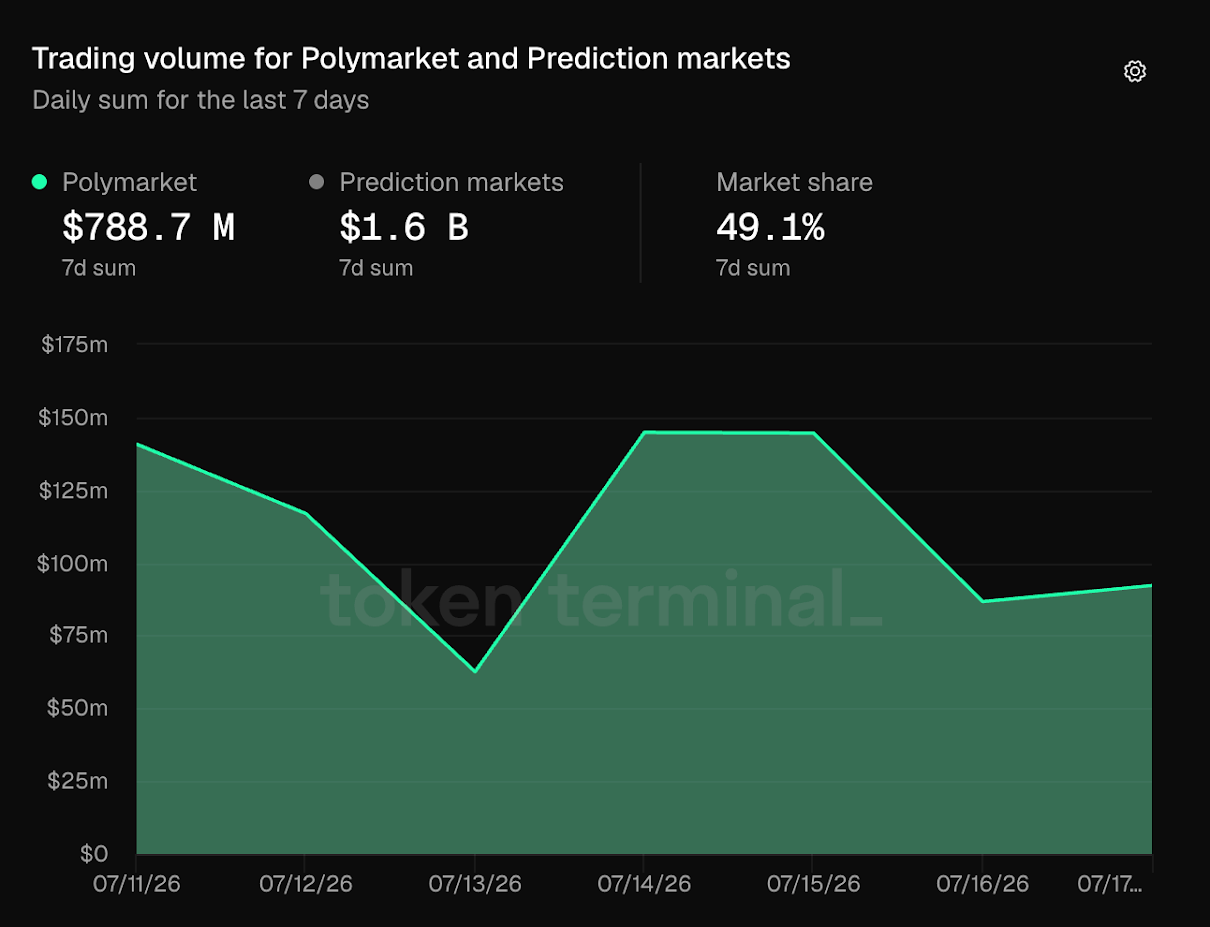 Token Terminal – Polymarket
Over the past seven days, Polymarket recorded $788.7 million in trading volume, representing 49.1% of the $1.6 billion generated across all prediction markets. Daily volume fluctuated during the period, falling to around $62 million on July 13 before rebounding to nearly $145 million on July 14 and 15. Although trading activity moderated afterward, Polymarket still closed the week with daily volume near $90 million, highlighting sustained user engagement despite recent regulatory scrutiny.