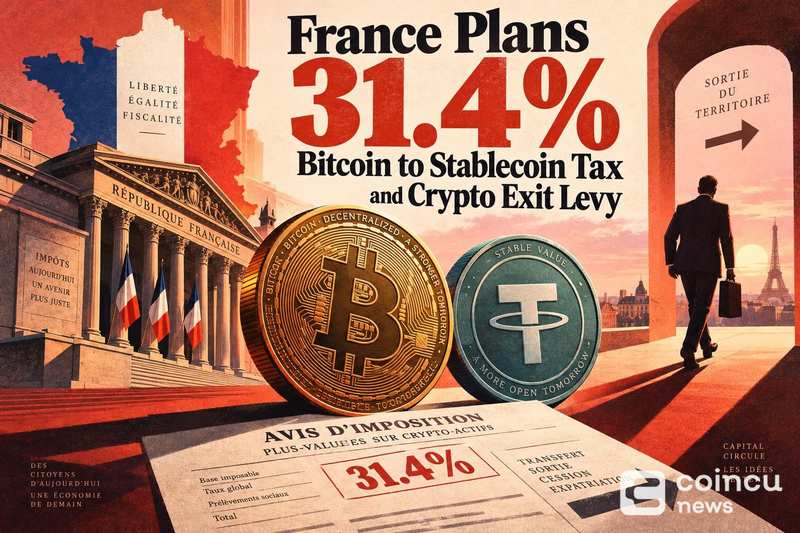
France is considering a 31.4% tax on Bitcoin-to-stablecoin exchanges alongside a possible departure tax targeting large crypto holdings, a two-pronged fiscal approach that would make converti
France is considering a 31.4% tax on Bitcoin-to-stablecoin exchanges alongside a possible departure tax targeting large crypto holdings, a two-pronged fiscal approach that would make converting Bitcoin into dollar-pegged assets a taxable event while potentially penalizing holders who relocate outside French jurisdiction.
What France's Proposed 31.4% Rate Would Cover
The reported proposal, which has not been confirmed as enacted law, would apply a 31.4% rate specifically to Bitcoin-to-stablecoin exchanges, treating such conversions as a taxable disposal rather than a like-for-like transfer. That framing matters because holders who routinely move between Bitcoin and stablecoins as a risk-management tool would face a recurring tax event each time they do so, even without converting to euros or withdrawing to a bank account. For related coverage, see France Finance Committee Passes Stablecoin and Crypto Tax Amendments.
No official bill text, effective date, or implementing regulation accompanies the reported figure at this stage. The distinction between a proposal under parliamentary consideration and an enacted tax obligation is critical: French residents should not assume the rate is currently in force. For related coverage, see Weekly Top Crypto News (June 12 - June 18).
Why Bitcoin-to-Stablecoin Exchanges Are the Focus
French tax authorities have long debated whether a swap between two crypto assets constitutes a taxable realization. Targeting Bitcoin-to-stablecoin exchanges specifically signals that legislators view such swaps as economically equivalent to a sale, given that stablecoins are pegged to a fiat reference value and thus represent a clear exit from price-volatile exposure. For related coverage, see Crypto Liquidations Reportedly Top $19B on October 10.
What Details Remain Unconfirmed
The research available does not specify the tax base calculation method, whether exemptions apply below a threshold amount, which stablecoins fall within scope (euro-denominated versus dollar-denominated), or whether the rate is a flat withholding rate or a progressive capital-gains rate. Those gaps matter significantly for any compliance assessment.
How a Bitcoin-to-Stablecoin Exchange Could Be Treated
If adopted as reported, the taxable event would likely be triggered at the point of swap, with the gain calculated against the original acquisition cost of the Bitcoin. A holder who acquired Bitcoin at a low cost basis and converts to a stablecoin at a higher market price would potentially owe tax on the appreciation, at the reported 31.4% rate, before any fiat withdrawal occurs.
Transaction Records Holders May Need to Review
Under a regime that taxes crypto-to-crypto exchanges, accurate per-transaction cost-basis records become essential. Holders with multiple Bitcoin acquisition dates at varying prices would need to identify which lots are being disposed of, applying either a first-in-first-out or specific identification method depending on final legislative language, neither of which has been confirmed in the current proposal stage.
Questions on Scope, Thresholds, and Stablecoin Definitions
Whether the proposed rule applies only to USDT and USDC or extends to euro-denominated stablecoins such as EURC remains undefined. Thresholds for de minimis transactions, treatment of lending and liquidity pool positions involving stablecoins, and cross-border exchange activity conducted on non-French platforms are all material questions with no available answers at this reporting stage.
Possible Departure Tax for Large Crypto Holdings
Separately from the exchange-level tax, the reported proposal includes the possibility of a departure tax that would apply to holders with large crypto positions who transfer their tax residency out of France. The stablecoin capital-gains framework under review in the National Assembly has previously intersected with questions about how France retains taxing rights over unrealized gains when residents emigrate.
A departure tax would function differently from a transaction tax: rather than taxing a swap or sale event, it would assess tax on the unrealized appreciation of crypto holdings at the moment a holder ceases French tax residency. France applies analogous exit-tax rules to equity shareholdings under existing law, and extending that architecture to digital assets would represent a natural legislative extension.
Which Thresholds and Valuation Rules Are Not Yet Known
No holding threshold, portfolio valuation methodology, or minimum asset value that triggers departure-tax liability has been confirmed. Whether the proposal covers wallets held in self-custody, exchange-custodied assets, or both remains undisclosed. The absence of a defined valuation date creates further uncertainty for holders with illiquid or non-stablecoin positions.
Why Residency and Timing Would Matter if Adopted
If the departure tax is adopted, the relevant trigger would be the date a holder formally ceases French tax residency, not the date of any subsequent asset sale. That sequencing means the tax would be calculated against a market value at departure, potentially creating a liability on paper gains that have not been monetized, a design that has drawn constitutional challenges in analogous regimes elsewhere in the EU.
What to Watch Before Any French Crypto-Tax Change Takes Effect
The Finance Committee's prior amendments on stablecoin and departure-tax rules indicate the policy has legislative momentum, but parliamentary progress, final rate confirmation, effective dates, transitional provisions, and implementing decrees are all outstanding. The two components, the exchange-level 31.4% rate and the possible departure tax, address distinct taxpayer behaviors and may advance through separate legislative vehicles on different timelines.
Exchange users and large holders face different exposure profiles under this dual framework. Exchange users whose primary risk is routine Bitcoin-to-stablecoin activity need clarity on rate finalization and effective dates. Holders whose primary concern is the departure tax need threshold confirmation and an understanding of how unrealized gains would be valued and paid, particularly if the assets are illiquid at the time of departure. Qualified, current French tax counsel is essential for any personal assessment given the unresolved legislative state of both measures.
FAQ: France's Proposed Bitcoin-to-Stablecoin Tax
Is France's 31.4% Bitcoin-to-stablecoin tax already in force?
No. Based on available reporting, the 31.4% rate is a proposed or planned measure, not an enacted law. No official effective date or implementing regulation has been confirmed in the current research available. Holders should not treat existing transactions as subject to this rate until official legislative text is published.
Does the proposal apply to every cryptocurrency trade?
The reported 31.4% figure is specifically linked to Bitcoin-to-stablecoin exchanges, not to all crypto-to-crypto trades. Whether the same rate or a different treatment would apply to other trading pairs, such as Bitcoin-to-Ether or altcoin-to-altcoin swaps, is not established by available reporting.
Who could be affected by a crypto departure tax?
The departure tax component is described as targeting large crypto holdings, but the threshold that qualifies a portfolio as "large" has not been defined. Current French tax residents who hold significant Bitcoin or digital asset positions and are considering relocating would be the most directly affected group if the measure is adopted as described.
Key outstanding items include: final legislative text for both the exchange tax and departure tax; the defined tax base and calculation method for the 31.4% rate; the holding threshold and valuation methodology for the departure tax; effective dates and any transitional provisions for existing positions; and the scope of eligible stablecoin types covered by the exchange-level rate.
Additional source references: source document 1, source document 2.
Disclaimer: This article is for informational purposes only and does not constitute financial or investment advice. Cryptocurrency and digital asset markets carry significant risk. Always do your own research before making decisions.
The post France Plans 31.4% Bitcoin-to-Stablecoin Tax and Crypto Exit Levy was initially published on Coincu.