A crypto trader can now use shares in a regulated money-market fund as collateral on Bybit without first transferring those fund shares onto the exchange. That sounds like a narrow institutio
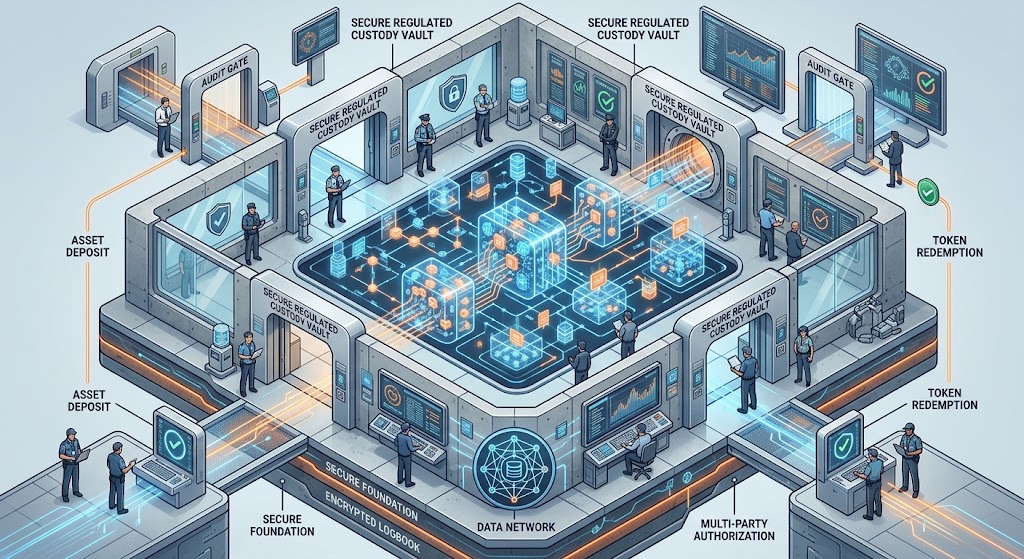
A crypto trader can now use shares in a regulated money-market fund as collateral on Bybit without first transferring those fund shares onto the exchange.
That sounds like a narrow institutional product. It is actually a useful picture of where tokenization is heading: traditional assets are becoming programmable balance-sheet objects inside crypto markets, while custody and trading are being deliberately separated.
Franklin Templeton and Bybit announced the arrangement on September 28. Eligible clients can pledge tokenized money-market fund shares issued through Franklin Templeton’s Benji Technology Platform, receive USDT or USDC trading credit on Bybit, and continue earning the yield generated by the underlying fund assets.
CoinDesk reported that the eligible Benji-issued shares represented roughly $686 million in net assets at the time of announcement. The fund shares remain held off-exchange through ByCustody, while their collateral value is mirrored inside Bybit’s trading environment.
The custody detail is the whole point.
A normal exchange-collateral model asks a trader to deposit an asset onto the venue. Once deposited, the trader has exchanged direct control of the asset for an account balance and becomes exposed to the exchange’s custody and operational stack.
The Franklin Templeton structure is different. The tokenized fund shares remain in a separate custody environment. Bybit recognizes their value for a credit line, but the underlying collateral does not have to sit in the exchange’s own wallet infrastructure.
That distinction is becoming one of the most important institutional uses of tokenization. Optimisus has already covered Bybit moving in this direction through RWA Earn, which gives eligible users access to tokenized institutional bond strategies. The new Franklin Templeton program moves tokenized assets from something an investor can hold into something the investor can actively finance against.
Traditional collateral creates an opportunity-cost problem. Cash posted as margin is useful for risk management but may earn less than the asset an institution would otherwise hold.
Here, the collateral itself remains a yield-bearing money-market position. The trader can preserve that yield while using the position to support USDT or USDC trading liquidity.
That is a meaningful shift because tokenization is not creating a new economic asset. It is making an existing asset easier to recognize, transfer, pledge and settle across systems.
Optimisus saw a similar direction when Franklin Templeton’s USPX exposure was brought on-chain through xStocks on Mantle. That product expanded where an ETF exposure could trade. The Bybit arrangement expands what a tokenized fund position can do once it already exists.
The phrase off-exchange collateral can sound safer than the structure actually is if it is read too broadly.
Keeping the fund shares outside the exchange reduces the amount of asset custody concentrated inside a trading venue. It does not remove market risk, liquidation risk, stablecoin exposure, legal enforceability questions, custody-provider risk or the operational dependency between the exchange and the collateral-mirroring system.
If a leveraged position loses value, the collateral can still be subject to the contractual liquidation process. If the mirror between custody and the exchange fails, access to trading credit can still be disrupted even when the fund shares themselves remain intact.
That is similar to the distinction Optimisus made in its recent article on Coinbase’s fixed-rate bitcoin-backed loans: making a crypto product look more like familiar finance can improve usability without making the underlying credit mechanics disappear.
Franklin Templeton already runs an off-exchange collateral program with Binance, and CoinDesk notes that similar tokenized-fund collateral models exist elsewhere in institutional crypto.
The important trend is therefore not a single Bybit integration. It is that collateral is becoming portable across venues without physically moving every time a trader changes where capital is deployed.
That is a much more credible institutional use case for tokenized funds than putting a conventional fund on-chain simply so it can trade at 3 a.m.
The end-state looks less like ‘TradFi versus crypto’ and more like a common collateral layer: regulated assets remain in custody, blockchain-based records make them portable, and trading venues compete on where that collateral can be recognized.
Three things matter from here. First, whether the program expands beyond a small institutional client base. Second, whether more regulated custodians and exchanges adopt interoperable collateral recognition rather than proprietary mirrors. Third, whether tokenized Treasury and money-market products become acceptable collateral across several venues at once.
If that happens, the value proposition of tokenization changes. The selling point is no longer merely 24/7 ownership records. It becomes capital efficiency.
That is harder to market in a headline. It is also much closer to why institutions would actually use the technology.
This is not financial advice.