Crypto investors are starting to look beyond interest rates and judge individual assets on their own merits, according to Chris Perkins, head of Franklin Crypto at Franklin Templeton. Speakin
Crypto investors are starting to look beyond interest rates and judge individual assets on their own merits, according to Chris Perkins, head of Franklin Crypto at Franklin Templeton.
Speaking with TheStreet Roundtable at Token2049 in Singapore, Perkins said he sees a shift in how investors assess digital assets. He did not argue that Bitcoin or the wider crypto market had become immune to the economy.
"Crypto has been hyper, hyper sensitive to liquidity and interest rates," he said, but "each token has different fundamentals."
His argument is that investors should examine the activity, revenue and other features behind each asset, rather than treat all cryptocurrencies as the same risky investment. That is an investment thesis, not proof that the market has permanently changed.
Related: Hyperliquid climbs Roundtable 100 as ICE plans market
Interest rates still matter
Perkins pointed to Bitcoin rising while interest rates also moved higher as evidence that investors were looking at more than monetary policy.
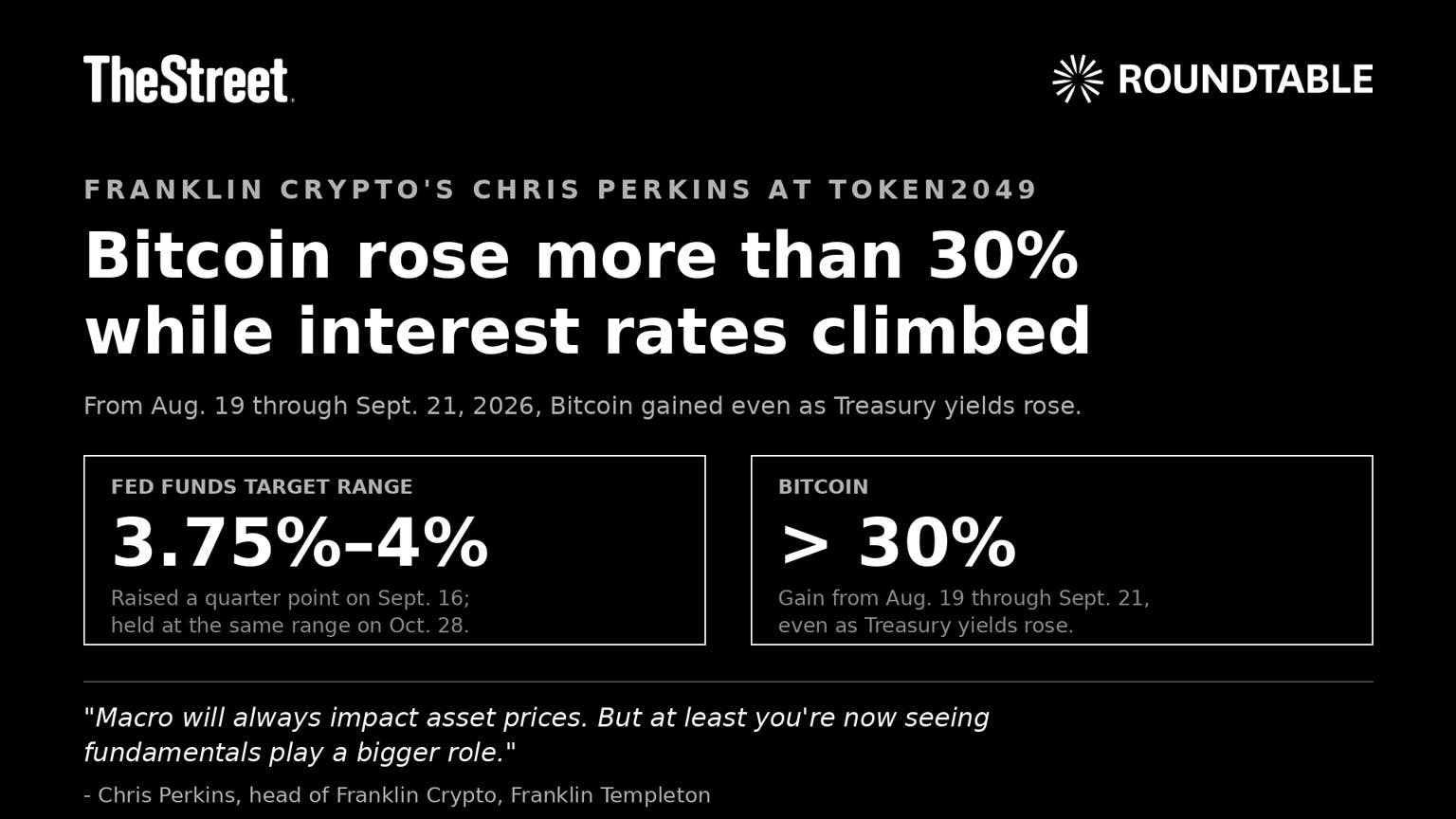
The Federal Reserve raised its benchmark rate by a quarter percentage point on Sept. 16, setting a target range of 3.75% to 4%. CME Group's analysis reported that Bitcoin gained more than 30% from Aug. 19 through Sept. 21, even as Treasury yields rose.
Bitcoin gained more than 30% from Aug. 19 through Sept. 21 even as Treasury yields rose, according to a CME Group analysis. The Fed raised its target range to 3.75% to 4% on Sept. 16 and held it on Oct. 28. Quote: Chris Perkins, head of Franklin Crypto, Franklin Templeton. Graphic: TheStreet Roundtable.
That period supports the narrower point that Bitcoin can rise alongside rates. It does not establish that higher rates caused the rally or that interest rates no longer affect crypto prices.
"Macro will always impact asset prices," Perkins said. "But at least you're now seeing fundamentals play a bigger role."
The Fed subsequently held the target range at 3.75% to 4% on Oct. 28. Governors Lisa Cook and Beth Hammack dissented because they preferred another quarter-point increase.
What Perkins sees in Washington
Perkins also expressed confidence in the direction of U.S. crypto policy, pointing to Federal Reserve Chair Kevin Warsh and Treasury Secretary Scott Bessent.
"All these guys are aligned," Perkins said. "They want responsible innovation, and they're executing on it."
Warsh's earlier comments provide context for that view. In a Hoover Institution interview recorded in May 2025, he described Bitcoin as an asset that could inform policymakers when they were getting things right or wrong, while saying it was not a substitute for the dollar.
In that interview, Warsh also advocated a new agreement defining the responsibilities of the Fed and Treasury. Perkins's view that a new accord is taking shape should not be read as confirmation that the two institutions have adopted one.
Bessent has said stablecoin growth could increase demand for U.S. Treasuries. Stablecoins are digital assets designed to maintain a stable value, often against the U.S. dollar.
Stablecoin rules are still being implemented
The GENIUS Act sets out a regulatory framework for payment stablecoins, but it does not require issuers to hold all their reserves in Treasury bills.
The law requires at least one-to-one backing and permits several types of reserve assets. They include cash, qualifying bank deposits, Treasuries with maturities of 93 days or less, and certain other liquid assets.
The Fed's Sept. 24 proposals address reserve assets, capital, risk management and applications for issuers under its supervision. They are proposed rules, not a completed regulatory framework.
Treasury's August implementation notice identifies Jan. 18, 2027, as the law's expected effective date. Investors should distinguish a law's passage from the rules and approvals needed to put it into practice.
Perkins's outlook combines confidence in that policy direction with a belief that investors will increasingly distinguish between crypto assets. His qualification remains that the Fed will continue to play an important role.
More news: