On July 1, 2026, the EU's transitional grace period under the Markets in Crypto-Assets Regulation expires. For the vast majority of crypto businesses still operating across Europe, this is no
On July 1, 2026, the EU's transitional grace period under the Markets in Crypto-Assets Regulation expires. For the vast majority of crypto businesses still operating across Europe, this is not a regulatory formality. It is a hard stop.
Any platform providing crypto-asset services to EU customers without full MiCA authorisation must cease operations. France has taken one of the clearest enforcement positions. The AMF has stated that unauthorized providers must stop serving French clients from July 1, with firms that ignore the rule facing a two-year prison sentence and a fine of €30,000. National authorities are empowered to blacklist platforms, warn users publicly, and seek court orders to block websites.
The deadline is not a surprise. It has been visible for three years. And yet the scale of non-compliance remains striking. Analysis from OKX Europe found that 60% of European crypto users are still on platforms without MiCA authorisation, representing 7.6 million of 18.5 million exchange app downloads across the region in the past year. Non-compliant exchanges have already seen a 40% decline in EU-based users, and more than €540 million in fines have been issued since MiCA enforcement began.
This is the market fracture. But for one organisation, it is not a disruption to manage. It is a moat already built.
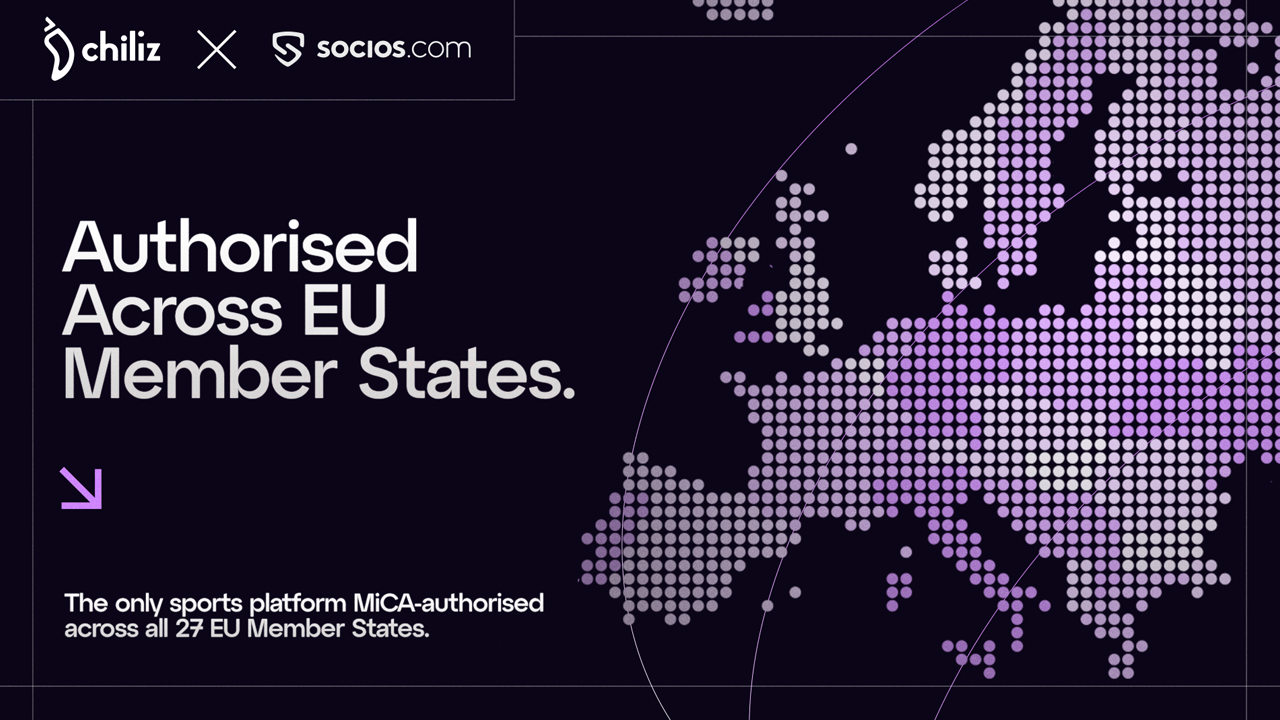
Socios Europe Services Limited, part of The Chiliz Group, was officially granted authorisation as a Crypto-Asset Service Provider by the Malta Financial Services Authority on 11 September 2025, becoming the first MiCA-authorised entity within the blockchain and sports sector in the EU. With it, over 400 million fans across Europe gained access to regulated crypto-asset services through Socios' compliant infrastructure. No other sports platform holds this. No competitor in the fan token or sports blockchain space has reached the same threshold.
In a regulated market that took most of the industry by surprise, Chiliz arrived early, on purpose, and alone in its category.
What MiCA Actually Does
Before examining what the authorisation means commercially, it is worth being precise about what MiCA does and why it is structurally more valuable than any previous national registration framework.
Prior to MiCA, crypto businesses operated under a patchwork of national regimes. A German BaFin registration did not entitle a firm to operate in France. A Maltese VFA licence carried different obligations than an Irish one. Every new market required a separate regulatory relationship, separate legal entity, and separate compliance stack.
MiCA replaced all of that with a single rulebook. Obtain CASP authorisation from any national competent authority in any EU member state, and that authorisation passports across all 27 countries. Authorize once, notify the rest, operate everywhere. ESMA maintains a central register of all authorised entities. A platform not on that register is, from July 1, legally barred from serving EU clients in any regulated capacity.
This is not a simple registration. It is a full regulatory review covering governance, capital adequacy, management suitability, IT security, and AML infrastructure.. A CASP authorisation cannot be rushed, crowdsourced, or acquired. It requires institutional infrastructure, legal standing, and a demonstrated track record, all verified by a national financial regulator.
As of May 2026, there are only 204 authorised CASPs on the ESMA Interim MiCA Register. There are tens of thousands of crypto projects. None of the other 203 are sports platforms.
Chiliz Filed First, Filed Correctly, and Filed Across the Full Stack
Chiliz's regulatory position in Europe stems from two parallel and reinforcing compliance tracks.
The first is as a token issuer. The Chiliz Group filed its MiCA white paper for the CHZ token under Title II of Regulation (EU) 2023/1114, registered in accordance with ESMA guidelines, with Malta designated as the home member state and all remaining 26 EU countries as host member states. The process to register individual Fan Token white papers with ESMA through the MFSA has also been started, meaning the entire product stack, chain, token, platform - is on a compliance pathway.
The second track is the CASP authorisation granted to Socios Europe Services Limited. All Socios.com crypto-asset operations shifted to the newly authorised entity on 1 October 2025, accompanied by updated platform and wallet terms and a dedicated complaints handling procedure. The authorisation covers custody and administration of crypto-assets, exchange services between crypto and fiat, placement of crypto-assets, and crypto transfer services, the full scope of activities that fall within MiCA's regulated perimeter.
Any competitor looking to build a comparable position would need to begin the authorisation process from scratch today and could not expect to complete it before mid-2027 at the earliest. By that point, Socios will have had nearly two years of uncontested, regulated access to the EU market.
The authorisation is not replicable on a short timeline.
Why This Is a Moat, Not a Milestone
The distinction between compliance and competitive advantage matters, and it is worth stating plainly.
Compliance is a cost centre. You build it to stay in the market. Competitive advantage is what you hold when competitors cannot match your position without years of investment and regulatory relationship-building. The Socios CASP authorisation is clearly the latter.
Consider what it unlocks. EU-regulated crypto custodians have seen a 55% rise in institutional deposits since MiCA enforcement began. The EU crypto market is projected to reach €1.5 to €1.8 trillion. MiCA-authorised platforms are the only access point for institutional capital to that market, legally. A platform not on the ESMA register cannot be recommended by a regulated fund manager, included in a client portfolio, or used as the basis for an institutional partnership.
For any sports organisation considering digital asset issuance, the regulatory question is now among the first they will ask. Can the platform operate legally in France, Germany, Spain, and Italy, the four largest football markets in Europe? If the answer requires a year-long licensing process, a new legal entity, and regulatory approval from scratch, that is not a near-term option for any competitor. If the answer is Socios.com, the pathway already exists and is fully operational.
This is not a hypothetical. It is why SBI Digital Asset Holdings, the digital asset arm of SBI Holdings, a financial group with over 50 million clients, conducted due diligence on the Chiliz ecosystem and committed to a joint venture, with SBI DAH also joining as a node validator on the Chiliz Chain. Regulated institutions do not partner with unregulated platforms. They partner with platforms that have already cleared the bar they themselves are measured against.
It is also why NAVER Pay, South Korea's largest digital payment service with 33 million users, chose Chiliz Chain as the inaugural blockchain for its Digital Assets Wallet, with over 1,000,000 wallets since created on Chiliz Chain.
As Alexandre Dreyfus, CEO of The Chiliz Group, stated at the time of authorisation: "Securing full MiCA authorisation positions us at the forefront of regulated Web3 innovation in sports and entertainment. This milestone validates our long-term vision of building compliant, sustainable blockchain infrastructure that empowers fans and organisations within Europe and beyond."
The Commercial Case: 400 Million Investors, One Authorisation
The €16 trillion RWA tokenisation market projected for 2030 will not arrive via offshore token issuers or unregulated sports ventures. It will arrive through platforms that regulators, banks, and institutional allocators have already cleared. That is the operating environment MiCA is designed to create and it is the environment Socios is already authorised to operate in.
Think about what this means for the sports RWA thesis that Chiliz 2030 is building toward. Sports organisations hold enormous locked value in media rights, stadium equity, and brand IP. Tokenising that value requires a compliant infrastructure layer. A club in La Liga or Ligue 1 that wants to issue a revenue-share token to European investors does not want to conduct a legal review across 27 jurisdictions. It wants one authorised platform with one passport. That platform exists. It is Socios.
For fund managers and capital allocators assessing SportFi as an emerging asset class, the regulatory picture across Europe is now straightforwardly readable. The Chiliz Chain is the purpose-built settlement layer. CHZ is a MiCA-compliant token with a white paper registered under ESMA. Socios holds the only sports-specific CASP authorisation across the full EU. The entire stack - chain, token, platform is institutional-grade in a way that no competing sports blockchain project can currently claim.
The July 1 Deadline and What Follows
The immediate effect of July 1 is market consolidation. ESMA has been explicit that after July 1, 2026, any entity providing crypto-asset services to EU clients without a MiCA licence will be in breach of EU law and must cease those services. Grandfathered entities do not benefit from an EU passport unless they obtain a MiCA licence. The users of non-compliant platforms will migrate to authorised alternatives. The capital behind sports digital assets will follow compliant infrastructure.
The secondary effect, less discussed, more consequential is the institutional shift. A platform that is MiCA-authorised is one that institutional investors can access, recommend, and include in client portfolios. A platform that is not is one they legally cannot. That binary resolves on Tuesday.
Separately, in March 2026, the SEC and CFTC issued joint guidance providing long-sought regulatory clarity on Fan Token classification in the United States, opening the door for US sports teams and exchanges to engage with the asset class at scale. Combined with the MiCA position in Europe, Chiliz enters the second half of 2026 as the only sports blockchain project with regulatory clarity confirmed across both major markets simultaneously. The two developments reinforce the same underlying thesis: the infrastructure layer for sports finance is being built on compliant ground, and Chiliz built it first.
For sports organisations considering digital asset issuance, for PE firms building sports exposure, and for institutional allocators constructing a thesis around the trillion-dollar sports economy, the question is the same: which on-chain infrastructure is legally operational in Europe today?
There is one answer.