Functional Encryption: Can Software Use Secrets Without Leaking Them? Most encryption is all or nothing. You hold the key and read everything. Or you hold nothing and read nothing. Functional
Functional Encryption: Can Software Use Secrets Without Leaking Them?
Most encryption is all or nothing. You hold the key and read everything. Or you hold nothing and read nothing. Functional encryption changes that deal. It lets a data owner issue keys that unlock one approved calculation, not the full record.
Software has a similar problem. A company may want customers to run its program without learning how it works. That goal is called program obfuscation.
This matters for crypto. Public chains expose on-chain data to everyone. AI services often need private inputs, a tension we touched on in our piece on AI inference. Tools that release answers without releasing data could ease that trade-off. This guide explains both ideas, how they connect, and what the 2026 research really shows.
Key Terms Used in This Cryptography Guide
FE:encryption where a function-specific key reveals only f(x).
FHE: fully homomorphic encryption. It computes directly on ciphertext.
iO: indistinguishability obfuscation. Equivalent programs look the same once obfuscated.
MPC:secure multiparty computation. Parties compute together without sharing inputs.
ZKP: zero-knowledge proof. It proves a claim without revealing the secret behind it.
Collusion: key holders pooling their outputs to learn more.
TEE: trusted execution environment, a protected hardware area.
What Is Functional Encryption and How Does It Work?
Functional encryption is encryption where a key reveals one approved result instead of the full plaintext. The model was formalized in 2011 byBoneh, Sahai and Waters in a Theory of Cryptography Conference paper. A basic scheme has four steps:
Setup creates a public key and a master secret key.
Encrypt locks the data x.
KeyGen issues a secret key for a function f.
Decrypt applies that key and returns f(x).
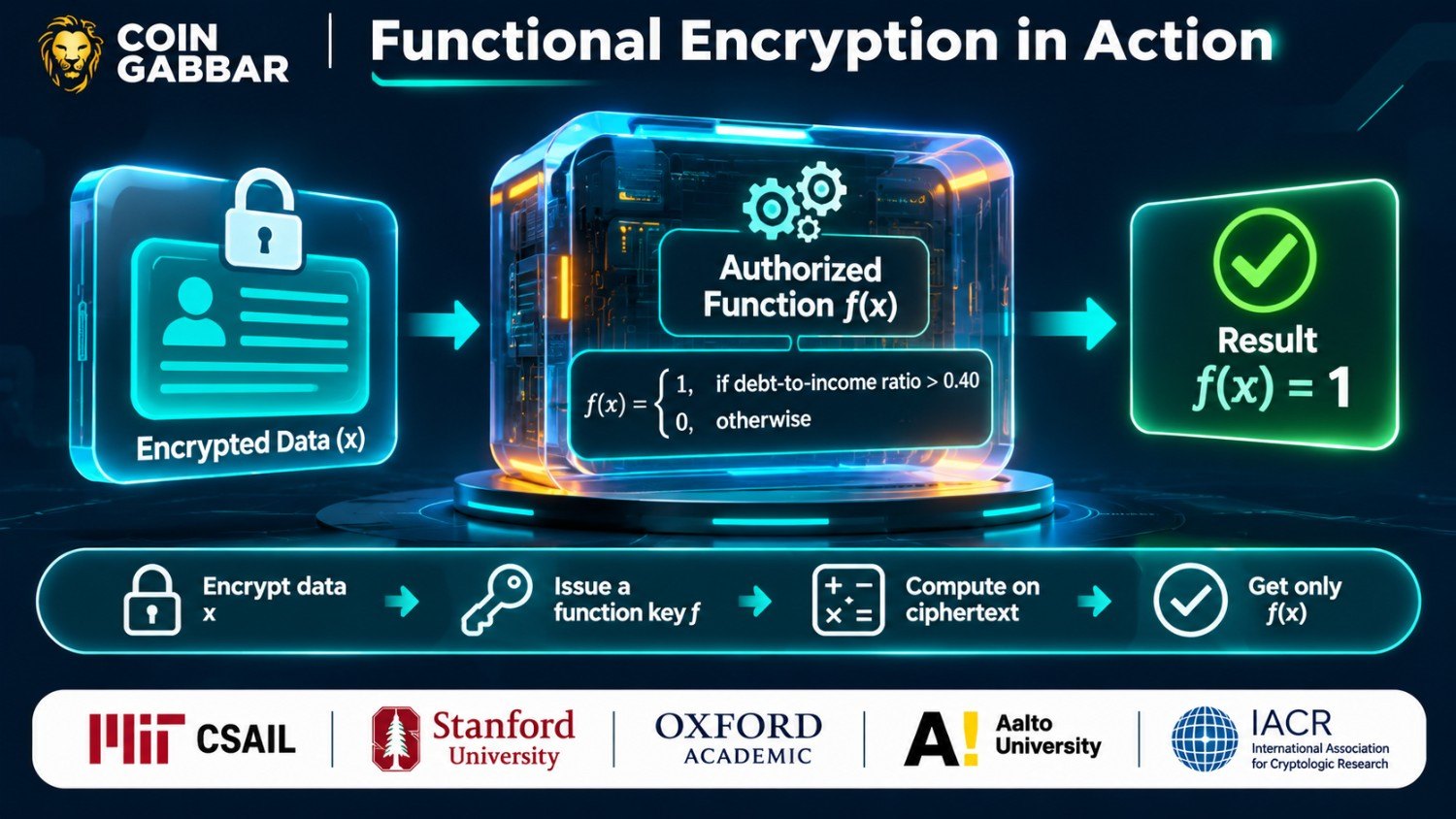
Here is a simple example: A bank stores an encrypted customer record. An analyst only needs to know whether debt exceeds 40% of income. The bank issues a key for that one test. The bank and the 40% threshold are our illustration, not a real deployment.
How Is Functional Encryption Different From FHE?
The main difference is the output. It gives a key holder a permitted answer. FHE lets a server compute on ciphertext and usually returns an encrypted result.
Feature
Functional encryption
FHE
Main goal
Limit what a keyholder learns.
Compute directly on ciphertext.
Keys
Function-specific keys
Evaluation keys and authorized decryption
Output
Authorized result f(x)
Usually an encrypted result
Main hurdle
Collusion, function scope, key management
Noise, bootstrapping, speed
Neither replaces the other. Neither stops leakage from repeated queries. MIT CSAIL's Cryptography and Information Security Group lists homomorphic encryption, functional encryption, and obfuscation as related routes to private outsourced computation.
What Are the Main Types of Functional Encryption?
Functional encryption is a family of schemes, and each supports a different function class. Always check which class a paper covers.
Inner-product schemes
Inner-product functional encryption lets a key holder learn x₁y₁ + x₂y₂ + … without recovering the vector x. It is one of the most concrete families. A 2024 IEEE survey reviews its use in privacy-preserving machine learning, along with usability limits.
Multi-input schemes
Multi-input functional encryption lets one key work across several separate ciphertexts. Three hospitals could allow one approved statistic across their datasets. Goldwasser and co-authors introduced the idea at Eurocrypt 2014.
Function-hiding schemes
Function-hiding functional encryption protects the question as well as the data. A request about a rare disease can reveal your research aims. A 2026 ICISSP paper by Antonis Michalas and Alexandros Bakas, "It Runs and It Hides," tackles this for private-key multi-input schemes. It uses a TEE.
Multi-hop schemes
Multi-hop functional encryption lets results flow through several stages. Each stage reveals only its approved output and forwards the encrypted state. Pratish Datta, Jiaxin Guan, Alexis Korb, and Amit Sahai introduced the model at TCC 2026, first published online on 7 November 2026. Their generic construction covers polynomial-size circuits. It starts from standard indistinguishability-secure FE. It is a theory result, not a cloud product.
What Is Program Obfuscation and Why Does It Matter?
Program obfuscation transforms a program so it computes the same function but reveals less about how it is built. Ordinary code scrambling only raises the effort for a reverse engineer. Cryptographic obfuscation aims for a provable guarantee instead.
In 2001, Boaz Barak and co-authors showed that the strongest form, virtual-black-box obfuscation, cannot exist for all programs. That result pushed researchers toward weaker goals such as iO.
How Does Indistinguishability Obfuscation (iO) Work?
iO guarantees that two equal-size programs with the same behavior look alike after obfuscation. An attacker cannot tell which version was used.
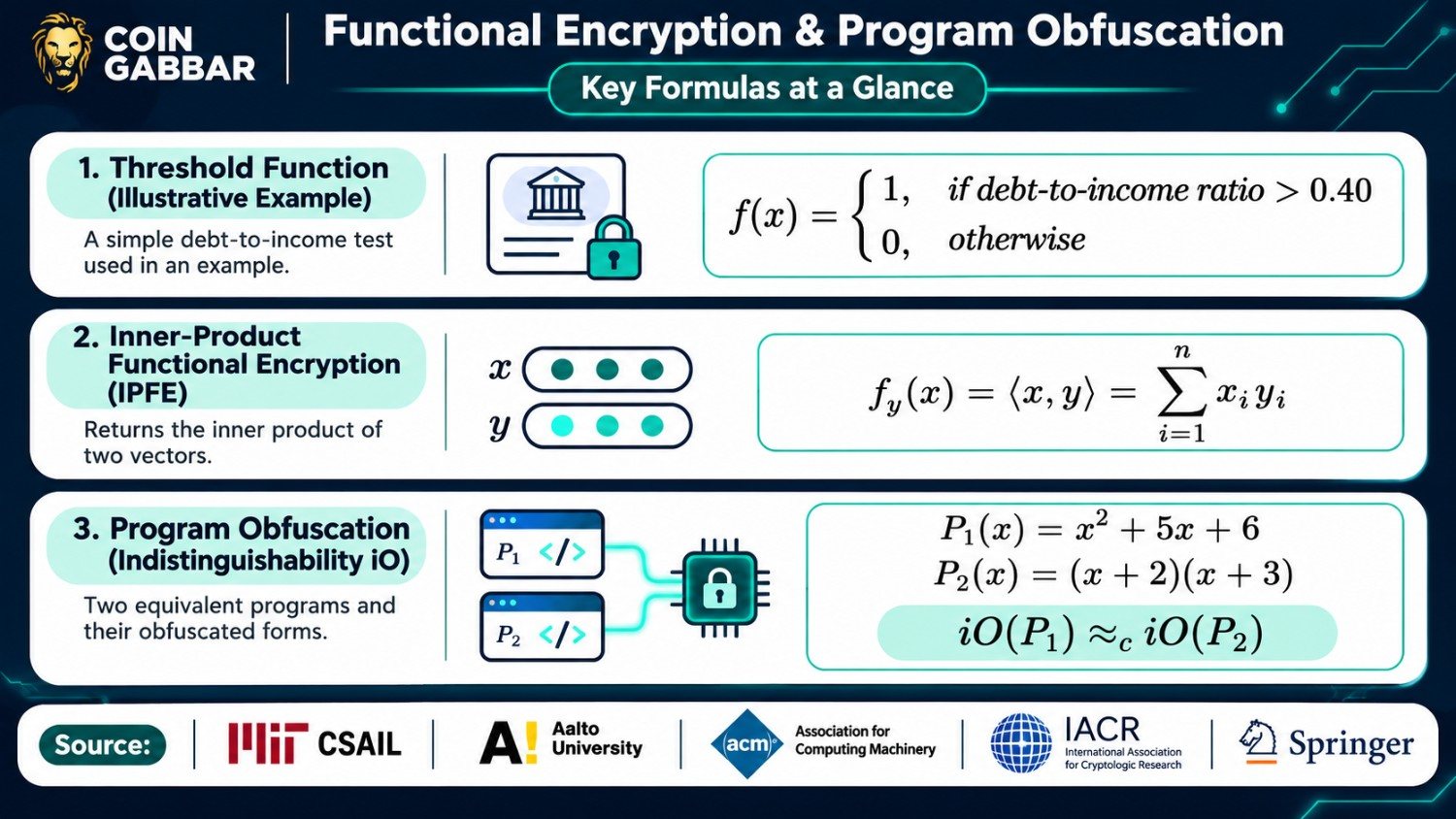
The biggest 2026 milestone is the Journal of the ACM version ofJain, Lin and Sahai, published on 12 February 2026 in Volume 73, Issue 1. They build iO from the subexponential hardness of four assumptions: LWE, LPN, a local pseudorandom generator (NC⁰ PRG), and DLIN in symmetric bilinear groups. They also obtain collusion-resistant public-key for all polynomial-size circuits.
Two cautions apply. DLIN means this construction is not purely post-quantum. And it is theory, not fast software protection.
How Are Functional Encryption and Obfuscation Connected?
They are different tools, but each can build the other under some conditions. Three links stand out:
Functional encryption from iO: general-purpose schemes can rely on iO.
iO from functional encryption:sufficiently powerful FE can imply iO.
Functional encryption without iO: registered and multi-authority schemes for narrower tasks can avoid iO.
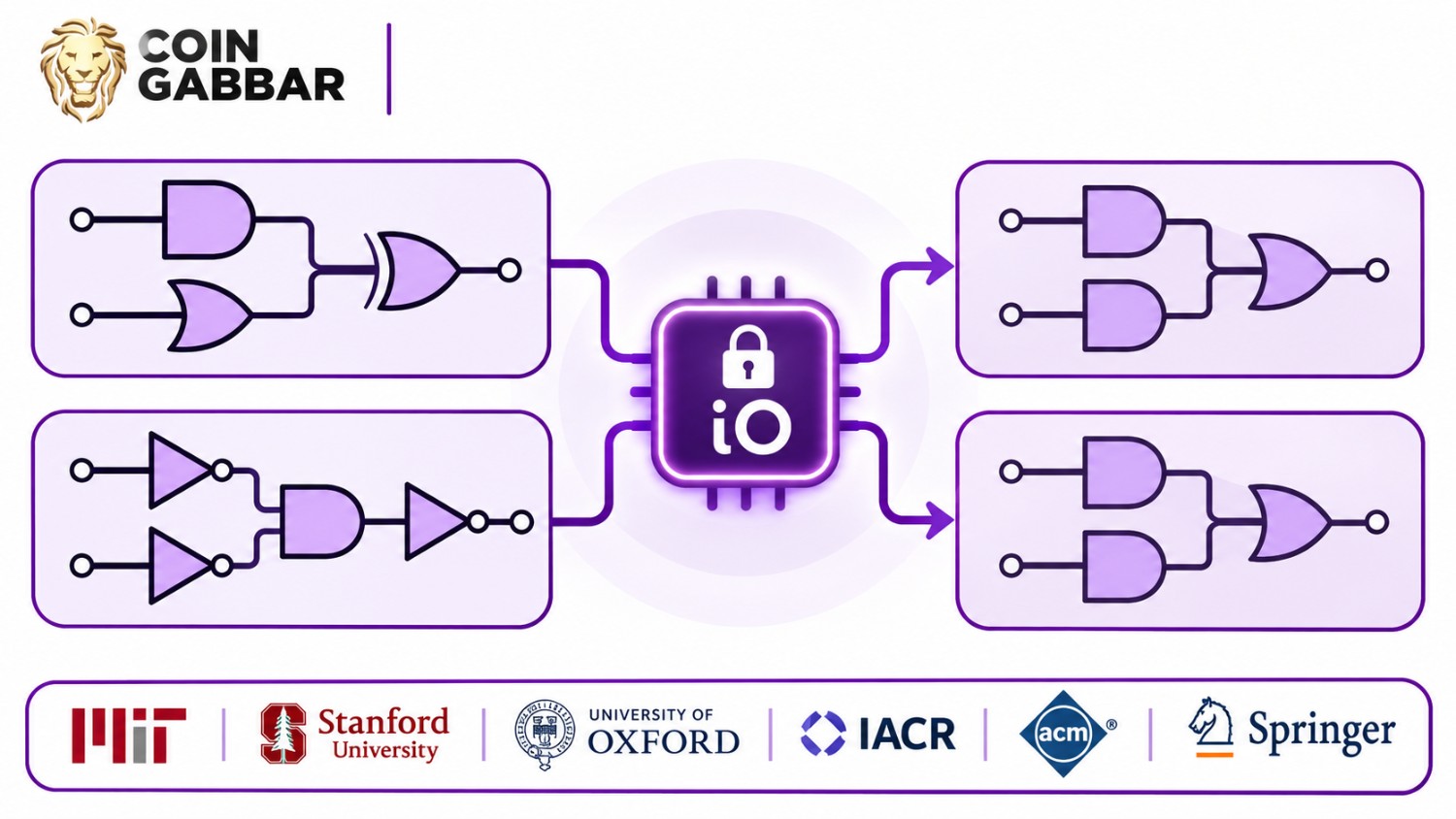
The lesson is simple. General-purpose obfuscation is powerful. But specialized constructions may do many useful jobs without it.
What Did 2026 Functional Encryption Research Discover?
Paper
Contribution
Stage
Multi-Hop FE (Datta et al., TCC 2026)
Controlled outputs across multi-stage computation
Peer-reviewed theory
Decentralized Multi-Authority FE (Goyal and Yadugiri, TCC 2026)
Distributed authorities, malicious-authority security
Peer-reviewed theory
It Runs and It Hides (Michalas and Bakas, ICISSP 2026)
Function privacy using a TEE
Peer-reviewed, with experiments
iO from Well-Founded Assumptions (Jain, Lin, and Sahai, JACM 2026)
iO from four established assumption classes
Peer-reviewed theory
Lattice-Based Obfuscation (Cini, Lai, and Woo, CRYPTO 2025)
Plausibly post-quantum iO candidate
Proposal with a new assumption
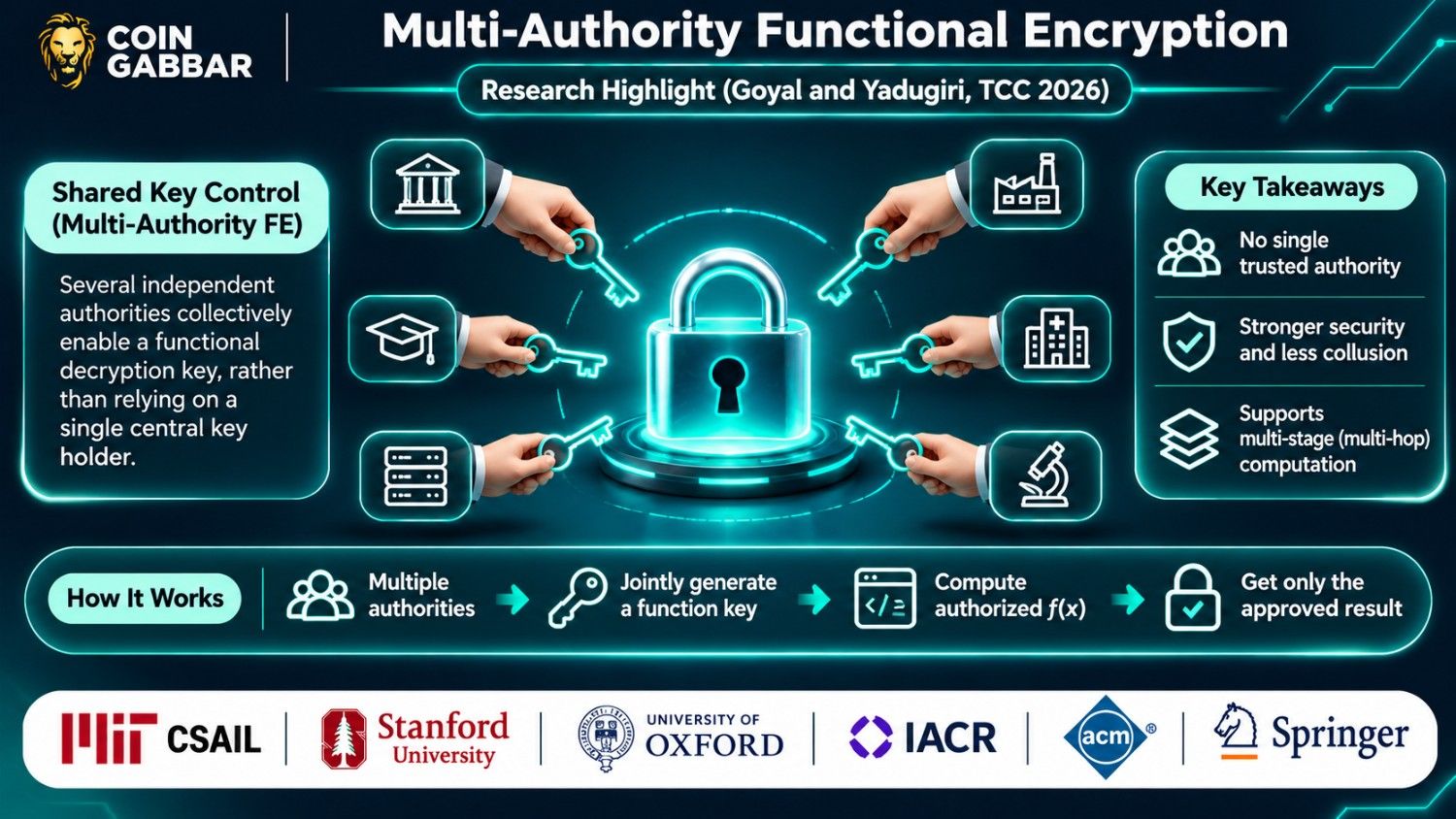
Rishab Goyal and Saikumar Yadugiri target a real weakness. In classic FE, one authority holds the master secret and issues every key. Their multi-authority design studies malicious authorities. It includes a bounded-collusion construction from public-key encryption assumptions.
In Python on a commodity laptop, they indexed hypothetical families of up to 10,000 functions. The largest run produced more than 50 million indexed pairs in about 28.2 seconds (ICISSP 2026). That measures the framework's indexing, not general FE speed.
Two 2026 IACR preprints extend registered functional encryption, one for dynamic bounded collusion and one with certified everlasting security. A third preprint shows generic-group barriers for function-hiding and multi-input FE. Impossibility results matter too.
Can Functional Encryption Protect Financial and Medical Data?
In theory, yes, for narrow and approved calculations. The sources we reviewed describe research designs, not widely deployed products. Credible use cases include:
Finance:weighted risk scores through inner-product schemes.
Healthcare: approved statistics across hospital datasets.
Cloud access: function keys for a provider instead of plaintext.
Machine learning:specific model operations with limited input access.
Shared governance:multi-authority schemes when several organizations control keys.
Now picture three banks building a joint fraud indicator. MPC lets them compute it together. FHE lets an outside service compute on ciphertext. FE grants keys for selected calculations. ZKPs prove that input or output rules were met. iO could, in theory, protect the program doing the work. These tools complement each other.
Why Is Practical Cryptographic Obfuscation Still Difficult?
Theory and engineering sit far apart. The main hurdles are
Narrow function classes: most schemes handle inner products or predicates, not arbitrary programs.
Collusion:key holders can pool outputs.
Central authority: one master key holder is a trust point.
Output leakage:repeated threshold questions can reveal an exact income.
Function leakage: the function itself can be sensitive.
Efficiency: general schemes rely on heavy tools such as iO.
System trust: key issuance, revocation, and hardware all matter. The TEE dependence shows how fixes add assumptions.
CoinGabbar Expert View on Selective Disclosure
CoinGabbar analysis suggests the next step in encryption is deciding what each party may learn, not just who may decrypt. Three research stories show this. Multi-hop FE controls release across stages. Multi-authority FE spreads key power. iO reshapes how software can be shared.
Disclaimer: This article is educational. It is not financial, legal, security, or investment advice. The technologies described are research-stage. Check the cited papers before relying on any claim. The author is not personally invested in any project mentioned.