The U.S. Securities and Exchange Commission issued temporary, conditional exemptive relief on September 17, 2026, allowing eligible Tokenized Securities Venues to facilitate secondary trading
The U.S. Securities and Exchange Commission issued temporary, conditional exemptive relief on September 17, 2026, allowing eligible Tokenized Securities Venues to facilitate secondary trading of tokenized NMS stock through permissioned automated market makers and liquidity pools, while Galaxy Digital's research arm framed the action as a five-year pilot window that runs through September 17, 2031, per Galaxy's analysis of the order.
What the SEC Order Actually Grants
The Commission's action, identified as Exemptive Release No. 34-106402, SEC File No. 4-927, invokes Section 36(a)(1) of the Securities Exchange Act to grant relief from the statutory definition of an exchange. The relief is temporary and conditional, not a general approval of decentralized finance or tokenized equities as an asset class, and is explicitly structured to let the Commission observe the model while it considers durable rulemaking. For related coverage, see Vietnam Plans First Crypto-Asset Provider Licenses for 2026.
SEC Commissioner Hester M. Peirce, in a statement accompanying the release, wrote: "The innovation exemption has arrived," according to the Commission's published statement. Chair Paul S. Atkins was also named among the order's principals. For related coverage, see Circle's Arc Launches Payment Agent With Managed x402 Access.
The exemption expires five years after publication, with the SEC simultaneously opening a public comment process on possible modifications and next steps toward permanent rulemaking. For related coverage, see Solana Targets 250ms Block Times in Speed Upgrade Push.
SEC innovation exemption
Five years
Conditional relief for eligible tokenized NMS-stock trading expires five years after publication. Source: U.S. Securities and Exchange Commission.
Conditions TSVs Must Satisfy
A Tokenized Securities Venue seeking to operate under the exemption must verify that a tokenized NMS stock confers the same rights and privileges as an equivalent traditional share, per the Commission's press release. For third-party tokens, where the TSV lists a tokenized share issued by an entity unaffiliated with it, the venue must provide the underlying issuer written notice and a 30-day window to object before listing proceeds, per Galaxy's breakdown of the order's terms.
Smart contracts used by eligible TSVs must be auditable and publicly accessible on a permissionless distributed ledger, even though the AMM participants themselves are permissioned. The structure mirrors a pattern emerging elsewhere in regulated tokenization efforts, including Hong Kong's planned trial of tokenized Exchange Fund Bills, where public ledger transparency coexists with restricted participant access.
What Falls Outside the Exemption's Scope
Galaxy's research explicitly identifies instruments that do not qualify for relief under the order: synthetic exposure products, security-based swaps, linked securities, and interests held through special-purpose vehicle wrappers are all excluded. The exemption covers secondary trading of tokenized NMS stock only; primary issuance and instruments that merely reference equity exposure rather than represent it are outside the order's scope.
This distinction matters for product design. Platforms structuring tokenized equity access through derivatives or wrapper vehicles cannot rely on the TSV exemption and will still need to navigate exchange registration requirements or separate no-action relief. The regulatory perimeter set here is narrower than the headline framing of a broad "innovation exemption" might imply.
Why the Five-Year Window Is the Key Variable
A pilot structure running to September 17, 2031 gives market participants enough runway to build infrastructure, accumulate trading data, and engage in the comment process, while preserving the Commission's ability to tighten, expand, or terminate the relief before it becomes entrenched. The public comment request is not a formality: the SEC has framed durable rulemaking as the intended outcome, meaning the terms governing TSVs after 2031 will depend partly on how participants and the public respond during the pilot.
For institutional players evaluating tokenized equity distribution, custody, and settlement, the five-year clock creates a concrete planning horizon. Venues that can demonstrate equivalent shareholder rights, auditable smart contracts, and simultaneous halt procedures during the pilot period are best positioned to influence what permanent rules look like. This dynamic is consistent with how the Commission used the no-action framework in early ETF development, where temporary relief preceded formal rulemaking by several years. The broader global push for crypto-asset service provider licensing creates parallel pressure on U.S. rulemakers to resolve the tokenized securities framework before offshore venues capture activity that could otherwise be regulated domestically.
What Participants and Observers Should Track
The comment process attached to the order is the most direct channel for shaping durable rules. Participants should monitor the SEC's docket under File No. 4-927 for comment submissions and any Commission responses that indicate which conditions may be modified. Volume and symbol limits referenced in the order's conditions will be the first quantitative signals of how aggressively TSVs can scale during the pilot period.
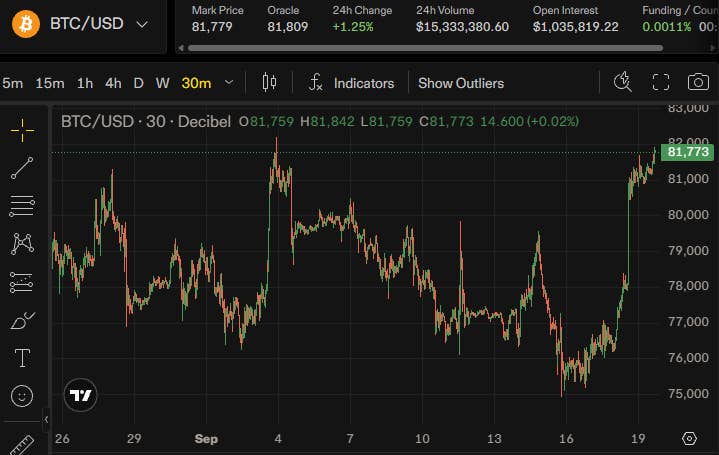
Bitcoin traded at $81,599 as of the data snapshot accompanying this report, up 1.1% in 24 hours against a Fear & Greed Index reading of 71 (Greed), suggesting the broader crypto market entered the exemption announcement in a risk-on posture that could accelerate institutional interest in regulated tokenized equity products.
FAQ: SEC Tokenized Stocks Exemption
What did the SEC issue on September 17, 2026? The Commission issued Exemptive Release No. 34-106402 (File No. 4-927), granting temporary, conditional relief from the Exchange Act's exchange definition for Tokenized Securities Venues trading tokenized NMS stock through permissioned AMMs.
Does the exemption apply to every tokenized stock? No. It applies to tokenized NMS stock meeting the conditions set in the order; synthetic exposure, security-based swaps, linked securities, and SPV-wrapper interests do not qualify, per Galaxy's analysis.
How long does the exemption last? Five years from the date of publication, expiring September 17, 2031, after which durable rules would need to be in place for TSV activity to continue under a regulatory framework.
What should market participants check before relying on the exemption? Participants should review the full order text at SEC File No. 4-927, confirm whether their specific instrument and structure meet the TSV conditions, verify the 30-day issuer notice requirement for third-party tokenized shares, and submit or monitor comments through the SEC's public docket to track how conditions may evolve before the pilot expires.
Disclaimer: This article is for informational purposes only and does not constitute financial or investment advice. Cryptocurrency and digital asset markets carry significant risk. Always do your own research before making decisions.
The post Galaxy Says SEC Granted Five-Year Tokenized Stocks Exemption was initially published on Coincu.