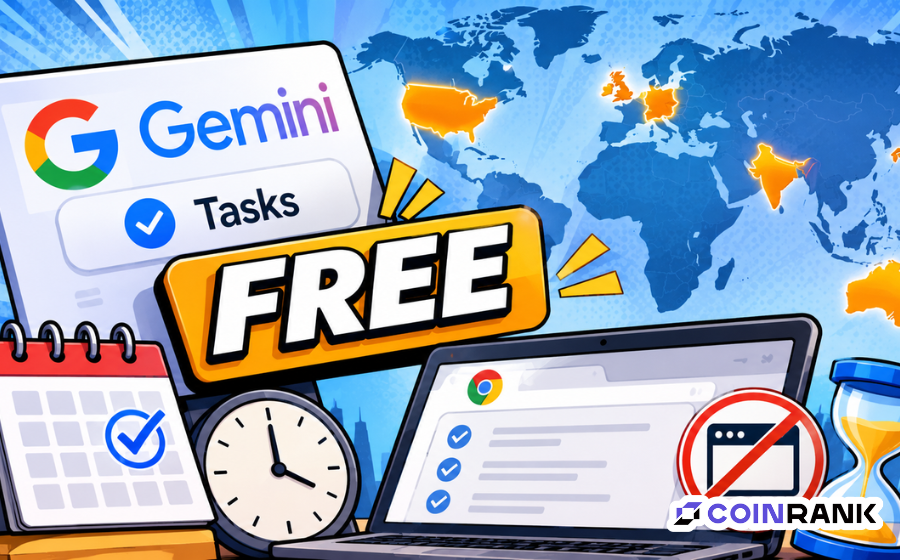
Google is rolling out free Gemini Tasks access in six countries, with eligibility limited to personal accounts aged 18 or older with History enabled. Free and Plus users can schedule tasks on
Free and Plus users can schedule tasks once daily, while Pro and Ultra offer more frequent scheduling, Gmail triggers, and topic monitoring.
Google is making Gemini Tasks free in six countries, but scheduling frequency, browser access, and task execution limits still vary by plan.
Google announced on November 17 that Tasks in Gemini is rolling out free in the United States, Japan, South Korea, Canada, Australia and India. But free access does not include every scheduling feature, and a scheduled task is not a guarantee of an on-time result.
The rollout uses Gemini 4 Hydrogen, with additional advanced features starting in the United States. Google also acknowledges that tasks can fail or require users to finish a step themselves.
The useful way to understand the product is to separate 3 questions: Can this account use it? What can trigger the work? What must happen before that work is actually complete?
WHO CAN USE GEMINI TASKS FOR FREE?
Google requires a personal account, age 18 or older and History enabled. Work and school accounts are excluded. Outside the 6 free-access countries, Tasks requires Pro or Ultra in supported Gemini markets, excluding the European Economic Area, Nigeria, Switzerland and the United Kingdom. It is available through Gemini’s mobile, Mac and web apps.
This makes “free” an access rule, not a universal feature promise. Account eligibility is the first check; the next is whether the available schedule matches the job.
HOW DO FREE AND PAID SCHEDULES DIFFER?
For free and Google AI Plus users, tasks can be scheduled up to once daily within a broad overnight, daytime or evening window. Pro and Ultra add more frequent time-based schedules, Gmail-filter triggers and topic monitors. Active-schedule limits are 10 for free or Plus and 50 for Pro or Ultra.
These are different limits: the number of saved active schedules does not describe how many tasks can run simultaneously. Google separately caps running tasks at 15. Exhausted usage allowances, concurrent work and heavy traffic can stop or delay a scheduled run.
Even paid scheduling is not an exact-time service guarantee. Google describes execution times as approximate and cautions against using monitors for fast-moving or time-critical events.
In practical terms, a daily digest and an alert that must arrive before scarce tickets sell out have different failure costs. Our reading is that choosing an automation should start with how much delay the task can tolerate, not simply whether a scheduling option exists.
Looking for the latest scoop and cool insights from CoinRank? Hit up our Twitter and stay in the loop with all our fresh stories!
〈Gemini Tasks Goes Free in 6 Countries: Scheduling and Browser Limits〉這篇文章最早發佈於《CoinRank》。