GENIUS Act One Year Anniversary: What Changed Since 2025 One year ago today, the United States got its first federal stablecoin law. The unfinished business around it is exactly why crypto po
GENIUS Act One Year Anniversary: What Changed Since 2025
One year ago today, the United States got its first federal stablecoin law. The unfinished business around it is exactly why crypto policy watchers aren't celebrating quietly.
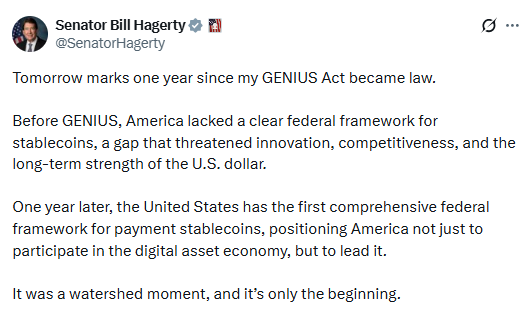 Source: X(formerly Twitter)
The GENIUS Act one year anniversary lands on July 18, 2026 — the same date Senator Bill Hagerty, one of the law's lead authors, marked with a post calling it a watershed moment that positioned America to lead the digital asset economy rather than just participate in it. But the anniversary arrives with an awkward asterisk: the law's own implementation deadline falls on this exact date, and regulators haven't finished the job.
GENIUS Act One Year Later: What Actually Changed
The GENIUS Act — formally the Guiding and Establishing National Innovation for U.S. Stablecoins law— was signed into law on July 18, 2025 as Public Law 119-27, becoming the first comprehensive federal framework for payment stablecoins in U.S. history. Before it, issuers operated under a patchwork of state money-transmitter rules with no unified federal standard.
The market response has been measurable. Industry group The Digital Chamber reports the global stablecoin market has grown to roughly $315 billion in 2026, up from about $206 billion at the start of 2025, while real-world stablecoin payment volume has roughly doubled over the same stretch to around $390 billion. Executives across the payments industry point to the same underlying shift: legal clarity, not new technology, is what unlocked business adoption that had been stalled by regulatory uncertainty.
GENIUS Act Anniversary: The Rules Still Aren't Finished
Here's the part getting less attention on the anniversary itself. The GENIUS Law gave six federal agencies — the OCC, Federal Reserve, FDIC, NCUA, Treasury, and FinCEN/OFAC — exactly one year to finalize implementing rules, with that deadline landing on the same July 18, 2026 date being marked as an anniversary. As of the deadline, agencies have published proposed rules, including an OCC capital floor proposal and a joint AML/sanctions framework, but none have been finalized into binding regulation.
That gap matters most for new federal applicants, foreign issuers, and state-qualified issuers still waiting to learn whether they qualify as "permitted" under the law. The framework's ultimate effective date is now anchored to a backstop: the earlier of 120 days after final rules or January 18, 2027. Until the rulebook closes, the law's biggest promise — clear market access — remains partly theoretical for the issuers most exposed by the delay.
CLARITY Act 2026: Why Lummis Calls This the Last Chance
The GENIUS Act only ever solved half the puzzle — it governs stablecoins specifically, not the broader question of who regulates the rest of the digital asset market. That's the gap the CLARITY Act is meant to close, and it's why Senator Cynthia Lummis has spent July tying the two bills together in public.
Lummis has repeatedly warned that the current session is likely Congress's last realistic window to pass comprehensive market structure legislation before 2030, framing the CLARITY Law as the furthest any market structure bill has ever traveled — a 294-134 House vote, a 15-9 committee vote, and a merged Senate text now targeted for floor action. The bill needs seven Democratic votes before the Senate's August recess to clear the 60-vote threshold, with a defense spending bill competing for the same floor time.
The stakes Lummis describes are direct: without passage now, jurisdiction over crypto policy risks freezing for years, particularly if control of Congress shifts after November's midterms — leaving, in her words, another country to write the rules while America spends the next decade catching up.
Conclusion
The GENIUS Act one year anniversary marks real progress — a $315 billion stablecoin market and the first federal framework in U.S. history — alongside an unfinished rulebook. The CLARITY Act now carries the next chapter, with Lummis framing the coming weeks as the narrowest window Congress may get before 2030.
Disclaimer
This article is for informational purposes only and does not constitute legal, financial, or investment advice. All legislative details, dates, and figures are based on publicly available statements and data as of July 18, 2026, and are subject to change as rulemaking and Senate proceedings continue. Always consult official government sources or a qualified professional for guidance on regulatory matters.