A bipartisan group of U.S. senators has urged the Treasury Department to keep state regulators involved as final rules under the GENIUS Act move closer. In a June 16 letter to Treasury Secret
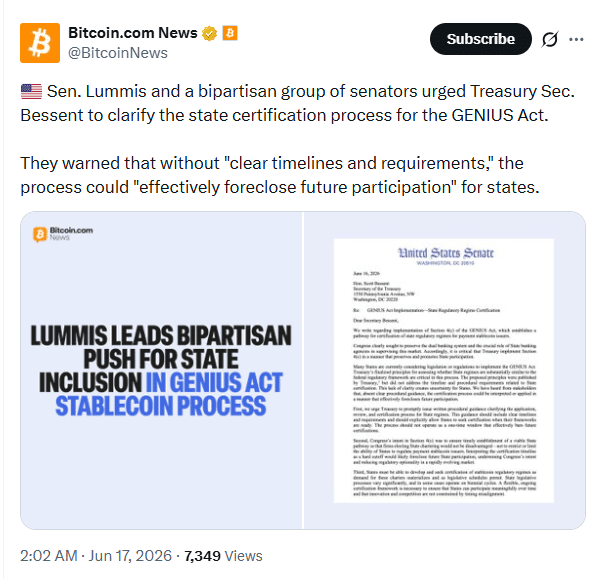
A bipartisan group of U.S. senators has urged the Treasury Department to keep state regulators involved as final rules under the GENIUS Act move closer. In a June 16 letter to Treasury Secretary Scott Bessent, the lawmakers warned that unclear certification steps could create uncertainty for state banking agencies.
They said Congress intended to protect the dual banking system while allowing states to supervise eligible payment stablecoin issuers. The senators asked the Treasury to ensure that state participation remains open, practical, and clearly defined.
Senators Defend State Role Under GENIUS Act
The letter was led by Senator Cynthia Lummis. It was also signed by Senators Kirsten Gillibrand, Bill Hagerty, Kevin Cramer, Pete Ricketts, Angela Alsobrooks, and Catherine Cortez Masto.
The senators said the GENIUS Act gives states a path to certify their own stablecoin rules. Those rules must be substantially similar to federal standards.
Source:
XThe dispute focuses on the Treasury’s approval process. It concerns state-level stablecoin supervision.
Lawmakers said Congress designed the GENIUS Act to protect the dual banking system. That system gives oversight power to both federal and state regulators.
They urged the Treasury to apply the law carefully. They said state participation should be preserved. They warned against concentrating too much authority in Washington.
State Certification Takes Center Stage
The senators focused on Section 4(c). It explains how states may qualify to supervise eligible payment stablecoin issuers.
Their letter said Treasury’s proposed principles were unclear. They did not explain application steps. They also did not set review timelines or decision procedures.
Without those details, states may face uncertainty. That could affect states trying to align their rules with federal requirements.
Lawmakers Ask for Written Guidance
The group asked Treasury to publish written guidance. The guidance should explain how states can apply.
It should also explain how reviews will work. It should say when states can expect decisions. The senators said the process should remain open. They said it should not be treated as a one-time chance during early GENIUS Act implementation.
Why Timing Matters for States
The lawmakers noted that state legislatures do not all operate on the same schedule. Some meet annually, while others convene only every two years. They argued that states should be allowed to seek certification whenever their stablecoin frameworks are complete.Smaller Issuers Could Be Most Affected
The state pathway mainly applies to payment stablecoin issuers with no more than $10 billion in outstanding issuance. The GENIUS Act allows those smaller issuers to choose state supervision if their regulator receives federal certification.
Rulemaking Enters Final Phase
Treasury opened public comments on its proposed state-level principles in April, with the comment period closing in early June. The senators’ letter arrived after that window ended, as the department prepares a final rule.
Compliance Rules Also Advance
Treasury is also working on stablecoin rules covering illicit finance controls. Those measures would treat permitted issuers as financial institutions for Bank Secrecy Act purposes and require sanctions programs. Industry groups have pushed for clearer limits on AML duties.
New York’s Department of Financial Services has proposed updates to align its stablecoin rules with the GENIUS Act. The state has said eligible issuers could continue under DFS supervision if New York receives federal certification.
Conclusion
The senators’ message places state oversight back at the center of the stablecoin debate. Their position is that the Treasury can finalize strong national rules without sidelining state regulators.
The final certification process will determine whether smaller issuers gain a state-supervised route or face a centralized federal system.
Appendix Glossary of Key Terms
Payment Stablecoin Issuer: A company or institution that creates and manages stablecoins used for payments.
State Certification: A federal approval process that allows state regulators to supervise eligible stablecoin issuers.
Dual Banking System: A U.S. regulatory model where both state and federal agencies oversee financial institutions.
Treasury Department: The federal agency responsible for financial policy, economic regulation, and rulemaking.
Bank Secrecy Act: A U.S. law requiring financial institutions to help detect and prevent illicit finance.
AML Compliance: Anti-money laundering rules and controls used to identify suspicious financial activity.
Sanctions Program: A compliance system that helps prevent transactions with restricted people, companies, or countries.
Frequently Asked Questions About GENIUS Act
1- What are the senators asking the Treasury to do?
They want the Treasury to keep state regulators involved, clarify certification steps, and allow states to apply when ready.
2- Why is certification important?
It decides whether a state regime can supervise eligible payment stablecoin issuers.
3- Which issuers could use state supervision?
Mainly payment stablecoin issuers with no more than $10 billion in outstanding issuance.
4- What happens next?
The Treasury is expected to finalize its state-level stablecoin rule after reviewing comments and lawmaker concerns.
References
Crypto.News
TheBlock