Ghana’s Minister for Communication, Digital Technology and Innovations, Samuel Nartey George, has criticised the country’s high number of broadcast stations, calling the situation “pure madne
Ghana’s Minister for Communication, Digital Technology and Innovations, Samuel Nartey George, has criticised the country’s high number of broadcast stations, calling the situation “pure madness” and “media tyranny” rather than true media freedom.
While delivering a keynote address on Monday, the minister questioned why a country of 35 million people would have almost 700 radio stations and 120 television stations. He argued that the situation is concerning and could create challenges for the media industry.
“Explain to me why a country like Ghana, with 35 million people, should have almost 700 radio stations and 120 TV stations,” the Ghanaian Minister said, adding that “it is pure madness.”
IM: Footy Blog
Also Read: What Ghana’s ID card and digital wallet plan means for payments in Africa.
Beyond criticising the high number of media organisations, Samuel George also criticised how political and religious organisations own media stations in the country, which violates existing regulations. He noted that these organisations found a loophole in the system and now obtain licences under the cover of other entities.
“We have a law that says religious bodies should not own broadcast houses, but we know that they own them because they use pseudo-entities to apply to the National Communications Authority,” he explained.
He went on to emphasise his readiness to shut down some stations, which he said was highly criticised by top-ranking individuals and the opposition parties. At some point, when the idea was set to materialise, the Minister recounted how the President received warnings that one of his Ministers was going beyond the boundary.
“If you leave me, I will shut down every political and religiously affiliated media house so that we have a clean slate in this country,” he added.
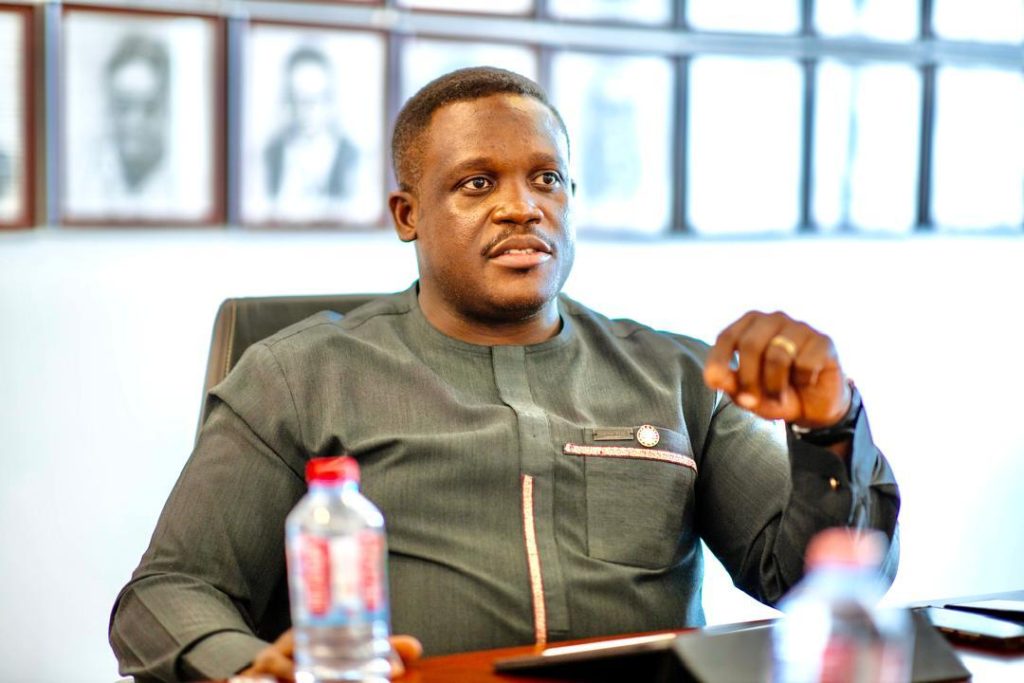
Ghana’s Minister for Communication, Digital Technology and Innovations, Samuel Nartey George (IM: Ministry of Communications, Digital Technology and Innovations)
Samuel George went on to suggest an ideal cap of fewer than 100 active radio stations for better sustainability and quality and criticised the urban concentration, chaotic oversaturation, and opaque ownership structures.
His comments have spurred massive debate over where the line between media freedom and media chaos is drawn. The arguments are about when shutting down a media organisation translates to hindering press freedom, or when it comes in contrast to revoking licenses from media organisations that obtain them through back doors.
Another bone of contention is whether shutting down politically and religiously owned media stations would not create national unrest and massive criticism, and whether the backlash would be averted through the use of regulatory frameworks that dictate the extent of their operations.
Ghana faces a test of media freedom vs media tyranny
When a government or authority intentionally cuts off internet access, especially during protests, social unrest or elections, it directly sabotages the ability of the press to function and citizens to stay informed. As a result, an internet blackout is frequently termed media suppression because the internet has evolved into the primary infrastructure for modern journalism, free speech, and the free flow of information.
The above also relates to ongoing debates in Ghana. Shutting down media organisations strikes a direct blow to the heart of democracy, public safety, and human rights. Broadcasting networks are the lifeline that connects everyday people to the primary updates on what is happening in their country.
Under local and international law, such as the Universal Declaration of Human Rights, freedom of expression and the right to seek, receive, and impart information are protected, making forcible shutdowns a direct violation of these rights.
The arguments also touch on instances when media organisations intentionally spread false information or weaponise their platforms for political warfare. As explained by the Ghanaian Minister, the rapid and politically motivated licensing over the past two decades has led to spectrum clutter, frequency congestion, and financially unviable media operations.
While partisan or hate-instigating media can cause social harm, threatening to shut down every politically and religiously affiliated media house to achieve a clean slate can be construed as an extreme regulatory measure.
In a constitutional democracy like Ghana, governed by the 1992 Constitution, which explicitly protects press freedom and independence under Chapter 12, sweeping executive shutdowns risk violating constitutional rights and press freedom.
Can the government shut down media organisations?
In extreme situations when media organisations constitute acts of misinformation, commit unfair broadcasts, or act partisan, most democratic-backed constitutions do not empower the government to shut down a Radio or TV station.
In Nigeria, the 1999 Constitution does not grant the government an arbitrary or absolute right to shut down media organisations. Section 22 enshrines the role of the media to hold the government accountable and report information to the public, while Section 39 guarantees freedom of expression and the press.
As the National Broadcasting Commission (NBC) regulates broadcast media under the NBC Act, civil society groups like the Socio-Economic Rights and Accountability Project (SERAP), human rights lawyers and courts have repeatedly ruled that shutting down radio and TV stations or revoking licenses over administrative or political disagreements violates constitutional rights to a fair hearing and free expression.
Regulations such as the Nigeria Data Protection Commission (NDPC) under the Nigeria Data Protection Commission (NDPC), have been invoked by lawmakers and the government to tighten control over online platforms and digital creators.
On Press Freedom
The 1992 Constitution of Ghana strictly prohibits government control, interference, censorship, or harassment of media organisations, protecting press freedom under Chapter 12. As Article 162(1) explicitly guarantees the freedom and independence of the mass media in Ghana, Article 162(2) states that, subject to the Constitution and laws not inconsistent with it, there shall be no censorship in Ghana.
Also, Article 162(4) dictates that editors and publishers shall not be subject to control or interference by the government, nor shall they be penalised or harassed for their editorial opinions, views, or publication content.
Also Read: How Africa lost $1.12 billion to govt-imposed internet shutdowns in 2025.
Oftentimes, if given the power to shut down media organisations, government authorities always abuse this power by labelling legitimate and verified investigative journalism exposing government corruption as false info or fake news just to protect themselves. This results in total censorship, where the only allowed information is what praises the politicians in power.
Instead of the government shutting down TV and Radio stations, an independent broadcasting commission, such as the Nigerian NBC, is tasked with reviewing complaints and making decisions such as issuing warnings, mandating on-air retractions, or issuing fines.