Goldman Sachs has named 109 new partners, the largest group since 2010. But when the investment bank unveiled the promotions on Thursday, it did not provide the customary breakdown of the cla
Goldman Sachs has named 109 new partners, the largest group since 2010. But when the investment bank unveiled the promotions on Thursday, it did not provide the customary breakdown of the class by gender and race. The omission comes amid a growing aversion among US companies towards the disclosure of diversity data.
The class grew, the disclosure shrank
In Goldman’s announcement for 2026, which is set to come into effect on January 1, 2027, the number of newly appointed partners stands at 109. In 2024, it announced 95 newly appointed partners. That indicates a 14.7% increase between 2024 and 2026.
However, what makes the announcements more interesting is that the 2024 announcement included other numbers. The number of women was 26 (27%), and the number of Asian partners was 17 (18%), while the number of partners from Hispanic/Latino and Black communities were six (6%) and four (4%), respectively. The recent announcement, however, has not provided any of this information. This suggests less disclosure, not necessarily less diversity.
Around 85% of the newcomers work in revenue-generating businesses, Reuters reported. An executive said more than 100 women will serve among roughly 500 partners overall. But that figure says nothing about this incoming group.
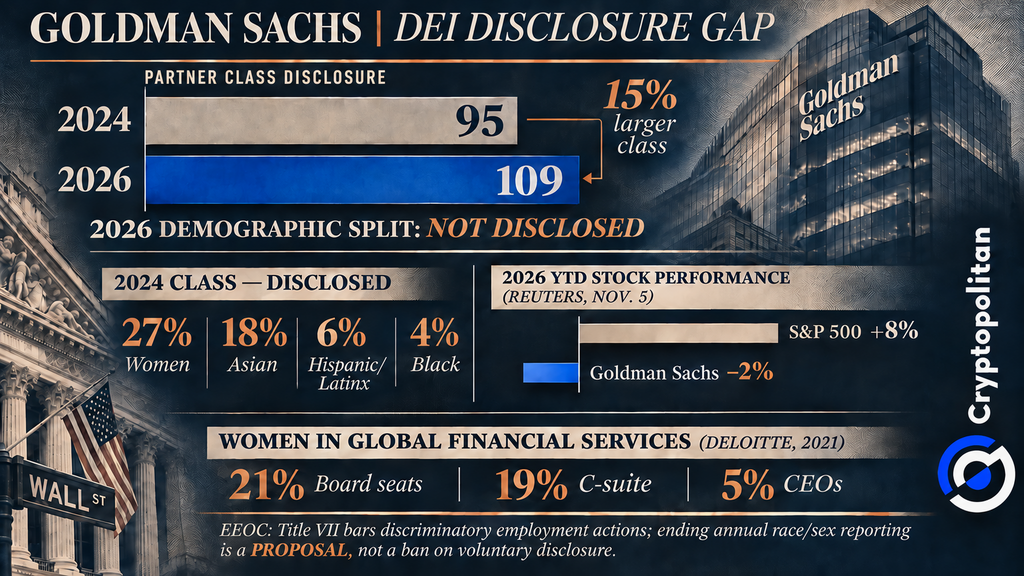 Goldman Sachs 2026 Partner Class: 109 Promotions, Diversity Disclosure Gap and Market Comparison
An executive points to the legal climate
A Goldman executive told Reuters that the changing legal climate influenced the decision to withhold this year’s demographic breakdown. The executive maintained that workforce diversity remains important to the bank’s business. The move comes as the Trump administration challenges certain corporate diversity, equity and inclusion initiatives.
Not everyone accepted that explanation. Mayra Rodriguez Valladares, managing principal at MRV Associates, questioned why a bank as influential as Goldman would withhold the figures rather than clearly state its position on equal opportunity.
Partner data is not Goldman’s only diversity report
Goldman continues to publish information about diversity in its other reports. Its 2023 People Strategy Report contained information about its partner class and US workforce for 2022. The bank also emphasized that workforce diversity is key to its commercial success reflected in its filing for 2025. Its proxy for 2026 describes the make-up of its board. But all of these disclosures present different groups, and none shows the demographic composition of this year’s partners.
What the EEOC has and has not done
Goldman’s decision to withhold its 2026 partner-class demographics raises a question: Does US employment law restrict companies from publishing diversity figures? Guidance from the Equal Employment Opportunity Commission (EEOC) does not prohibit companies from voluntarily publishing aggregate demographic figures. Instead, the guidance warns that employment decisions influenced even partly by race, sex or another protected characteristic can violate Title VII of the Civil Rights Act of 1964, the US federal law prohibiting workplace discrimination.
In July 2026, the EEOC also proposed ending mandatory annual workforce reports on race and sex. The agency estimated that these reports cost employers nearly $275 million a year. The proposal concerns information submitted to regulators. It would not prevent companies from voluntarily sharing diversity statistics with the public.
What investors and clients lose in the gap
The pullback in diversity reporting extends beyond Goldman. The Conference Board found that 53% of S&P 100 companies changed their DEI messaging or organization in 2025 filings.
Still, tracking progress requires consistent data. Deloitte’s global study found that women held 21% of financial-services board seats, 19% of C-suite positions and just 5% of CEO roles in 2021. Such benchmarks help measure women’s advancement into leadership, but only when companies continue publishing comparable figures.
Goldman shares were down about 2% in 2026 as of November 5, while the S&P 500 had gained 8%, Reuters reported. There is no evidence that the missing diversity disclosure caused the difference. The concern is transparency. In the absence of the latest partner-class diversity disclosure, employees, investors and clients have less information to assess whether Goldman’s commitment to diversity is reflected in its leadership appointments.
The smartest crypto minds already read our newsletter. Want in? Join them.