Google and Unity revealed AI-powered tools on Wednesday that allow anyone to develop functional video games without any coding experience. The technology increases accessibility of game devel
Google and Unity revealed AI-powered tools on Wednesday that allow anyone to develop functional video games without any coding experience. The technology increases accessibility of game development. However, it also raises questions about whether existing safety protocols are effective in dealing with the new technology.
On October 7, Google and Unity unveiled their collaboration by introducing Google’s Playground while getting ready to launch Unity Spark in the near future. These tools are supposed to facilitate the process of making games, but there are questions as to whether current safety and review mechanisms will be able to cope with it.
What Google and Unity actually shipped
The Playground is only accessible to US users who are at least 18 years old. The platform lets creators select the genre, explain the visual and gameplay design, and create games in 2D or 3D formats. It allows uploads, editing, and game sharing using links or Google’s Explore gallery.
Playing games on Playground is free, but creating them makes you consume the weekly allowance of tokens. Paid subscribers are granted more tokens to create new games.
Unity Spark is still under its testing phase. It is expected to launch closed beta testing this year. The purpose of Unity Spark is to provide creators with more control over games, better 3D environments, and access to the game engine of Unity.
Unity CEO Matt Bromberg stated that the purpose of AI is to help people create rather than kill the creative process.
Unity Spark is about being able to create real, unique interactive experiences.
— Matt Bromberg, President and CEO of Unity, October 7, 2026
In his October 7 statement, Bromberg mentioned the necessity of proper refinement and distribution of original works of art.
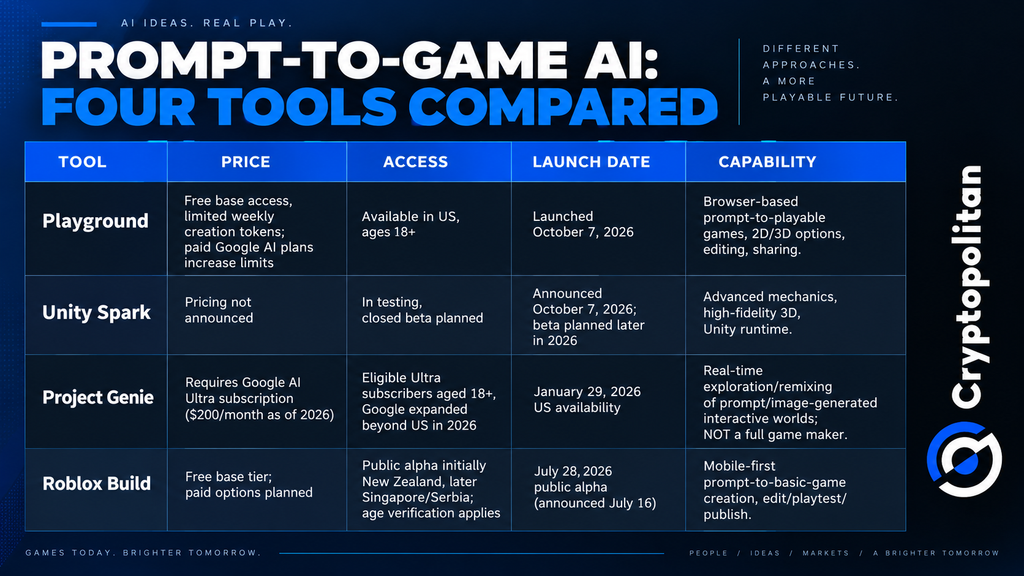
Google Playground vs Unity Spark vs Project Genie vs Roblox Build: Features, Pricing and Access
Why the safety net has holes
According to Google, published Playground games are subject to safety checks and also allow users to report them. Still, these safety procedures are just part of the company’s platform policies, not independent age ratings.
The Federal Trade Commission states that the ESRB rating system does not apply to advertisements or independent user-generated content. Ratings may also become useless as time goes on and the video games get updated post-release. The agency also warns about harmful AI chatbot responses and in-game purchases.
Although Playground permits only adults to create content, the greater problem is yet to be resolved: AI video games can be developed and altered much faster than traditional quality control can be implemented.
No single referee for AI games
Oversight is divided among platform policies, consumer protection, child-safety rules, and AI regulations.
The EU AI Act requires AI-generated content to comply with transparency obligations starting August 2. Existing systems have until December 2 to comply with specific marking and detection obligations.
A non-binding Code of Practice that was released on June 10 assists companies in complying with these requirements without imposing new legal obligations on them. But the Act gives no guidance on how to rate AI-generated games.
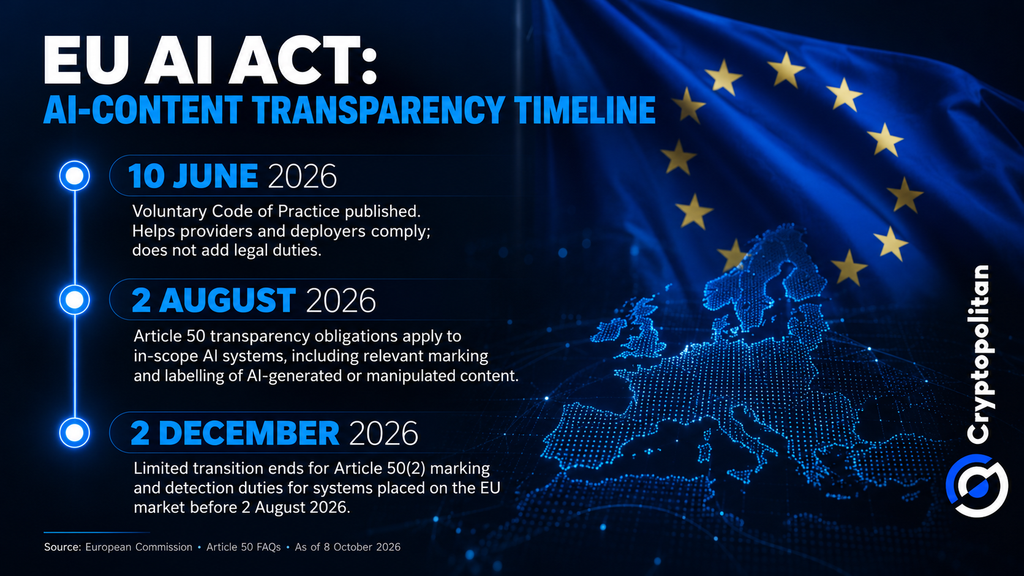
EU AI Act 2026 Timeline: Key Transparency and Compliance Deadlines for AI-Generated Content
Google had already explored AI-generated interactive experiences with Project Genie, which lets subscribers explore virtual worlds created by AI. Roblox Build, launched in July, also allows users to turn text prompts into playable games.
While each tool works slightly differently, they have a common challenge. As the game creation process becomes simpler, regulators and game platforms are looking for ways to ensure that safety regulation does not lag behind the process.
The smartest crypto minds already read our newsletter. Want in? Join them.