The most anticipated video game on Earth has taken 12 years to make. Grand Theft Auto 6, due in November after two delays, carries an estimated budget of $1 billion to $2 billion — likely the
The most anticipated video game on Earth has taken 12 years to make.
Grand Theft Auto 6, due in November after two delays, carries an estimated budget of $1 billion to $2 billion — likely the most expensive entertainment product ever made, by anyone, in any medium.
Thousands of people across multiple studios built its world the old way, manually.
Rockstar's owner is proud of that.
"Their worlds are handcrafted," Take-Two CEO Strauss Zelnick said, insisting "generative AI has zero part" in the game. "They're built from the ground up, building by building, street by street, neighborhood by neighborhood."
However, nobody, in gaming thinks the $2 billion game is a viable business. And on Oct. 2 in Tokyo, one of the industry's oldest companies proposed a way out.
First, who is Capcom?
Capcom is one of the oldest and biggest names in video games.
The Japanese company, founded in 1979 and based in Osaka, made Resident Evil, Street Fighter, Monster Hunter, Mega Man and Devil May Cry. If you've ever held a game controller, you've probably played something Capcom made. A new Resident Evil film is in theaters right now.
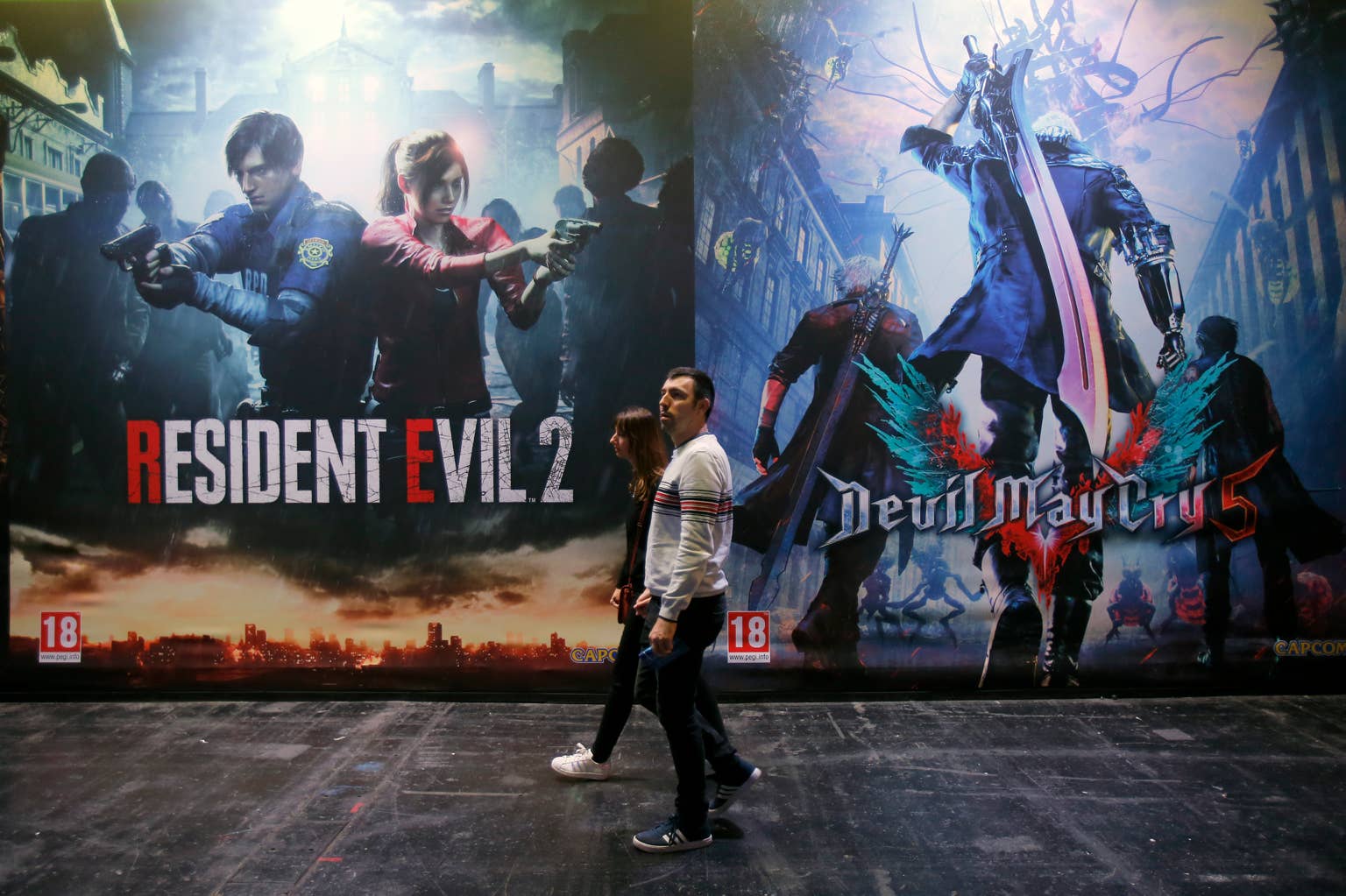
PARIS, FRANCE - OCTOBER 27: Posters from video games 'Resident Evil 2 Remake' developed and published by Capcom and "Devil May Cry 5" developed by Capcom Production Studio 1 and published by Capcom are displayed during the 'Paris Games Week' on October 27, 2018 in Paris, France. 'Paris Games Week' is an international trade fair for video games and runs from October 26 to 31, 2018. (Photo by Chesnot/Getty Images)
At its own conference in Tokyo, the company announced it is turning the system it uses to build all its games into what it calls an "AI-generation game engine."
To understand why that matters, you need to know what a game engine is.
It's the software that handles everything a game needs — the graphics, the sound, the physics of how a character jumps or a door opens. Developers don't build each game from nothing. They build it inside the engine.
Can't AI just make the whole game?
People have tried.
The most famous attempt is Oasis, an AI version of Minecraft that went viral in 2024 — a game with no code at all, where an AI model dreams up each frame based on what you press. Viral AI remakes of GTA work the same way.
Playing them is another matter.
Oasis runs at a blurry 360p, forgets the world behind you when you turn around, and teleports you somewhere else mid-action. PC Gamer summed up the genre as showcasing "AI's unlimited ability to copy things but worse."
Zelnick's deeper objection is about the art.
"There is no creativity that can exist by definition in any AI model," he has said — AI can only look backward at what exists, and hits come from what doesn't exist yet.
More on TheStreet Roundtable
At its March shareholders' meeting, Capcom said:
"We will not implement assets generated by AI into our games. However, we plan to proactively use it as a contributing technology to improve the efficiency and productivity of the game development process."
In simple words: no AI-made monsters, faces, music or artwork will ever appear in a Capcom game. Humans make everything you see and hear.
Capcom already tried this.
In January 2025, GameSpark reported the company built an AI tool that reads design documents and suggests ideas for the thousands of small objects that fill a game world — barrels, signs, furniture.
Why would they need that? Technical director Kazuki Abe explained with Monster Hunter: the team has to come up with "hundreds of thousands of unique ideas" for a single game. The AI suggests, humans decide. Staff reportedly loved it.
The problem, as Capcom programmer Sashi Ishida explained it, modern games look so detailed that even a tiny change takes a huge amount of work. Making games has become slow and expensive — GTA 6 is the extreme proof.
The whole industry is moving this way
A survey this year found 36% of people working in games already use AI on the job every day. mostly for research and brainstorming, not the creative work.
The reason is money.
Games cost more to make than ever, and the industry has been through waves of layoffs.
At a conference last October, Dead Space creator Glen Schofield argued AI could help fix that — not by replacing people, but by making them faster.
The giants are all moving.
Microsoft has built generative AI that can create video game scenes, trained on its own titles.
Ubisoft runs an AI tool that predicts where bugs will appear in code before they happen.
Electronic Arts CEO Andrew Wilson has told investors AI sits at "the very core" of the company's business. And Rockstar's own parent, for all the handcrafting pride, is running "hundreds of pilots" of generative AI inside Take-Two — in the tools, not the art.
Wall Street has put a number on the prize.
A Morgan Stanley analysis estimates generative AI could hand the game industry $22 billion in extra operating profit by cutting the cost of making content — the single biggest expense in gaming.
Editor's take
Development costs are what push the sticker price on your games.
The standard new release sat at $60 for roughly 15 years, jumped to $70 in 2020, and crossed $80 in 2025 when Nintendo priced Mario Kart World there — the first ordinary edition at that level since the cartridge era.
Two price hikes in five years, after a decade and a half of none, and both arrived as budgets ballooned toward GTA 6 territory.
"If AI genuinely cuts the cost of making games, it's the industry's main lever against the next jump to $90. But when making games gets cheaper, one of two things happens, games get cheaper, games get more adventurous." Mehab Qureshi, Senior Editor, TheStreet.