What to Know Before Using GXT Exchange A gxt exchange review matters right now because the platform is mid-launch, not fully settled. Mining phases have wrapped, two presale stages have sold
What to Know Before Using GXT Exchange
A gxt exchange review matters right now because the platform is mid-launch, not fully settled. Mining phases have wrapped, two presale stages have sold out, and the project's own roadmap points to a Token Generation Event around late August 2026.
That timing puts this review in an odd spot. The official roadmap targets a TGE date that has already passed as of this writing, yet the homepage still shows presale messaging as live. That gap alone is worth flagging before anything else.
This piece checks GXT Exchange's own published pages against each other, separates confirmed numbers from marketing claims, and lays out what a careful reader should verify before touching the presale token allocation or funding an account.
What Is GXT Exchange and What Does It Offer?
GXT Exchange describes itself as a global digital-asset trading platform, founded in 2026, offering spot trading, futures, a self-custody wallet, a launchpad, earn products, and a peer-to-peer fiat marketplace.
The stated core product line includes:
Spot trading across 200+ pairs
Futures with leverage (the homepage lists up to 125x, while the whitepaper separately states up to 50x; this discrepancy hasn't been resolved on the official pages)
A self-custody Web3 wallet spanning 80+ chains
P2P fiat on/off ramps in 100+ payment methods
A phased GXT Mining program and a GXT Launchpad presale
The project says it serves users in 180+ countries, though it also notes that certain features and pairs are restricted in specific jurisdictions.
What Is the GXT Token Used For?
GXT is the native utility token. According to the project's published tokenomics, GXT is used for trading fee discounts, Launchpad access, staking yield, governance voting, and buyback-and-burn mechanics funded by exchange revenue.
The tokenomics page lists the network as BNB Chain (BEP-20), while the whitepaper separately describes GXT as "multi-chain, issued on major EVM networks at launch." Buyers should confirm the exact contract address and chain directly before sending funds, since the two official documents don't fully agree.
How Is the GXT Token Supply Distributed?
The stated plan is a fixed 300,000,000 GXT supply with no further minting.
Category
Allocation
Share
TGE Unlock
Community & Mining
100,000,000 GXT
33.3%
92,700,000 GXT
Team & Advisors
60,000,000 GXT
20.0%
0 GXT (48-month vesting)
Liquidity & Market Making
50,000,000 GXT
16.7%
0 GXT (exchange reserves)
Private Investors
30,000,000 GXT
10.0%
0 GXT (48-month vesting)
Marketing & Operations
30,000,000 GXT
10.0%
0 GXT (48-month vesting)
Reserve
20,000,000 GXT
6.7%
0 GXT (locked 10 years)
Presale
10,000,000 GXT
3.3%
7,300,000 GXT
Token vesting is the schedule that controls when locked tokens become spendable. Here, 66.7% of total supply sits in vesting or long-term lockups, while the circulating figure at TGE is limited to 100 million GXT.
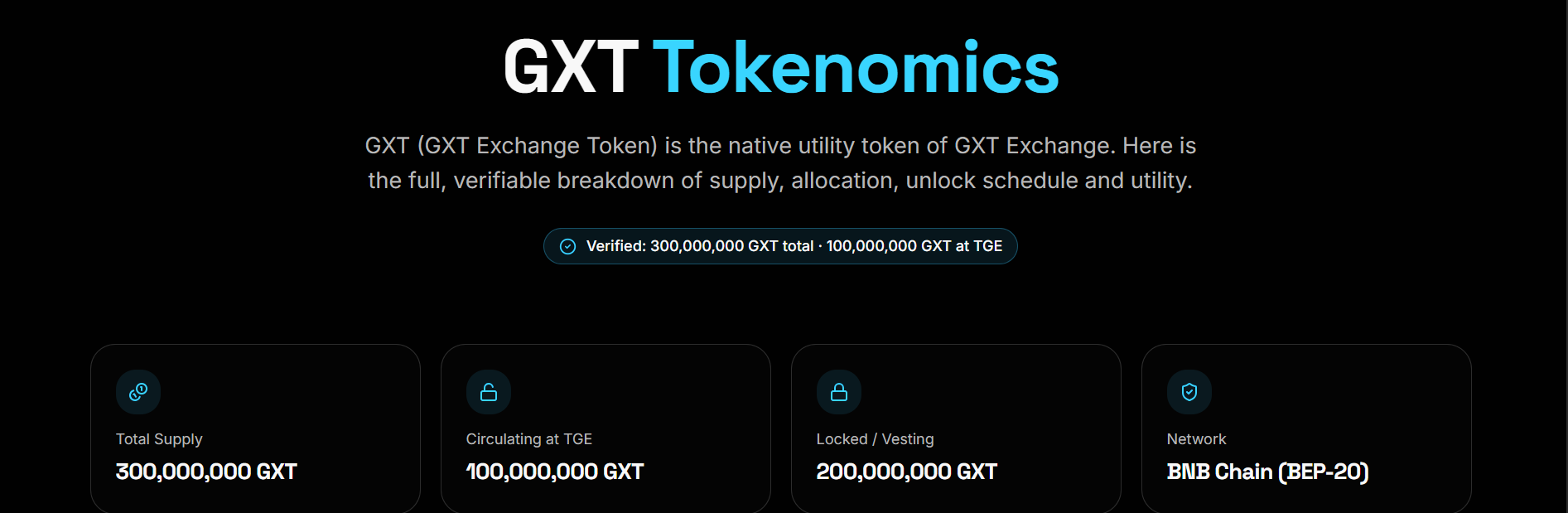
That's a meaningfully lower unlock ratio than many exchange tokens launched with on paper, it should reduce early sell pressure from team and investor wallets. It doesn't touch the mining and presale supply, though, which can move as soon as TGE hits.
What Is the GXT Presale Status in 2026?
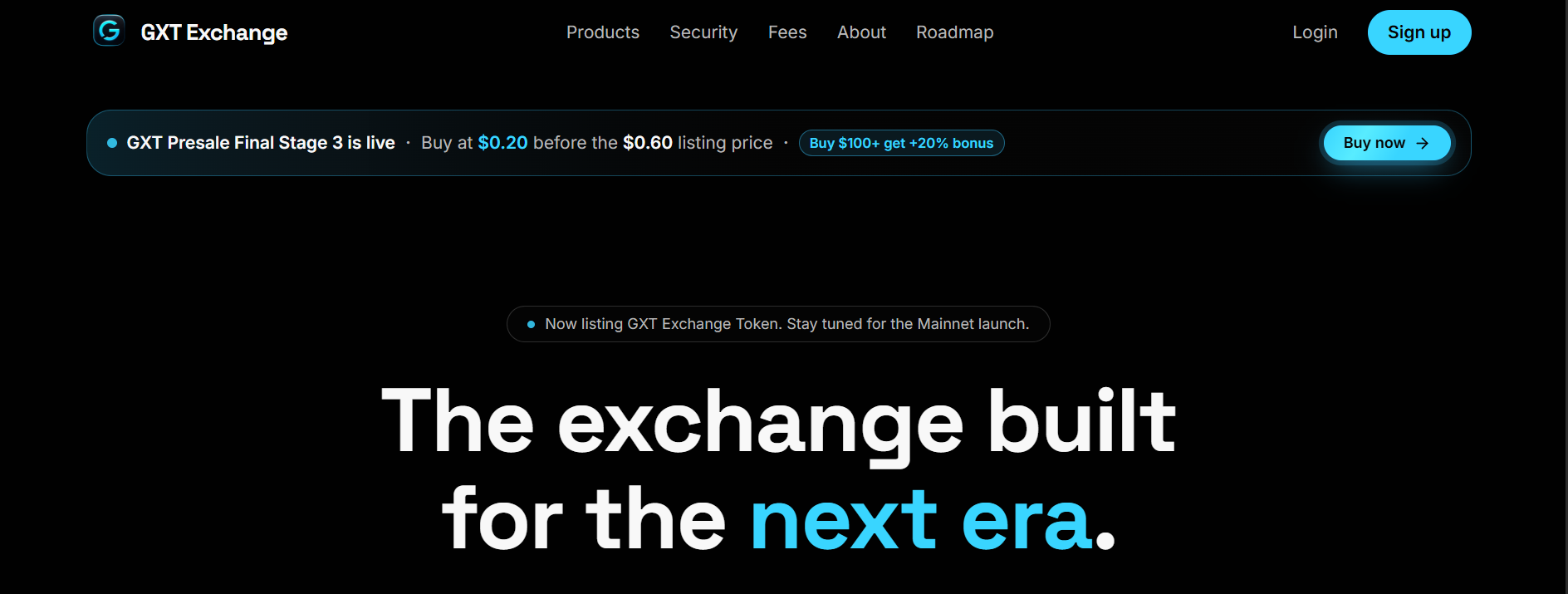
As of the latest check against the official roadmap, Presale Stage 1 (5M GXT at $0.12) and Stage 2 (3M GXT at $0.15) are marked sold out. Stage 3 (2M GXT at $0.20) is shown as live on the homepage banner, which also references a stated listing price of $0.60. That's a project claim, not a confirmed exchange price, so treat it accordingly.
Stage
Supply
Price
TGE Unlock
Status
Stage 1
5,000,000 GXT
$0.12
80%
Sold Out
Stage 2
3,000,000 GXT
$0.15
70%
Sold Out
Stage 3
2,000,000 GXT
$0.20
60%
Live per homepage
Here's a small but telling detail: the whitepaper's own FAQ section describes Stage 2 as "live and ends July 28, 2026," which conflicts with the roadmap page marking it sold out. That's exactly the kind of gap a presale eligibility check should catch before anyone buys in on outdated information.
How Secure Is GXT Exchange?
On paper, the security setup looks fairly standard for a centralized exchange. The project keeps 98%+ of user assets in multi-signature, air-gapped cold storage, and says it publishes monthly Merkle-tree attestations as Proof of Reserves.
There's also a stated $300M User Protection Fund meant to cover extreme, black-swan-style events, plus tiered KYC and AML checks the project claims line up with FATF and MiCA guidance. On the account side, expect mandatory 2FA, withdrawal allow-lists, and device binding, nothing unusual, but the basics are there.
One gap is worth pointing out directly: the whitepaper mentions independent security audits and a bug bounty program, but neither an audit report link nor an auditor name shows up anywhere on the pages reviewed. If that matters to you, it's worth asking the project for it before trusting the claim at face value.
What Are the Main Risks of GXT Exchange?
GXT Exchange's own risk disclosure section is fairly thorough, and a few points stand out as genuinely worth weighing:
Regulatory risk – rules and access can shift with little warning in any given jurisdiction
Vesting and dilution risk – 200M GXT still sits in lockup, and future unlocks could pressure the price
Liquidity risk– GXT may simply trade thin before and after listing, guarantees aside
Presale and mining risk – the dates, prices, and unlock ratios on offer are targets, not promises
Smart-contract risk– audits help, but they don't erase the chance of bugs or exploits
Is GXT Exchange Legit? Key Signs and Red Flags
Honestly, the picture is mixed rather than clear-cut.
On the plus side, the math holds up. The published allocation table adds up correctly to 300 million GXT, and locking team and investor tokens into 48-month vesting while giving the community a 33.3% share is a more conservative setup than plenty of exchange-token launches bother with. The security claims read as specific too, not vague marketing cold storage, monthly Proof of Reserves, mandatory 2FA.
But then there's the other side. Flip between the project's own pages and things stop lining up: mining phase dates shift, presale status contradicts itself, even the network standard and futures leverage change depending on which page you're reading. A project that's genuinely buttoned-up usually doesn't have its own documentation arguing with itself like this.
And then there's the timing question. TGE and the first CEX listings were targeted for late August 2026 a date that, per the whitepaper's own wording, was never more than a target to begin with, so slipping past it isn't automatically damning. Still, add that uncertainty to the unresolved contradictions, and it's hard to call GXT Exchange definitively legit based on the official pages alone. The more honest answer is: unverified, pending a direct check of the live platform.
Is GXT Exchange Safe to Use in 2026?
Based on what's published, GXT Exchange shows standard-tier security practices: cold storage majority custody, 2FA, monthly reserve attestations, and KYC/AML gating. Those are reasonable baseline protections for a centralized exchange.
What isn't independently confirmable from the official pages alone is the audit itself, the exact token contract and chain, and whether the presale and TGE timeline will hold.
Conclusion
GXT Exchange positions itself as a full-service trading platform built around a fixed-supply, community-weighted token with a structured mining and presale rollout. The allocation math checks out, vesting terms favor long-term alignment over insider unlocks, and the stated security stack covers the basics.
At the same time, the official pages disagree with each other on presale status, mining dates, futures leverage, and the token's network standard, and the Token Generation Event date the project itself set has already passed without a clear public update at the time of this check.
Disclaimer
This article is for informational purposes only and is not financial advice. Cryptocurrency investments, presales, and exchange accounts carry significant risk, including possible loss of capital. Always do your own research.