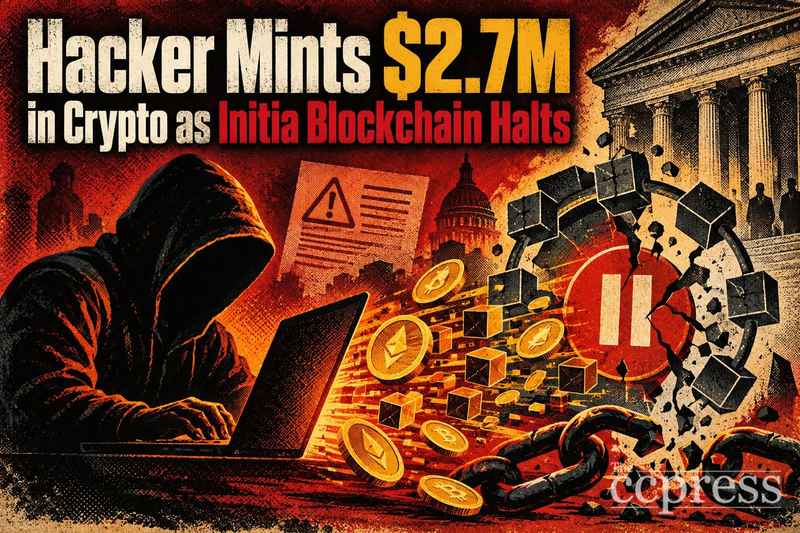
A hacker reportedly minted $2.7 million in unauthorized crypto on the Initia blockchain, forcing the network to halt operations entirely. The incident raises urgent questions about how the pr
A hacker reportedly minted $2.7 million in unauthorized crypto on the Initia blockchain, forcing the network to halt operations entirely. The incident raises urgent questions about how the project plans to contain the damage, restore the chain, and address the inflated token supply now sitting on the network.
What Happened in the Initia Blockchain Hack?
According to reporting by Bitcoin.com News, an attacker exploited a vulnerability on the Initia network to mint crypto tokens without authorization, generating approximately $2.7 million in assets they had no right to create. For related coverage, see Best Crypto Casinos for Halloween 2026: Live Events, Spooky Slots, and Real Bonuses.
In blockchain terms, “printing” or minting tokens means writing new supply into existence. When that creation is unauthorized, it is effectively counterfeiting at the protocol level. The attacker did not steal existing funds from a wallet; they manufactured new ones. For related coverage, see Bitget Enters Thailand With Licensed Crypto Exchange Acquisition.
The Initia network subsequently ground to a halt. Whether validators paused the chain as a defensive measure or the network stalled under the pressure of the incident has not been independently confirmed. The distinction matters: a deliberate pause suggests the team responded quickly; an organic failure suggests the exploit had a broader technical impact.
Initia is a relatively young modular blockchain project designed to let developers build interconnected application-specific chains. A halt at the base layer would freeze activity across any applications or rollup chains built on top of it, not just one isolated contract. This is the kind of cross-protocol fallout that makes network-level exploits particularly damaging compared to isolated smart contract bugs, as seen when the Bitget hacker routed stolen funds through THORChain after another protocol refused to freeze them.
Why the Network Halt Matters for Initia Users
A blockchain halt is not a routine maintenance window. When a network stops producing blocks, every transaction submitted during that window is in limbo: unconfirmed, unexecuted, and potentially subject to reordering once the chain restarts.
For users with open positions, pending transfers, or active applications on Initia, the halt means they cannot move funds, cannot execute trades, and cannot interact with any on-chain protocols until the network resumes. The longer the chain stays down, the more compounding uncertainty builds around which transactions will be honored and in what order.
Bridge connections between Initia and other chains also become a concern. If tokens were transferred in or out of the network near the time of the exploit, settlement finality is unclear until the chain is back up and validators confirm the canonical state. Projects that have dealt with similar bridge-adjacent fallout, such as the Symbiosis bridge exploit where 15 BTC was at stake, show how costly the recovery process can be even after the vulnerability is closed.
The network halt should be understood as a containment measure, not a resolution. Stopping the chain prevents further unauthorized minting and limits the attacker’s ability to move or swap the fraudulently created tokens. But it also freezes legitimate users in place.
What Initia Needs to Clarify After the $2.7M Minting Incident
Several critical questions remain unanswered as of this report. First: what happened to the minted tokens? Were they moved to an external wallet, swapped on a decentralized exchange, or frozen before the attacker could liquidate? The answer determines whether the $2.7 million figure represents a real loss or a contained accounting anomaly.
Second: does the team plan to burn the unauthorized supply, roll back the chain state, or absorb the inflated tokens into the existing circulating supply? Each option carries different consequences for legitimate holders. A supply burn or state rollback would require coordination with validators and could itself introduce new complications.
Third: do exchanges, bridges, or external applications need to take action? If the attacker moved any of the minted tokens off-chain before the halt, counterparties holding those tokens may be exposed. Exchanges that listed Initia assets should be watching their deposit queues carefully. The speed at which illicit funds can move through decentralized infrastructure was on full display when Bitget had to suspend withdrawals after a hacker converted stolen ETH before anyone could respond.
Finally: what was the root cause? A minting exploit can stem from a logic flaw in a smart contract, a compromised admin key, a misconfigured permission system, or a deeper consensus-layer vulnerability. The fix and the timeline for a safe restart depend entirely on the answer. Until the project publishes a post-mortem with specifics, third-party developers and users building on Initia have no reliable basis for assessing whether it is safe to resume activity.
The project had not, as of this writing, confirmed the conditions under which the network will be restarted. Validators would typically need to reach consensus on a patched binary before producing new blocks, and a security review should precede any public restart announcement. How Initia handles this next phase, whether the team moves fast and transparently or goes quiet, will define how much trust the project retains after the exploit.
Who ends up holding the bag for the $2.7 million in minted tokens? That question does not have an answer yet.
Additional source references: source document 1.
Disclaimer: This article is for informational purposes only and does not constitute financial or investment advice. Cryptocurrency and digital asset markets carry significant risk. Always do your own research before making decisions.
The article Hacker Mints $2.7M in Crypto as Initia Blockchain Halts first featured on theccpress.com.