Federal Reserve guidance that remains hawkish could spark sharper stress across global risk assets in the run-up to the central bank’s December rate decision, economist Robin Brooks warned th
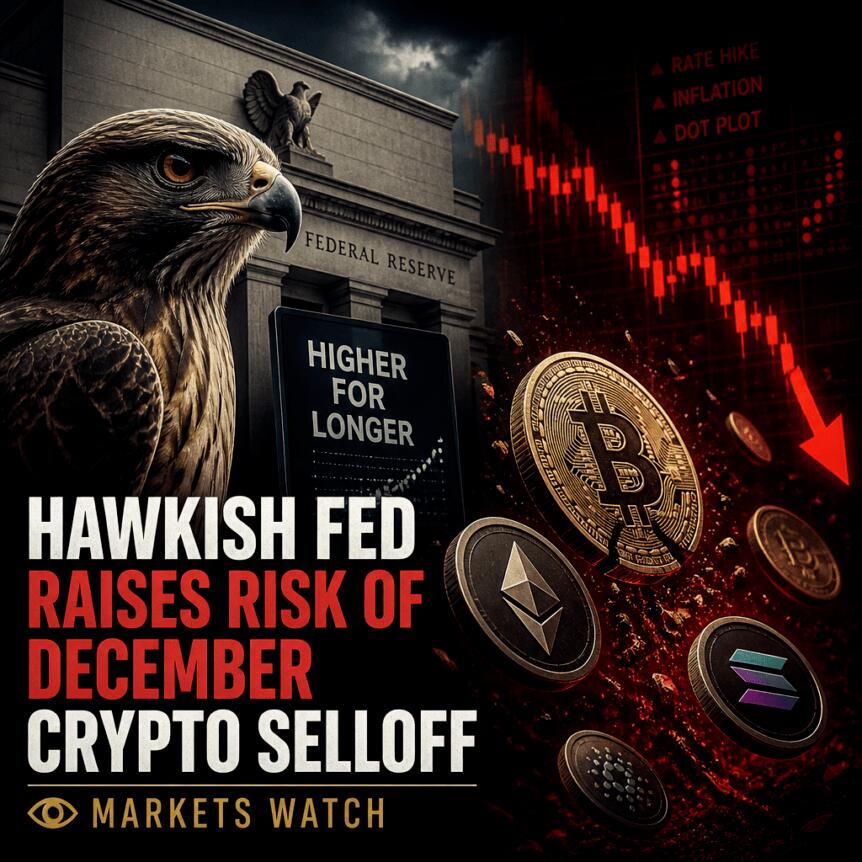
Federal Reserve guidance that remains hawkish could spark sharper stress across global risk assets in the run-up to the central bank’s December rate decision, economist Robin Brooks warned this week.
Brooks, a senior fellow at the Brookings Institution and former chief FX strategist at Goldman Sachs, argued that tightening policy while energy prices are falling and the US dollar is strengthening could push real interest rates higher—an environment he says is already setting up a “full meltdown” scenario that may force the Fed to reconsider the odds of a rate hike.
Key takeaways
- Economist Robin Brooks warned that a hawkish Fed stance could trigger severe risk-asset stress within roughly two weeks, before the Dec. 8–9 FOMC decision.
- WTI crude slid to below $80 per barrel for the first time since Aug. 10, while the US Dollar Index (DXY) rose to a nine-month high of 104.5.
- Brooks cited a “super-charged” rise in real rates as a mechanism that could amplify stress across stocks and other risk assets.
- CME FedWatch data still shows markets heavily favor a 25-basis-point hike, with only a 0.5% probability priced for no change as of Thursday.
- Stress could escalate into an outcome where the Fed ultimately chooses not to raise rates—despite widespread expectations.
Brooks links hawkish policy to a “super-charged” rise in real rates
Brooks’ warning centers on the combination of falling oil prices and continued hawkish Fed messaging. He pointed to the Fed’s posture as still implying that policy rates may need to stay higher for longer—even as WTI crude weakens.
He referenced a July?—no, a current—shift in market conditions: WTI crude fell below $80 per barrel, reaching levels not seen since Aug. 10, while the dollar strengthened. According to Brooks, this backdrop makes the Fed’s tightening stance more damaging because it increases real interest rates.
In his analysis, that dynamic can create a feedback loop: higher real yields raise borrowing costs and pressure valuations, while a stronger dollar can strain risk-heavy positions. Brooks also warned that the resulting carry-trade unwinds could occur “in chaotic fashion,” contributing to sharp volatility.
“That’s causing the Dollar to rise sharply versus emerging markets as this particular carry trade unwinds in chaotic fashion.”
What could happen before the blackout period
Brooks’ timing matters. He noted that on Nov. 28—the second Saturday before the Dec. 8–9 meeting—the FOMC enters its blackout period. During blackout windows, committee members are not allowed to give interviews or speak publicly about monetary policy and macroeconomic developments.
He argued that if the Fed does not find ways to calm markets ahead of that period, selling pressure could intensify. In that scenario, Brooks suggested it could become increasingly difficult for the Fed to deliver the anticipated hike without triggering further damage across financial conditions.
“That’ll bring a full meltdown in markets and we’ll end up not getting a hike on December 9. Unfortunately, this is the path we’re on.”
Dollar strength, weaker crude, and mounting equity pressure
Market moves cited alongside Brooks’ call for caution show a tightening financial picture. On Monday, the US Dollar Index rose to 104.5, its highest level since March. The index has also been above 100 since mid-September, signaling persistent dollar strength.
At the same time, US equities have struggled. The article noted that the S&P 500 fell to 6,882 points on Friday, a level last seen in mid-April. Brooks also observed that even news-driven optimism—such as the reinstatement of Nvidia’s CEO Jensen Huang—was not enough to lift investor sentiment.
Brooks’ concern extends beyond stocks. The article also pointed to weakness in gold, describing it as suffering its worst 60-day sell-off in more than 40 years. While gold’s drivers can be complex, the broader theme aligned with his thesis: tighter financial conditions and real-rate pressure can weigh across multiple asset categories.
CME FedWatch still leans toward a hike—so what would “pause” require?
Despite Brooks’ bearish scenario, market pricing as of Thursday still reflected confidence in a relatively contained Fed outcome. According to CME Group’s FedWatch tool, markets overwhelmingly expected a 25-basis-point rate increase in December.
As presented in the source, the probability of the Fed keeping its target range at 3.75% to 4% stood at just 0.5%, leaving little room in pricing for a pause.
That creates a key tension for investors and traders: Brooks is arguing that the cost of a hawkish stance may become too high as stress builds, potentially leading to a policy decision that diverges from current expectations. But unless market turmoil forces the Fed’s hand, the pricing suggests many participants still expect the conventional hike path.
Why crypto holders should track this shift in conditions
Crypto markets often react to changes in global liquidity and real-rate expectations, not just to token-specific news. Brooks’ warning therefore matters less as a direct signal about any single asset and more as a read on broader risk appetite: if risk assets are heading toward a rapid repricing as the dollar strengthens, correlated selling pressure can spill into highly liquid crypto venues as well.
For now, the most actionable takeaway is to watch the interaction between the dollar, energy price trends, and the probability of a Fed outcome priced by derivatives—because that combination is the mechanism Brooks says could turn a “standard” hike expectation into a faster, more disruptive unwind.
With the FOMC blackout period approaching and Fed expectations still heavily tilted toward a 25-basis-point hike, the next developments to watch are whether market stress accelerates in the intervening days—and whether that translates into any meaningful change in FedWatch probabilities ahead of Dec. 8–9.
This article was originally published as Hawkish Fed raises risk of December crypto selloff, markets watch on Crypto Breaking News – your trusted source for crypto news, Bitcoin news, and blockchain updates.