I like a lot of what Hedera is trying to build. The network is fast, transaction costs are tiny, major companies participate in its governance, and Hedera continues to target areas such as to
I like a lot of what Hedera is trying to build.
The network is fast, transaction costs are tiny, major companies participate in its governance, and Hedera continues to target areas such as tokenization, payments and enterprise infrastructure.
But none of those points automatically answer the question I care about as an investor:
Why do I need to own HBAR?
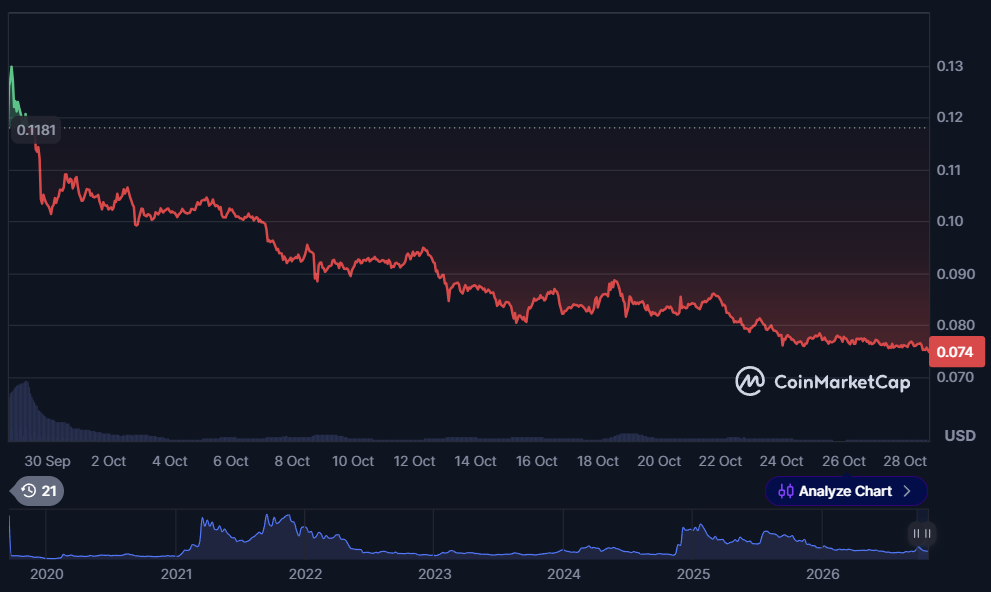
That distinction has become more important as HBAR price continues to struggle. The token is trading around $0.076 today, after losing roughly 8% over the past week even as the broader crypto market suffered a smaller decline.
For me, Hedera still needs to prove that growing network adoption can create enough persistent demand for HBAR itself.
Hedera’s Biggest Strength Creates an Interesting HBAR Problem
Hedera deliberately makes its network inexpensive and predictable for businesses.
Fees are denominated in U.S. dollars but paid using HBAR. If HBAR price rises, the amount of HBAR needed for the same transaction falls so that the dollar cost remains relatively stable.
A standard token transfer, for example, can cost around $0.001. Hedera promotes this fee model as an advantage for companies that need predictable operating expenses.
From an enterprise perspective, I understand the appeal.
From an HBAR investor’s perspective, it raises another question.
If a company can process a huge number of transactions without needing to acquire large amounts of HBAR, how much token demand does enterprise adoption ultimately create?
More transactions do create more fee demand. HBAR is also used for staking and network security.
But transaction growth itself is not the same thing as value flowing to token holders.
That is the part of the thesis I still want Hedera to demonstrate at much greater scale.
I talked about this in my recent YouTube video:
The Current Numbers Show the Difference
Hedera is not inactive.
The network processed more than 700,000 transactions over the latest 24-hour period, and Hedera itself reports more than 71 billion transactions historically.
But compare that activity with the economic value currently being generated around the retail crypto ecosystem.
As of October 28, DeFiLlama puts Hedera’s tracked DeFi TVL at roughly $31.2 million.
Its stablecoin market cap is about $24.1 million, and decentralized exchanges processed around $13.3 million during the previous seven days.
Those are modest figures for a network whose native token still carries a market capitalization around $3.4 billion.
The fee numbers are also worth looking at.
DeFiLlama currently records only a few hundred dollars in daily chain fees, with approximately $5,000 in total fees paid across the latest 24-hour period depending on the category measured.
That does not mean Hedera has no value.
It means transaction count alone can give a very different impression from economic activity.
A network can process hundreds of thousands or even millions of inexpensive transactions without generating enormous demand for the asset used to pay those fees.
Hedera Is Still Building Interesting Technology
There are legitimate reasons to stay interested.
Earlier this month, Hedera introduced Agent Accounts, which allow AI agents to make autonomous payments under predefined on-chain restrictions without handing over private keys.
Potential uses include paying for APIs, purchasing data and settling invoices automatically.
That is exactly the type of infrastructure Hedera is good at targeting: high-volume applications where predictable costs and fast settlement are useful.
The network also continues to position itself around stablecoins, tokenization and enterprise payments.
I do not dismiss any of that.
The question is whether those applications eventually create enough HBAR demand to change the token’s economics.
If an application produces millions of cheap transactions but only needs a relatively small pool of HBAR to pay for them, network success and token appreciation do not necessarily move at the same speed.
HBAR Price Still Needs to Give Buyers Something
The Hedera chart is not helping the investment case either.
HBAR is currently around $0.076-$0.077, with a market capitalization near $3.4 billion.
 Source: CoinMarketCap/Hedera
The token has repeatedly struggled to sustain its recovery attempts this year, and the latest weekly decline again shows that buyers are not aggressively defending HBAR when the broader market weakens.
That does not make $0.076 an automatic sell.
At these prices, a broader altcoin recovery could still produce a strong HBAR bounce.
But if I am considering a longer-term position, I want something more convincing than a token becoming cheaper.
I would want to see HBAR begin producing higher highs and higher lows alongside measurable improvement in liquidity, DeFi usage, stablecoins and fee generation.
Subscribe to our YouTube channel for daily crypto updates, market insights, and expert analysis.
The post Hedera Has Real Utility, but That Doesn’t Make HBAR a Buy – Here’s Why appeared first on CaptainAltcoin.