Key Takeaways: HBAR trades near $0.083, below the $0.095 resistance level, with all three major moving averages positioned above current price Canary Capital’s HBAR spot ETF has recorded over
Key Takeaways:
- HBAR trades near $0.083, below the $0.095 resistance level, with all three major moving averages positioned above current price
- Canary Capital’s HBAR spot ETF has recorded over $93 million in net inflows since launch, with only a single day of outflows
- A mid-June open interest surge of 40% alongside a 98% volume spike explains short-term price volatility despite positive fundamentals
- JPMorgan Asset Management named Hedera the preferred public-permissioned DLT for tokenizing money market funds
A JPMorgan endorsement, a Merck supply chain deal, tier-one institutional custody via Copper.co, and $93 million in ETF inflows have all landed within weeks of each other — and the price has barely reacted.
Why Price and Fundamentals Are Moving in Opposite Directions
In mid-June 2026, HBAR’s open interest on derivatives exchanges surged by 40%, simultaneous with a 98% spike in trading volume that pushed 24-hour figures above $513 million, according to data from CoinGlass. When a token’s derivatives market is that active relative to its spot market, price responds to liquidation cascades rather than to news — which is the structural reason why positive catalysts have not translated into sustained upward movement.
The spot bid from Canary Capital’s ETF, which has logged over $93 million in net inflows with only a single day of outflows, provides a baseline floor but is not large enough on its own to absorb the volatility generated by that level of leverage. Adding to the near-term headwinds is an upcoming ecosystem token unlock of approximately 3.97 billion HBAR, which OTC desk activity suggests is being anticipated by large holders. Until the unlock clears or spot buying picks up, short-sellers hold the structural advantage.
HBAR’s Descending Channel and Where Support Sits
Since peaking near $0.12 in late 2025, HBAR has moved lower through a descending channel, and all three major moving averages sit above the current price and slope downward — meaning any recovery attempt has to work through layered resistance before it carries technical significance.
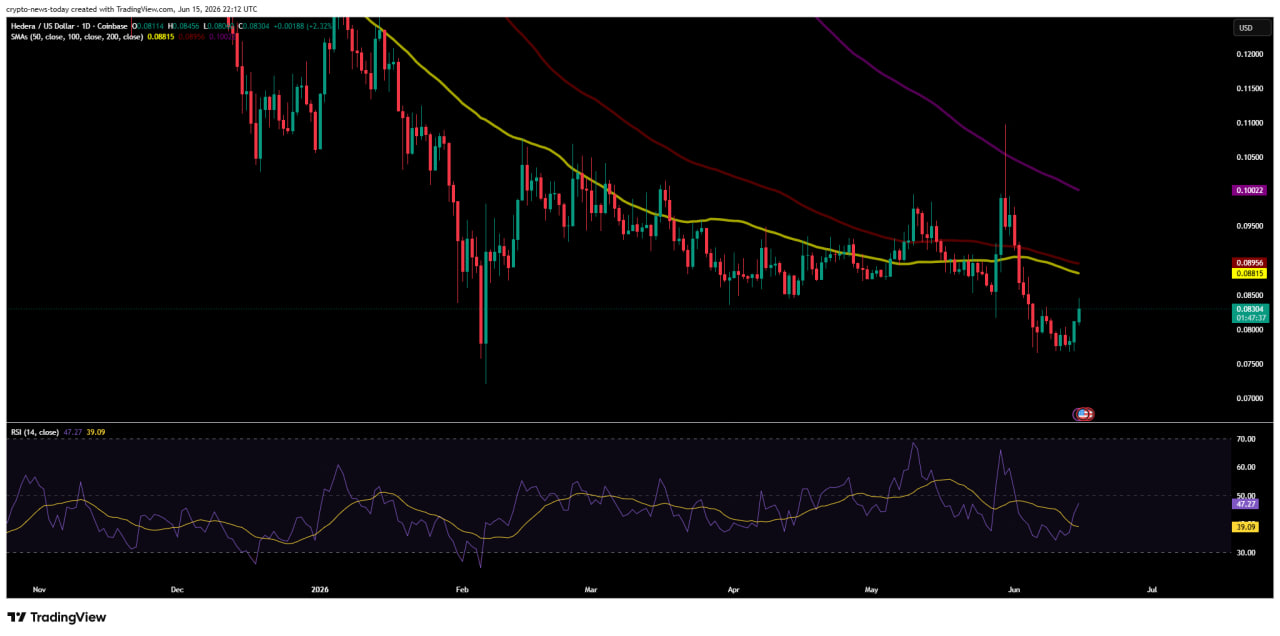
The nearest support floor at $0.078 has held twice in recent weeks. A confirmed daily close above $0.095 would open a path toward $0.102 and eventually $0.13. RSI at 47.27 places the asset in neutral-to-weak territory, while its 14-period average sits at 39.09 — a level that historically precedes either a bounce or an acceleration downward depending on whether buyers step in at support.
Level / IndicatorValueSignalCurrent price$0.083Neutral zoneNear-term support$0.078Held twice in JuneKey resistance$0.095Needs daily close aboveNext target if $0.095 clears$0.102 → $0.13Technical projection50-day moving average$0.088Price below — bearish100-day moving average$0.089Overhead resistance200-day moving average$0.100Not reclaimed in monthsRSI (14-period)47.27Neutral momentum
What Merck’s Supply Chain Partnership and JPMorgan’s Endorsement Actually Mean
On June 9, The Hashgraph Group formalized a partnership with Merck & Co.that connects the pharmaceutical company’s M-Trust authentication technology with TrackTrace, a decentralized product passport system built on Hedera. Every unit batch in Merck’s global supply chain receives an immutable cryptographic identity recorded through the Hedera Consensus Service. The mechanism that makes this economically viable on Hedera rather than a general-purpose blockchain is fee predictability — Hedera’s transaction costs are pegged in US dollar terms, starting at fractions of a cent, which means Merck can log millions of supply chain entries at a fixed, forecastable cost that variable gas fee networks cannot match at enterprise scale. In global pharmaceutical logistics, where regulators in both the US and EU are tightening traceability requirements, that cost predictability is not a minor advantage — it is the difference between a system that can scale compliantly and one that cannot.
On the institutional finance side, a JPMorgan Asset Management reportexplicitly identified Hedera as the optimal public-permissioned distributed ledger technology framework for the tokenization of money market funds — a sector representing trillions in institutional capital. The bank’s analysis pointed to three specific attributes: its consensus mechanism’s security architecture, an energy footprint of just 0.00025 kWh per transaction compared to Ethereum’s 2.95 kWh, and the fixed-fee model that makes large-scale settlements predictable. This kind of assessment from an institution with direct financial interest in getting infrastructure decisions right moves Hedera out of the altcoin conversation and into a category where corporate treasuries evaluate it alongside traditional financial infrastructure rather than alongside other layer-1 tokens.
A Network Running at Enterprise Scale
The network’s raw performance data reflects the same picture:
MetricValueNotesTotal processed transactions71+ billionSince mainnet; mostly enterprise data loggingNetwork throughput capacity10,000+ TPSTheoretical maximumActive operational load~2,400 TPSAverage real-world rateRWA settlements$10 billion+Cumulative on-chain value settledActive wallet growth (Q1 2026)+140% YoYYear-over-year change in active addressesEnergy per transaction0.00025 kWhvs. Ethereum ~2.95 kWh / Bitcoin ~1,087 kWh
Hedera has processed over 71 billion transactions since mainnet launch, settled more than $10 billion in real-world assets on-chain, and grown its active wallet count by 140% year-over-year in Q1 2026 — none of which has translated into meaningful upward price pressure for the same reasons outlined above.
Under the Hood: What the Block Node Migration Changes
Hedera is currently overhauling how it stores historical transaction data. Previously, nodes relied on external cloud providers like AWS or Google Cloud for historical data retrieval — an external dependency that created complications for enterprises seeking regulatory certification. The new architecture stores transaction history directly on dedicated Block Nodes rather than external cloud providers, cutting confirmation times to under a second and removing the external dependency entirely. For industries like pharmaceuticals and finance, where compliance certification requires a self-contained and independently verifiable audit trail, that distinction matters considerably.
AI Infrastructure, Copper.co Custody, and the Japan Listing
The Hedera Agent Kit V4 allows AI agents to execute independent on-chain financial transactions within hard-coded compliance guardrails:
- Hourly HBAR spending caps set at the protocol level that the agent cannot exceed
- Whitelisted payment destinations the agent cannot override
- Mandatory audit trails of the agent’s decision logic, recorded immutably to the Hedera Consensus Service at the point of execution
This solves a problem that has slowed enterprise AI deployment in regulated industries: how to let a system transact independently without losing the audit trail that compliance teams require. Separately, Hedera’s payment schemas were accepted into the x402 protocol standard, enabling native HBARand USDC micropayments for machine-to-machine API transactions — directly relevant to technology companies building AI systems that require continuous low-cost payments between services.
On June 12, Copper.co integrated Hedera into its institutional custody platform, giving corporate treasuries and large funds tier-one custody and staking access within a compliance-grade framework. This removes the last significant compliance barrier that had kept institutional capital on the sidelines despite growing interest in the network. In Asia, Hedera cleared Japan’s Financial Services Agency regulatory process — among the most stringent in the world for digital assets — and secured a listing on OKCoin Japan with a direct Japanese yen trading pair, giving Japanese investors their first regulated access to HBAR.
READ MORE:
 Bitcoin Has Won: Michael Saylor’s Plan to Capture Global Capital
Where Hedera’s Critics Have a Point
Two structural criticisms of Hedera remain unresolved by the recent run of positive developments. First, despite 71 billion total transactions, the majority of that volume comes from enterprise data logging — health trackers, ad fraud verification, supply chain entries — rather than the retail DeFi activity that drives token appreciation and speculative engagement on competing networks like Solana or Ethereum. Second, while anyone can hold HBAR and open a wallet, only Governing Council members — currently including Google, IBM, Boeing, FedEx, Accenture, Nvidia, and McLaren Racing among others — validate transactions at the consensus layer. Hedera is phasing in public node validation, but the network remains permissioned at its core, which rules it out for anyone who prioritizes decentralization above all else.
The long-term bull case, with price targets toward $1.00 extending into the 2026–2030 window, depends on corporate pilot programs transitioning to full mainnet production use — converting enterprise activity into sustained, recurring demand for the token. That transition has no fixed timeline. In the near term, the price behavior will be determined by two competing forces: whether the 3.97 billion token unlock generates enough sell pressure to break the $0.078 floor, and whether the accumulation of institutional developments — the ETF inflows, Copper.co custody, the Japan FSA clearance, and the JPMorgan endorsement — is sufficient to hold support and eventually force a clean break above $0.095.
DateCategoryDevelopmentQ1 2026RegulatorySEC/CFTC classify HBAR as digital commodity, removing securities-classification risk for institutional holdersQ1 2026MarketsCanary Capital HBAR spot ETF surpasses $93M in net inflows with only one day of outflows since launchQ1–Apr 2026GovernanceFedEx and Accenture join the Governing Council for logistics and enterprise AI infrastructure respectivelyQ2 2026Infrastructurex402 standard integration approved; native HBAR/USDC micropayments for machine-to-machine transactionsJun 9, 2026EnterpriseMerck & Co. supply chain partnership: M-Trust connected to TrackTrace for immutable pharmaceutical batch trackingJun 12, 2026InstitutionalCopper.co adds Hedera to institutional custody platform; tier-one custody and staking for corporate treasuriesJun 2026RegulatoryHBAR listed on OKCoin Japan with JPY pair after clearing Japan’s FSA framework
The post Hedera’s HBAR Is Attracting Institutional Capital – The Price Hasn’t Caught Up Yet appeared first on Coindoo.